


The Secrets of the Feline Brain and Why Cognitive Enrichment is Necessary
Cats are not merely beloved for their cute appearance and flexible movements. Having evolved alongside humans for thousands of years, cats are highly developed predators possessing remarkable adaptability and problem-solving skills. In particular, the feline brain, evolved for survival in the wild, is designed to prioritize hunting, exploration, and the ability to respond quickly to environmental changes. However, modern indoor cats live in environments where these instinctive activities are limited. Confined spaces, repetitive routines, and a lack of sufficient stimulation can lead to boredom and stress in cats, which may eventually result in behavioral issues or mental decline.
This is where the concept of ‘Cognitive Enrichment’ becomes essential. Cognitive enrichment refers to the intentional creation of training and environments that provide stimuli allowing animals to express natural instincts, solve new problems, and interact actively with their surroundings. This is a scientific approach that goes beyond simply providing toys; it creates opportunities for a cat’s brain to become active and learn. Just as zoos maintain the mental health of animals through point-target training and behavioral enrichment programs, similar approaches are necessary for household cats. As seen in the case of Seoul Children’s Grand Park, target stick training for specific point concentration and positive reinforcement training are key means to help animals develop the ability to think and act on their own.
A cat’s cognitive ability varies by age and individual, but they possess neuroplasticity, meaning their brains can learn throughout their lives. In other words, the process of learning and challenging new things strengthens neural connections and improves memory not only in kittens but also in adult and senior cats. Cognitive enrichment helps cats grow from passive consumers into active subjects that interact with their environment. This is one of the most effective ways to boost a cat’s self-esteem, deepen the bond with their owner, and improve their overall quality of life. In particular, nature-friendly and sturdy environmental improvement solutions like PlayCat’s solid wood furniture provide a physical space where cats can safely jump and hide, creating the optimal stage for cognitive enrichment training to take place.
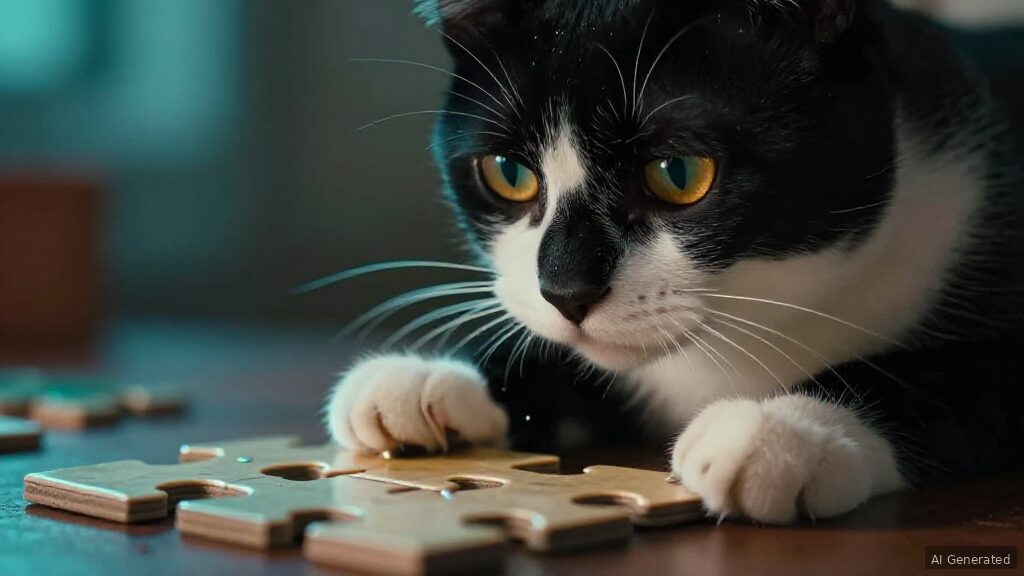
Recommended Guide for Puzzle Feeders and Smart Toys by Difficulty Level
The first step in cognitive enrichment is learning through ‘food’. Cats naturally use their brains in the process of hunting for prey and finding food. Puzzle feeders or smart toys transform the act of eating itself into brain training. As cats press buttons, push levers, open lids, or follow specific patterns to obtain food, their problem-solving skills are cultivated. However, not all cats can enjoy toys of the same difficulty level. It is important to distinguish between beginners and advanced users to select appropriate tools.
The table below summarizes the difficulty levels and characteristics of recommended puzzle feeders and smart toys based on the cat’s cognitive development stage and personality. Use this as a reference to choose toys suitable for your cat’s current level and gradually increase the difficulty.
| Difficulty | Recommended For | Toy Type & Characteristics | Expected Effects |
|---|---|---|---|
| Beginner (Introductory) | First-time puzzle feeder users, timid cats, senior cats |
|
– Extends mealtime – Teaches basic paw usage – Reduces anxiety |
| Intermediate (Standard) | Adult cats, curious cats, those who have completed basic training |
|
– Improves patience – Understands cause and effect (press to get) – Enhances concentration |
| Advanced (Challenge) | Highly intelligent cats, cats that enjoy problem-solving, trained cats |
|
– Complex problem-solving skills – Utilizes long-term memory – Deep engagement and prevents boredom |
When selecting toys, consider the cat’s body size and paw size. Holes that are too small can injure a cat’s paws, while holes that are too large allow food to escape easily, reducing the sense of challenge. Additionally, the material of the toy is important. PlayCat’s solid wood furniture or wooden puzzle toys provide a natural texture that stimulates a cat’s curiosity and offer the advantage of higher durability compared to plastic products, allowing for longer use. In particular, the wooden surface provides good friction for a cat’s paw pads, allowing them to train stably without slipping.
Adjusting the difficulty level is very important. If you give a cat a toy that is too difficult at first, they may feel frustrated and avoid it entirely. Conversely, toys that are too easy will cause them to lose interest quickly. Therefore, it is best to give plenty of praise and rewards when the cat successfully solves the toy, and if it becomes too easy over time, move on to a slightly more complex stage. This process should be a joyful journey of growth for both the cat and the guardian.
Basics of Clicker Training: Step-by-Step Methods and Reward Systems
Clicker training is one of the most effective positive reinforcement training methods recognized in animal behavior science. This method works on the principle of connecting a ‘sound (click)’ with a ‘reward (treat)’ to help the animal choose and learn desired behaviors on its own. Although cats are naturally independent, they can learn very quickly when given the right motivation. Clicker training is a powerful tool that goes beyond simple skill acquisition; it builds a trust relationship between the cat and the guardian and maximizes the cat’s cognitive abilities.
The first step to starting clicker training is ‘Clicker Marking’. This is the process of teaching the cat that the click sound and the reward always appear together. First, press the clicker when the cat is paying close attention and immediately give a treat. If you repeat this process 10 to 20 times, the cat will learn that “when I hear the click sound, something good happens.” At this point, it is crucial to keep the time interval between the click sound and the treat as short as possible. If delayed by more than 1 second, it will not be clearly communicated to the cat which behavior was rewarded.
The next step is ‘Target Behavior Induction’. Choose a simple behavior that the cat does naturally or that you can induce. Examples include ‘looking at the palm’, ‘sitting’, or ‘touching the hand’. When the cat performs the desired behavior, immediately click and give a treat. If the cat does not perform the behavior, you can induce it by holding a treat in your hand and moving it slowly in front of the cat’s nose. Click and reward the moment the cat’s nose touches your palm. By repeating this process, the cat will realize the cause-and-effect relationship that “touching my nose to the palm results in a reward.”
The third step is ‘Adding Commands’. Once the cat can perform the behavior stably, say a simple command (e.g., “touch”, “sit”) just before inducing the behavior. Once the behavior is completed, click and reward immediately. Through this process, the cat connects the verbal command, the behavior, and the reward. At this time, be careful to use commands consistently. Using different words for the same behavior can confuse the cat.
The reward system is the core of clicker training. The reward must be something the cat truly loves, and during training, it is best to cut treats into small, bite-sized pieces. After the reward, immediately move on to the next training session or take a break. Regarding reward frequency, give a treat every time in the early stages of learning, but once the behavior is established, you can maintain the behavior even with intermittent rewards. This is based on the principle of ‘variable ratio reinforcement’, which motivates the cat to perform the behavior more frequently, similar to gambling.
Clicker training can be applied to everything from kittens to senior cats. For kittens, consider their short attention span and train in 5 to 10-minute intervals. For senior cats, consider their joint health and focus on light movements like sitting or touching. Utilizing the flat surfaces or low steps of PlayCat solid wood furniture allows cats to move comfortably even during training, increasing training efficiency. This training method gives the cat a sense of control, making them feel “I chose the action and created the result,” which has a very positive impact on mental health.
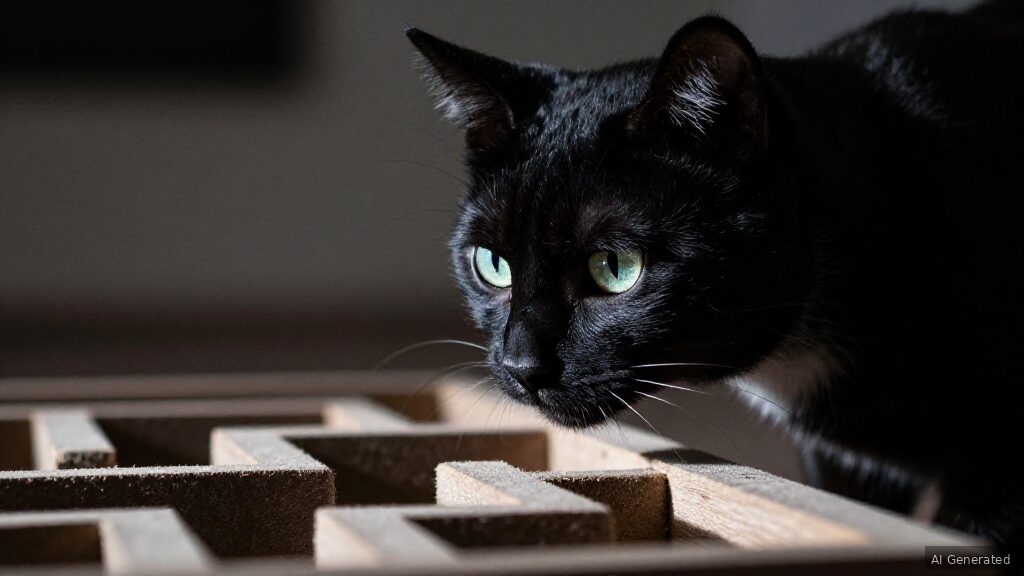
Hide-and-Seek and Treasure Hunt to Stimulate Exploration Instincts
Cats instinctively enjoy finding prey, hiding, and exploring. In the wild, they spend most of their day hunting and exploring, a process that activates various areas of the brain. Satisfying this instinct in indoor cats is the most natural way to achieve cognitive enrichment. ‘Hide-and-seek’ and ‘treasure hunt’ are excellent activities that simultaneously stimulate a cat’s sense of smell, vision, and problem-solving skills.
Hide-and-seek can be played by the guardian hiding and the cat finding them, or conversely, by the guardian hiding treats or toys for the cat to find. The latter is more effective for cognitive training. Initially, place the treat in a clearly visible spot, say “Find it!”, and reward the cat when they approach. Gradually increase the difficulty by hiding the treat halfway, and then completely. At this time, the cat’s behavior of moving its nose and digging with its paws to find the treat develops both its sense of smell and motor skills.
The treasure hunt game involves preparing several boxes and hiding a treat or toy in only one of them. The cat must move between the boxes, sniffing them, and deduce which box contains the treat. This process stimulates the cat’s memory and logical reasoning abilities. You can increase the number of boxes, turn them upside down, or move them to different locations to make the cat focus more. The drawers or empty spaces in PlayCat solid wood furniture provide a perfect stage for treasure hunt games. In the process of opening drawers or finding toys hidden behind furniture, the cat increases its understanding of the environment.
Exploring new spaces is also an important factor. When encountering a new environment, cats often feel curiosity before fear. Temporarily close off some areas of the house or arrange new toys and furniture to create opportunities for the cat to explore. For example, stacking several boxes to create a maze or installing a new lookout point by the window is also a good idea. At this time, safety must be the top priority. Install protective nets to prevent falls from heights and remove dangerous objects.
Exploration activities are also effective in relieving stress and preventing depression in cats. Especially for cats that spend the whole day alone, playing a simple treasure hunt game with the guardian after work can help relieve the day’s fatigue and strengthen the bond. At this time, it is important to give plenty of praise for the treasure the cat found on its own. Giving a treat along with the words “Good find!” will give the cat a positive impression of the exploration behavior. These small activities accumulate to keep the cat’s brain constantly stimulated and healthy.
Problem-Solving Training: Opening Drawers, Obstacle Courses, and Sequential Learning
Cats have a very high problem-solving ability. They display amazing intelligence in daily life, such as learning how to open door handles or finding routes to climb high places. By intentionally training these skills, you can further maximize the cat’s cognitive abilities. ‘Opening drawers’, ‘obstacle courses’, and ‘sequential learning’ are advanced training methods where the cat goes through complex processes to achieve a goal.
Drawer opening training is the process where the cat uses its hands or paws to open a drawer and obtain a reward inside. First, put a treat in the drawer and leave it slightly open. When the cat tries to open the drawer, click and reward. Gradually close the drawer more so that the cat has to exert more force or use its fingers to open it. This training cultivates the cat’s fine motor skills and patience. The drawers of PlayCat solid wood furniture are non-slip and sturdy, making them very suitable for this type of training. This is because the friction of the wooden surface helps the cat’s paws or front paws not to slip and exert force.
Obstacle course training involves guiding the cat to avoid or pass through obstacles along a set path. This includes activities like passing through chair legs, moving between boxes, or jumping over low barriers. At this time, the guardian holds a treat and guides the cat to set the path. Start with a simple straight path and gradually develop it into a curve or a complex maze. This training improves the cat’s spatial awareness and body control.
Sequential learning is training where the cat performs a series of actions in order to receive a reward. For example, teaching a complex sequence like “First open the drawer, then push the ball, and finally press the button to get a treat.” This requires long-term memory and logical thinking from the cat. Proceed by separating each step, learning them individually, and then gradually connecting them. This process is very effective in helping the cat develop the ability to plan and execute on its own.
Problem-solving training can also be an activity where the cat may feel frustrated. Therefore, the guardian must closely observe the cat’s reaction. If the cat finds it too difficult or feels stressed, it is advisable to lower the difficulty or take a break. Additionally, the reward upon success should be particularly generous to maintain motivation. This training goes beyond simply increasing intelligence; it helps the cat gain confidence in solving problems on its own, aiding in mental maturity.
Preventing Cognitive Decline: Brain Health Management for Senior Cats
Like humans, cats can experience cognitive decline as they age. This is called ‘Feline Cognitive Dysfunction Syndrome (CDS)’, and symptoms include memory loss, disorientation, changes in sleep patterns, and unnecessary nighttime activity. To maintain brain health and prevent cognitive decline in senior cats, consistent cognitive enrichment activities are essential.
Cognitive training for senior cats should be composed of light and repeatable activities rather than intense or complex ones. For example, it is good to use a simple puzzle feeder at the same time every day or have short clicker training sessions. These activities stimulate neural connections in the brain, helping to slow down the decline of cognitive function. Additionally, when introducing new environments or toys, proceed slowly to minimize the cat’s anxiety.
In the case of senior cats, joint health, vision, and hearing may decline, so it is important to create a safe training environment. The flat and non-slip surfaces of PlayCat solid wood furniture provide an environment where senior cats can move and train safely. If moving to high places is difficult, it is also good to increase accessibility by using low steps or ramps. Additionally, you can strengthen sensory stimulation by increasing the size of toys and using toys that make sounds.
Emotional stability is also important for brain health. Senior cats may become more afraid of new things, so they need the guardian’s warm affection and a stable routine. Playing together at a set time every day and letting them feel a sense of achievement through training is a great help to the cat’s mental health. Cognitive enrichment is still effective for senior cats, and through this, the quality of life in old age can be significantly improved.
DIY Cognitive Enrichment Tools: Materials and Methods
You can create excellent cognitive enrichment tools using everyday household items without expensive toys. DIY tools allow the guardian and cat to bond while making them together, and they also save costs. Below is a checklist of cognitive enrichment tools that are easy to make.
1. Box Maze Feeder
- Materials: Empty shoe box, scissors, tape, treats
- Method: Close the lid of the box and cut various sized holes on the sides. Put treats inside the box and guide the cat to take them out through the holes. You can adjust the difficulty by varying the size and location of the holes.
- Time Required: 10 minutes
2. Plastic Bottle Roller Feeder
- Materials: Empty plastic bottle (500ml), scissors, cat treats
- Method: Remove the label from the plastic bottle and cut several small holes in the body of the bottle. Put treats inside the bottle and close the cap. Let the cat push or roll the bottle to get the treats out.
- Time Required: 5 minutes
3. Glove Hide-and-Seek
- Materials: Old gloves, treats
- Method: Cut holes in the fingertips of the gloves or hide treats inside the fingers. Place the glove on the floor and let the cat dig into the fingers to find the treats.
- Time Required: 2 minutes
4. Creating Hiding Spots Using Solid Wood Furniture
- Materials: PlayCat solid wood furniture, blanket, toys
- Method: Lay a blanket in the empty spaces or drawers of the solid wood furniture and hide toys. Guide the cat to explore the furniture and find the hidden toys. The warm texture of the wood allows the cat to explore comfortably.
- Time Required: 5 minutes
These DIY tools stimulate the cat’s curiosity and increase interaction with the guardian. Additionally, they are environmentally friendly as they utilize recycled materials. The important thing is to select materials so that the cat can use them safely, and the guardian should always watch over them during the creation process.
Precautions and Common Mistakes
Cognitive enrichment is a great help in keeping a cat’s brain healthy, but if done incorrectly, it can cause stress instead. It is important to avoid the following precautions and common mistakes.
1. Failure to Adjust Difficulty: Toys or training that are too difficult can frustrate the cat and cause them to stop participating entirely. Conversely, toys that are too easy cause them to lose interest. You must observe the cat’s reaction and adjust the difficulty appropriately.
2. Excessive Training Time: Cats may have short attention spans. If a single training session is too long, they may feel fatigue and stress. It is effective to divide the training into 5 to 10-minute sessions several times a day.
3. Do Not Force: Do not force the cat to participate if they refuse training or lose interest. The cat’s voluntary participation is important, and forcing them can create negative associations.
4. Inconsistent Rewards: If rewards are inconsistent during clicker training or when using puzzle feeders, the cat will feel confused. Always provide a reward immediately after the behavior, and ensure the type of reward remains something the cat likes.
5. Ignoring Safety: You must check for dangerous elements such as small parts or sharp edges in DIY toys or training environments. Safety is the top priority, especially for senior or weak cats.
Cognitive enrichment does not happen overnight. Through consistent effort and observation, you must understand the cat’s personality and abilities and provide activities that match them. These efforts, filled with the guardian’s patience and love, will be the greatest foundation for the cat to live a healthy and happy life.
Frequently Asked Questions (FAQ)
Q1: How should I help if my cat is encountering a puzzle feeder for the first time?
A: At first, the guardian should operate the toy directly to show the process of the treat coming out, allowing the cat to eat the treat immediately. Gradually induce the cat to touch it with its paw or push it with its nose, and it is important to give big praise and rewards when they succeed. If it feels too difficult, take a break and try again later, or lower the difficulty level.
Q2: What is the most suitable treat for clicker training?
A: High-protein treats that the cat usually likes best, boiled chicken, or pieces of tuna are good. The treats should be cut small enough to be eaten in one bite. During training, it is advisable to adjust the portion of treats to consider calorie intake.
Q3: Can cognitive enrichment be performed on senior cats?
A: Yes, on the contrary, cognitive enrichment is very important for senior cats to maintain brain health and slow down cognitive decline. However, it is advisable to lower the difficulty level considering joint health and vision, conduct it in a safe environment, and keep the training time short.
Q4: How long should cognitive enrichment activities be done per day?
A: It is most effective to divide a total of 15 to 30 minutes per day into several sessions. Adjust the activity time considering the cat’s concentration and fatigue, and alternate various activities so the cat does not lose interest.
Q5: How does PlayCat solid wood furniture help with cognitive training?
A: PlayCat solid wood furniture provides an environment where cats can safely jump and hide due to its natural wood texture and sturdy structure. In particular, drawers or empty spaces are suitable for hide-and-seek or treasure hunt games, and the non-slip surface increases stability during training.
This content was created using AI technology. Always consult a veterinarian for medical information.