


Everything About Environmental Enrichment That Changes Your Cat’s Quality of Life
Cats are inherently wild animals with complex behavioral patterns such as hunting, exploring, hiding, and sleeping. However, in modern society, indoor cats have extremely limited opportunities to satisfy these instincts. Narrow spaces, repetitive routines, and a lack of stimulation can cause severe psychological stress in cats, often leading to abnormal habits known as ‘stereotypic behaviors.’ A recent case at Osaka Tennoji Zoo in Japan, where wolves, polar bears, and lesser pandas exhibited extreme stereotypic behaviors and appeared mentally withdrawn, clearly demonstrates how severe the condition can become when animals do not receive adequate environmental stimulation. Although the circumstances of pets are not exactly the same as those in zoos, indoor cats can also suffer from similar psychological withdrawal and behavioral problems if sufficient environmental enrichment is not provided.
Environmental enrichment goes beyond simply placing toys; it refers to the comprehensive design and improvement of physical, social, and cognitive environments to allow animals to express natural behaviors. This is a core element that protects not only the cat’s physical health but also its mental stability. In the long run, it is the most effective way to strengthen the bond between guardian and cat and prevent conflicts within the home. In particular, utilizing high-quality solid wood structures like PlayCat to expand vertical space and introducing natural materials can be the optimal solution, providing cats with a sense of security while offering various sensory stimuli. In this guide, we will examine in detail the five core areas of environmental enrichment essential for indoor cats, space design strategies, and practical application methods.
Five Core Areas of Environmental Enrichment and Their Roles
To implement effective environmental enrichment, five key areas that can satisfy a cat’s diverse needs must be balanced. These five areas do not act independently but work complementarily to provide cats with a rich life experience. Understanding how each area affects a cat’s behavior and mental state is the first step in space design.
| Enrichment Area | Main Purpose | Specific Execution Methods | Expected Effects |
|---|---|---|---|
| Sensory Enrichment (Sensory Enrichment) |
Stimulate the five senses (sight, hearing, smell, touch) to arouse curiosity | Using flooring with various textures, utilizing natural light, planting cat grass, using pheromone diffusers | Stress reduction, improved adaptability to new environments |
| Cognitive Enrichment (Cognitive Enrichment) |
Activate the brain by providing problem-solving skills and learning opportunities | Puzzle feeders, hidden treat hunting games, introducing new toys periodically | Relief from boredom, prevention of stereotypic behaviors, delayed aging effects |
| Social Enrichment (Social Enrichment) |
Provide appropriate interaction opportunities with guardians and other animals | Regular playtime, resource separation in multi-cat households, interaction spaces between cats | Development of social skills, reduced aggression, strengthened bonds |
| Foraging Enrichment (Foraging Enrichment) |
Induce food-finding behaviors that satisfy wild hunting instincts | Using puzzle toys instead of bowls, hiding food, playing toss-and-catch games with treats | Obesity prevention, appetite control, increased satisfaction from satisfying hunting instincts |
| Physical Enrichment (Physical Enrichment) |
Expand vertical and horizontal spaces, diversify hiding and resting spots | Installing cat towers, utilizing wall shelves, providing resting spots of various heights and materials | Stabilization of territorial awareness, stress relief, increased physical activity |
As seen in the table above, environmental enrichment does not merely mean that the space becomes larger. It is a reconfiguration of the ‘entire living space’ designed so that cats can express their instincts throughout the day without boredom. In particular, since the physical enrichment area is implemented through physical structures, it is very important to create natural vertical spaces and hiding spots using solid wood furniture like PlayCat. Wood provides a familiar texture for cats, and the texture of solid wood stimulates the sensation of their paw pads, creating a more natural environment.
Space Reorganization Strategies by Season and Timing
A fixed environment is a major culprit that quickly makes cats lose their curiosity. Even if it is difficult to move furniture frequently, simply changing the layout of the space or the location of accessories according to the season or situation allows cats to experience a new environment. This has an effect similar to seeing new scenery while traveling.
Importance of Seasonal Environmental Changes
In spring and summer, emphasize spaces near windows where sunlight streams in to strengthen the ‘sunbed’ function, allowing cats to nap in the warm sun. At this time, it is good to place cat towers or resting spots at a low height near the window to maximize the use of sunlight. On the other hand, in winter, you should prepare hiding spots with warm blankets near heaters or where radiant heat is good. Additionally, utilize high shelves with good ventilation in summer, and place resting spots in warm spaces close to the floor in winter, changing the vertical space utilization strategy according to the season.
Even a slight change in the position of furniture gives cats new routes and views. For example, creating narrow passages by utilizing the gap between the sofa and the wall, or using the space under the desk like a cat house, creates a ‘new exploration zone’ for cats. PlayCat’s modular solid wood furniture is often designed to facilitate such rearrangements, allowing flexible layout changes according to the guardian’s desired space configuration. Simply moving a cat tower from a corner of the room to the window side or adjusting the height of wall shelves provides new stimuli to the cat’s daily life.
Daily Change Cycles
Giving small changes daily or weekly is also important. Changing the location of toys or setting the location of hidden treats differently every day is the core of cognitive enrichment. Since cats have evolved to exert survival instincts in unpredictable environments, they show their most active selves when the environment changes slightly. Especially during the kitten stage, adaptability to new environments is high, so it is essential to frequently change locations to accumulate various exploration experiences. On the other hand, senior cats may have difficulty moving, so it is better to keep major resting spots, litter boxes, and feeding areas fixed while changing only the small elements around them.
Introducing Natural Elements: Restoring Ecosystems Through Plants
Introducing natural elements into the indoor environment provides visual and olfactory stimuli to cats while offering psychological stability. However, not all plants are safe for cats, so only non-toxic plants should be selected and introduced.
Cat Grass and Safe Plants
Cat grass is a plant that cats consume to aid digestion; beyond just eating, it stimulates hunting instincts by digging into the soil and pulling out roots. Placing potted cat grass near the window allows you to observe cats engaging in the natural behavior of nibbling on grass while looking at the sunlight. Additionally, you can create green spaces by placing cat-safe plants indoors, such as Spathiphyllum (Peace Lily), Nephrolepis, and Phalaenopsis orchids. These plants help cats recognize vertical space by directing their gaze upward, and the swaying of leaves acts as a moving toy that stimulates their hunting instincts.
When placing plants, it is advisable to use pots with lids to prevent cats from digging up the soil or cover the soil with gravel. Additionally, it is effective to create vertical routes by connecting cat towers or shelves to the space where plants are located, allowing cats to climb up and explore near the plants. PlayCat’s solid wood structures, with their natural wood material, create a harmonious natural landscape when placed with plants, providing a more comfortable and stable environment for cats.
Catio and Connection to Outdoor Spaces
If possible, converting a balcony or veranda into an outdoor space for cats known as a ‘Catio’ is an excellent method. A Catio is a space safely designed to allow cats to experience fresh air, sunlight, bird songs, and swaying leaves without escaping or being exposed to external dangers. You can install dedicated devices on windows or veranda doors to allow cats to come and go freely, or install nets yourself to secure outdoor space. This can be the most powerful means of environmental enrichment for cats that live exclusively indoors, playing a significant role in preventing mental withdrawal in limited spaces, as seen in the case of Osaka Tennoji Zoo.
Utilizing Vertical Space: Cat Towers and Wall Structures
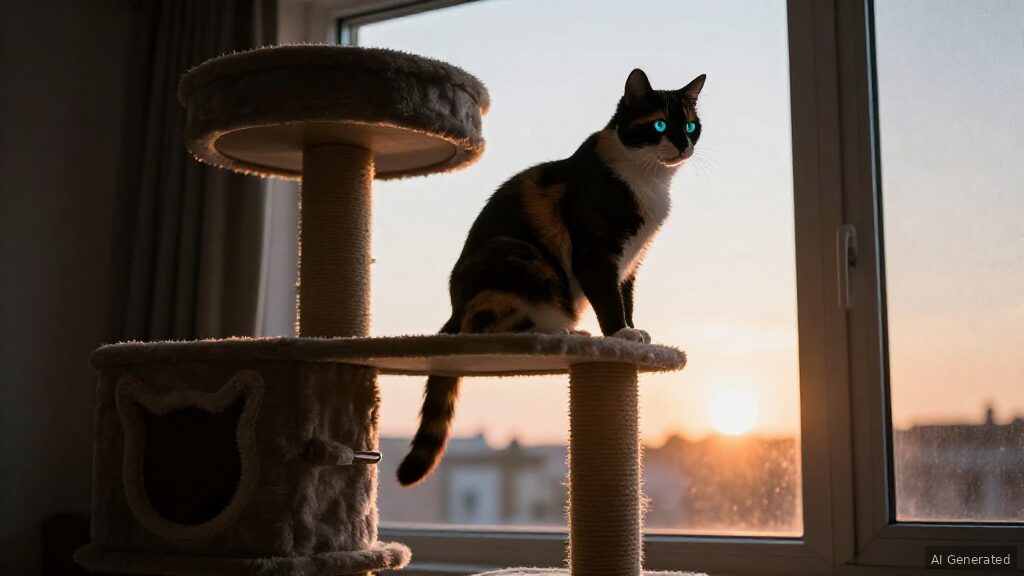
Cats are animals that naturally prefer to climb trees to survey their surroundings and rest. Therefore, horizontal space alone is insufficient, and maximizing the use of vertical space is the core of environmental enrichment. Vertical space satisfies a cat’s territorial awareness, reduces conflicts with other cats, and provides a safe observation distance.
Strategic Placement of Cat Towers and Wall Shelves
A cat tower should not simply be a tall structure but a complex space where cats can move, rest, and play hunting games. It is ideal to create a ‘cat highway’ by connecting high towers extending from floor to ceiling or shelves attached to walls. At this time, the important point is that the distance between the tower and the shelves must be an appropriate gap that allows the cat to jump and move. If it is too far, access is difficult; if it is too close, space utilization drops.
PlayCat’s solid wood structures provide stable jumping platforms and resting spots for cats with their natural wood material and sturdy design. In particular, solid wood has less impact on paw pads and is not slippery, making cats feel more comfortable when climbing. Additionally, the wood grain naturally performs a grooming function by sharpening cat claws, offering the advantage of claw management without the need for a separate scratching board. Wall shelves are a good way to utilize space efficiently; shelves installed high up serve as ‘watchtowers’ that cats love, while those installed low are used as resting spots.
Layering with Various Heights
Vertical space should be composed of layers with various heights. Low layers close to the floor are spaces easy for kittens or senior cats to access, middle heights are spaces for active cats to play, and the highest levels are used by adult or leader cats to rest or survey the surroundings. By dividing and arranging these layers, even in multi-cat households, each cat can use the space according to its preference, preventing conflicts. Additionally, different functions (resting, hunting, observing, hiding) should be assigned to each layer to induce cats to perform various behaviors.
Rest and Hiding Spaces: The Importance of Safe Havens
Cats inherently possess a dual nature as both predators and prey. While aggressive when hunting, they prefer hiding spots to protect themselves from external threats when resting. Therefore, one of the most important elements in environmental enrichment design is the ‘safe haven.’
Principles of Hiding Spot Placement
A hiding spot should be a space where cats can hide when stressed or anxious. This space should be easily accessible, yet dark and quiet inside, located in a place where they are not disturbed by the surroundings. It is best to avoid areas near litter boxes or feeding spaces; placing them in quiet corners or secluded high spaces is ideal. Furthermore, a hiding spot should not just be a box placed down, but a structure where the cat can comfortably lie down or curl up to rest.
Solid wood furniture like PlayCat performs the function of a hiding spot very well. The wood material helps block external noise, and the interior space remains warm and comfortable. In particular, resting spaces inside cat houses or towers made of solid wood provide psychological stability to cats, greatly helping to prevent stereotypic behaviors. It is good to have more than one hiding spot, placing several throughout the house so cats can choose according to the situation. This is effective in reducing stress by allowing cats to expand their territory and feel a sense of control.
Providing Various Resting Spaces
Cats’ preferred resting spaces vary depending on temperature, humidity, and lighting. Therefore, providing various forms of resting spaces is important. Place resting spots with warm pads in sunny window areas, cool and well-ventilated spaces in shaded areas, and wide flat resting spots in high places. Additionally, if the cat likes to curl up and rest, providing cylindrical or box-shaped resting spots with narrow interiors is also good. These various resting spaces help cats stay comfortable throughout the day, improve sleep quality, and enhance overall health.
Multi-Cat Household Environment Design: Conflict Prevention and Resource Dispersion
In households where multiple cats live together, environmental design that considers each cat’s personality and territorial awareness is essential. A lack of resources (food, litter boxes, resting spots) or unbalanced placement can cause conflicts between cats, leading to serious behavioral problems.
Dispersion and Separation of Resources
In multi-cat households, the ‘N+1’ rule should be applied. That is, if there are N cats, there should be N+1 litter boxes, and N+1 food bowls and resting spots respectively. Furthermore, these resources should be dispersed and placed far apart from each other. If all resources are gathered in one place, a specific cat may monopolize them, or other cats may feel stressed because they have difficulty accessing them. Litter boxes should be separated and placed in corridors or corners leading in different directions so that one cat is not disturbed by another while using the toilet.
Feeding spaces should also be placed separately. It is good to place visual barriers or separate rooms so that other cats cannot approach while one cat is eating. Utilizing PlayCat’s solid wood structures to provide dedicated resting or play spaces for each cat reduces resource competition and allows each cat to firmly establish its territory. This plays a decisive role in preventing conflicts in multi-cat households and maintaining the psychological stability of each cat.
Territory Separation and Conflict Management
In multi-cat households, a strategy of separating territories may be necessary depending on the relationship between cats. Especially when a new cat is adopted or there is conflict between existing cats, it is good to temporarily separate territories to give them time to recognize each other. At this time, it is important to provide sufficient vertical space and hiding spots for each cat so they can utilize the whole house without facing each other. Additionally, space design suitable for each cat’s personality is needed. It is good to prioritize wide vertical spaces and play equipment for active cats, and quiet, safe hiding spots and resting spaces for quiet cats.
Measuring Environmental Enrichment Effects: Behavioral Change Observation Checklist
Measuring the effects after introducing environmental enrichment is very important. Guardians must continuously observe changes in their cat’s behavior and modify the design if necessary. Below is an observation checklist for measuring the effects of environmental enrichment.
- Reduction in Stereotypic Behaviors: Have abnormal behaviors such as excessive grooming, tail biting, or wall scratching decreased?
- Increased Activity: Have the cats’ time spent moving actively and playing around the house increased?
- Improved Sleep Patterns: Is the cat observed sleeping soundly and comfortably?
- Appetite and Elimination Status: Is the cat eating well and using the litter box regularly?
- Social Interaction: Is interaction with the guardian or other cats becoming smoother?
- Reduced Stress Signals: Have signs of stress, such as ears pinned back, repeated yawning, or eyes closed, decreased?
Based on this checklist, observe the cat’s reaction and analyze which elements were effective and what parts need improvement. Environmental enrichment is not something that is completed perfectly at once, but a process of continuously modifying and developing according to the cat’s response. High-quality solid wood furniture like PlayCat can be an excellent tool in this process for observing cat behavior and optimizing space design.
Frequently Asked Questions (FAQ)
1. When should I start environmental enrichment?
Environmental enrichment should start the moment the cat begins indoor life. Especially during the kitten stage, curiosity about new environments is very high, so it is important to provide various stimuli to form correct behavioral patterns. Even after becoming an adult cat, the environment should be continuously changed to prevent boredom, and even for senior cats, it is necessary to adjust the environment according to physical limitations. Do not think it is too late; it is good to start with small changes.
2. Is environmental enrichment possible in a small studio apartment?
Yes, it is possible. There is no need to give up on environmental enrichment just because the space is small. Rather, a strategy of expanding space by maximizing the use of vertical space is important. By utilizing wall shelves, cat towers extending to the ceiling, and moving routes connecting the tops of furniture, sufficient vertical space can be secured even in a small space. PlayCat’s solid wood structures have high space efficiency and simple design, making them suitable for small spaces and allowing effective use of vertical space.
3. Which plants are safe for cats?
Plants safe for cats include cat grass, Spathiphyllum (Peace Lily), Nephrolepis, Phalaenopsis orchids, rosemary, and basil. On the other hand, lilies, aloe, dieffenbachia, and poinsettias have fatal toxicity to cats and should never be kept indoors. When purchasing plants, it is important to confirm that they are safe for cats to ingest and to manage them so the soil is not dug up.
4. How do I maintain cat towers and solid wood furniture?
Since solid wood furniture is a natural material, it is important to avoid humidity and direct sunlight. Wipe it regularly with a dry cloth to remove dust, and if necessary, apply natural oil to replenish the wood’s moisture to use it for a longer period. For cat towers, check that the surface is smooth so claws do not get caught, and inspect to ensure the structure does not wobble even after long-term use. PlayCat products are designed to be durable and easy to maintain, so guardians can easily manage them.
5. What if my cat gets stressed even with environmental enrichment?
If your cat gets stressed after introducing environmental enrichment, the rate of change may be too fast, or the new elements may have felt threatening to the cat. At this time, try temporarily removing the new elements or introducing them gradually into a space familiar to the cat. Also, it is important not to force unwanted elements by considering the cat’s personality. Give the cat time to choose and adapt on its own, and the guardian’s warm love and patience are required.
Environmental enrichment is a philosophy that enriches not just the space, but the cat’s entire life. As seen in the case of Osaka Tennoji Zoo, appropriate environmental stimuli are a core element in protecting an animal’s mental health. These same principles apply to cats living indoors. By utilizing PlayCat’s solid wood furniture to expand vertical space, introducing natural elements, and designing spaces that satisfy cats’ instincts, our cats will be able to lead healthier and happier lives. Start with small changes today and gift your cat a true quality of life.
This content was created using AI technology. Always consult a veterinarian for medical information.