


The Deep Connection Between a Cat’s Hunting Instinct and Feeding Enrichment
Cats are not essentially eagles or lions; they are small predators. In the wild, their ancestors replenished their energy with one or two successful hunts after dozens of attempts throughout the day. However, modern indoor cats live with this natural behavioral routine of hunt-predation-consumption-digestion-grooming severed. Food is always available in a bowl, and the necessity to forage for prey has disappeared. This environmental change causes psychological stress in cats, potentially leading to excessive sleeping, loss of appetite, or conversely, metabolic diseases such as obesity.
Here, ‘Feeding Enrichment’ plays a crucial role. This is an environmental improvement strategy that goes beyond simply providing food, encouraging cats to exert physical and mental effort to obtain their meals. According to zoological and behavioral studies, the longer and more complex the process of obtaining food becomes, the lower the cat’s stress hormone levels and the higher their satisfaction. For example, research on the behavior of snow leopards (Panthera uncia) searching for prey in snowy mountains revealed that environments including the process of foraging significantly reduced their abnormal repetitive behaviors (stereotypies) and increased social interaction.
This same principle applies to our cats living indoors. Instead of simply placing food in a bowl, if you hide it like prey or make them solve a puzzle to get it, your cat will rediscover the joy of their instinctual hunt. This becomes not just an act of filling their belly, but an important ‘job’ that structures their day. PlayCat’s solid wood furniture provides spaces optimized for these feeding enrichment activities. High shelves and hiding spots offer vertical spaces where cats can hide food or rest safely after play, supporting a natural behavioral flow.
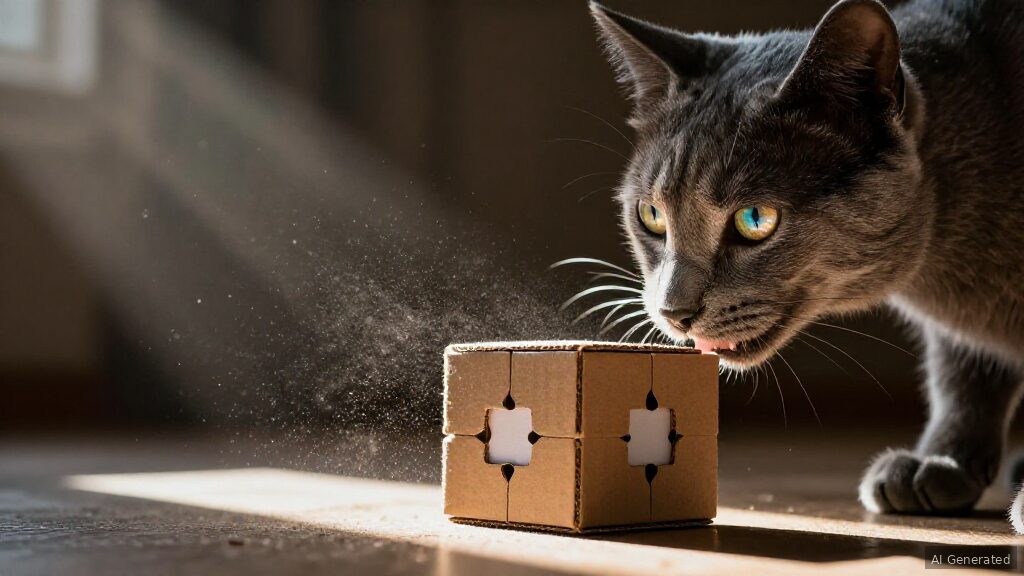
How to Use Puzzle Feeders by Difficulty Level and Product Comparison
A puzzle feeder is a device that requires a cat to perform specific manipulations (pushing, rotating, pulling, etc.) to obtain food. This stimulates a cat’s problem-solving skills and extends mealtime, promoting smooth digestion. Providing puzzle feeders of the same difficulty to all cats can actually cause stress, so it is essential to approach them in stages according to the cat’s learning ability and curiosity level.
Beginner: Simple Cover Removal Type
This is the stage for beginners. Place a thin plate over the hole containing the food, or use a small container with a lid. The cat simply needs to remove the lid or push the plate for the food to spill out. This stage is important for the cat to learn the cause-and-effect relationship that “my actions lead to obtaining food.” Initially, fill the feeder with plenty of food so the cat can succeed easily and spark their interest.
Intermediate: Rotating and Pushing Type
This stage is suitable after the cat has mastered a certain level of skill. These products are designed so that rotating a circular disc aligns holes, or pressing a lever releases food. At this stage, the cat must use their paw or nose for precise manipulation, which lengthens their concentration span. Since the food doesn’t spill all at once but comes out little by little, mealtime naturally extends.
Advanced: Multi-stage Complex Type
This stage is for skilled cats. Multiple stages of puzzles are connected, so the food in the second stage is only exposed after passing the first. Alternatively, the food holes are deep and narrow, requiring the cat to dig deep with their tongue or paw to eat. This stage requires long periods of concentration and repetitive effort, making it particularly effective for cats with strong hunting instincts.
| Difficulty | Product Type | Recommended For | Key Effects | Estimated Time |
|---|---|---|---|---|
| Beginner | Lid/Cover type, Simple hole type | First introduction, Seniors, Shy personalities | Learning cause-and-effect, Sparking interest | 1~3 minutes |
| Intermediate | Rotating disc type, Lever operation type | Active adults, Curious cats | Improved concentration, Extended mealtime | 5~10 minutes |
| Advanced | Multi-stage complex type, Deep type | Highly intelligent, Easily bored | Problem-solving skills, Satisfying hunting instinct | 15~30 minutes or more |
When introducing a puzzle feeder, it must be easy to start so the cat does not feel frustrated. If your cat only bats at the toy and gets angry because they can’t get the food, lower the difficulty level or make the food slightly easier to reveal. By combining PlayCat’s solid wood furniture with puzzle feeders, you can create a space where cats can naturally observe their surroundings while eating from a high place.
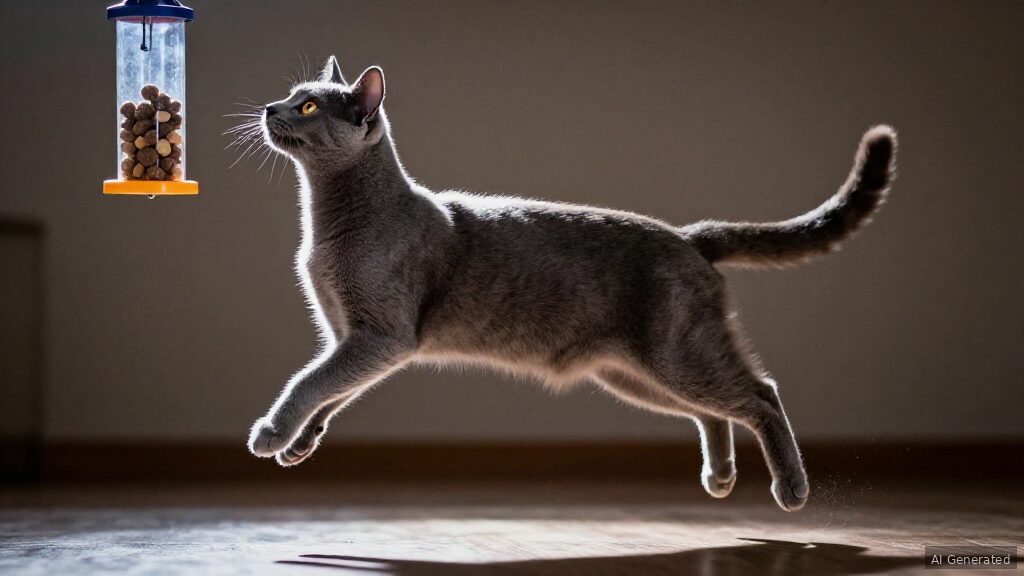
Strategy for Hiding Treats Throughout the House: The Art of Scatter Feeding
Cats have a habit of not hoarding food in one place, but rather dispersing and storing or consuming their hunted prey. This is known as ‘Scatter Feeding’. This provides cats with the fun of hunting for food all day long and is an essential activity, especially for highly active cats. You can start by simply scattering food on the floor and gradually increase the difficulty of hiding it.
Step 1: Floor Scattering
This is the simplest method. Spread one meal’s worth of food evenly over a wide area of the cat’s activity zone. The cats will wander around looking for the food and eating it. Note that scattering on carpets or vinyl flooring can make cleaning difficult, so it is better to do this on an easy-to-clean mat or in an area with clean flooring.
Step 2: Utilizing Hiding Spots
Utilize every nook and cranny of solid wood furniture like PlayCat. Hide food on top of shelves, under desks, between chair legs, or behind furniture—places that are easily accessible but not immediately visible. Cats are stimulated by their exploratory instinct during the process of finding and retrieving hidden food. This method effectively utilizes the vertical space of the home, making the cat perceive the entire house as their hunting ground.
Step 3: Utilizing Packaging Materials
Put food inside toilet paper rolls, small boxes, or paper bags. The cat must twist the box or dig a hole to get the food. If you cut a small hole in the side of the toilet paper roll, the food will fall out slowly, keeping the cat focused for longer. However, be careful to ensure the cat does not chew or swallow the roll, and only use safe materials.
Step 4: Utilizing Vertical Space
This strategy involves hiding food in high places. Placing food on high shelves or behind wall-mounted shelters requires the cat to use jumping or climbing skills. This also helps with muscle strengthening and physical fitness. PlayCat’s solid wood furniture provides shelves and resting spots at various heights, encouraging cats to make natural jumps and movements to find their food.
When hiding treats, adjust the number of dispersed locations so the cat doesn’t get too tired. It is best to start with 3-4 spots and gradually increase the number. Additionally, since finding hidden food should be a positive experience where the cat feels praised or happy, it is good to react with a soft voice when they find it.
Eating Slowly: The Effects of Slow Feeders and Mealtime Regulation
Many cats eat their food very quickly. This can stem from a competitive psychology to eat before others in the wild, or the instinct to eat fast because they are hungry. However, gulping food down quickly can cause various health problems such as indigestion, vomiting, and obesity. A slow feeder is a feeding tool designed to solve these problems; it uses physical barriers to prevent too much food from coming out at once, encouraging the cat to eat slowly.
Principle of the Slow Feeder
Slow feeders have irregularities (bumpy structures) or maze-like shapes inside the bowl. Every time the cat licks or eats, they must navigate around these obstacles for the food to enter their mouth. In this process, the cat moves their tongue more, lifts their head more frequently, and mealtime naturally extends by 2 to 3 times or more.
Improvement of Digestive Function
Eating slowly promotes saliva secretion and regulates the amount of food entering the stomach, allowing digestive enzymes to work efficiently. This reduces heartburn and vomiting and increases nutrient absorption rates. A slow feeder is an essential tool, especially for cats prone to overeating.
Psychological Stability
When mealtime is longer, the cat concentrates during that period, gaining psychological stability. Additionally, because the process of finding and consuming food is prolonged, they can maintain a feeling of fullness for longer, which also reduces the behavior of demanding treats. Slow feeders can also be used as diet aids for cats undergoing weight management.
When using a slow feeder, it may take some time for the cat to adapt initially. Since the cat might feel frustrated if they can’t get the food, it is best to start by lowering the obstacles in the bowl or spreading the food thinly, gradually increasing the difficulty. Placing a slow feeder on top of PlayCat’s solid wood furniture can create an environment where the cat can eat slowly from a stable position.
Connecting Play and Food: Building a Post-Play Feeding Routine
A cat’s natural behavioral sequence is ‘Hunt (Play) – Predation (Eat) – Grooming – Sleep’. If we follow this sequence, our cats can have the most satisfying day. In other words, the key is to always engage in hunting play before giving food.
Importance of Feeding After Play
Play allows cats to expend energy and mimic the behavior of chasing prey. During this process, the cat gets excited and releases energy, and at the moment the play ends, they receive food as a reward for ‘successful hunting’. This implants the perception in the cat’s brain that “I worked hard to get this food,” relieving stress and maximizing the feeling of fullness.
Effective Play Routine
- Focused Play (10~15 minutes): Use a wand toy or laser pointer to encourage the cat to jump, run, and spin. It is particularly important to create moments that feel like catching prey.
- Immediate Feeding: Give food immediately after play ends. Do not leave a gap between play and eating so that the connection of “Play = Successful Hunt = Meal” is strengthened.
- Grooming and Sleep: After the meal, let the cat naturally groom and take a nap. This aids in the natural digestion and rest process.
Repeating this routine daily will make the cat look forward to play and feel more satisfied during mealtime. PlayCat’s solid wood furniture offers spaces optimized for this play routine. High shelves are perfect for tossing prey (toys), and wide resting spots are the perfect space for resting after the hunt.
Especially if you play in the evening, it prevents the cat from being active all night and helps them sleep soundly. This is a very effective method to improve the sleep quality of both humans and cats.
DYI Food Puzzle Making: Materials and Difficulty Checklist
Even without expensive toys, you can make a cat-specific food puzzle using recyclables found around the house. This not only stimulates the cat’s curiosity but also strengthens the bond between owner and cat during the creation process. Here are some DIY food puzzle ideas that anyone can easily make.
1. Toilet Paper Roll Puzzle
- Materials: 2-3 toilet paper rolls, a small box or plate
- How to Make: Press both ends of the toilet paper roll closed with your fingers, or cut small holes on both sides. Place the rolls in a small box and put food inside. The cat must shake the box or pull out the rolls to get the food.
- Difficulty: Beginner
- Time Required: 5 minutes
2. Cupcake Tin Puzzle
- Materials: Muffin tin (cupcake tin), small balls or tennis balls
- How to Make: Put food in each hole of the muffin tin. Place a small ball on top of the food. The cat must push the ball to open the hole to eat the food.
- Difficulty: Intermediate
- Time Required: 2 minutes
3. Box Tunnel Puzzle
- Materials: Large shipping box, scissors, food
- How to Make: Cut several holes on the sides and top of the box. Put food inside and close the lid. The cat must reach their paw or hand through the holes to retrieve the food.
- Difficulty: Intermediate to Advanced (depending on hole size)
- Time Required: 10 minutes
When making DIY puzzles, always use safe materials. Be careful that glue or tape is not exposed to the cat, and do not use materials where small parts might fall off and be swallowed. Also, since cats may prefer different textures, it is good to try various materials like paper, plastic, and cloth.
PlayCat’s solid wood furniture can serve as a stage for these DIY activities. If you place the made puzzle on a shelf, the cat can feel a greater sense of accomplishment while searching for food from a high place.
Feeding Enrichment Strategies by Age: Customized Guide for Kittens, Adults, and Seniors
Since a cat’s physical abilities and behavioral patterns change with age, feeding enrichment strategies must also be applied differently.
Kittens (1 month ~ 1 year)
Kittens are curious and full of energy, but their coordination (motor skills) is not fully developed. Too complex puzzles can actually cause frustration.
- Strategy: Scatter feeding, where food is scattered on the floor, is most suitable.
- Product: Use beginner-level puzzle feeders with lids that are easy to remove.
- Caution: Divide the food into small portions and provide it several times a day to offer frequent hunting opportunities.
Adult Cats (1 year ~ 7 years)
Adult cats are at the peak of their physical abilities, and their instinctual hunting drive is strongest.
- Strategy: Combine multi-stage complex puzzle feeders with scatter feeding in high places. It is crucial to strictly adhere to the post-play feeding routine.
- Product: Use intermediate to advanced difficulty products such as rotating or lever types.
- Caution: To prevent boredom, introduce new puzzles or change their placement locations every week.
Seniors (7 years and older)
Senior cats may have reduced activity levels due to arthritis or dental issues. Avoid puzzles that are too difficult.
- Strategy: Use beginner-level puzzles that allow food to be obtained with simple operations. It is also good to make the food softer or put wet food in the puzzle.
- Product: Low-profile bowls that are easy to reach, or products with structures where food falls out easily.
- Caution: Consider not making them lift their heads too high, and focus on aiding digestion rather than extending mealtime.
Obese Cats
Obese cats need to reduce calorie intake while still feeling satisfied.
- Strategy: Instead of reducing the amount of food, extend mealtime significantly using a puzzle feeder. Providing just one meal a day via a puzzle feeder is also effective.
- Caution: Rapid dieting can cause liver disease (fatty liver), so proceed gradually after consulting with a veterinarian.
Safety Precautions and Foods to Avoid
When conducting feeding enrichment, the cat’s safety is the top priority. Wrong materials or foods can cause serious health problems.
Foods to Avoid
- Onions, Green Onions, Leeks: Destroy red blood cells and cause anemia.
- Chocolate, Coffee, Tea: Caffeine and theobromine stimulate the nervous system and can cause heart attacks.
- Grapes, Raisins: Can cause acute kidney failure.
- Fish Bones, Chicken Bones: Sharp bone fragments pose a risk of tearing the esophagus or intestines.
- Milk: Many adult cats are lactose intolerant, which can cause diarrhea.
Safety Precautions
- Watch for Small Parts: Remove small parts that may fall off from puzzle feeders or DIY materials as they pose a swallowing risk.
- Material Safety: Use BPA-free, non-toxic materials that cats might lick or chew.
- Cleaning: Wash puzzle feeders and DIY toys daily to prevent bacterial growth.
- Observation: When introducing a new puzzle, observe the cat’s reaction to ensure there is no excessive stress or frustration.
PlayCat’s solid wood furniture is made from nature-friendly materials, making it safe for cats, and its structures at various heights provide a perfect environment for feeding enrichment activities. We hope you create healthy eating habits and a happy daily life together with your cat.
Frequently Asked Questions (FAQ)
1. What should I do if my cat won’t eat when using a puzzle feeder for the first time?
Cats may be wary of unfamiliar toys at first. In this case, do not force them to eat; instead, place a few treats around the toy to spark curiosity. Also, it is good to lower the difficulty so they can get the food more easily, or put their favorite treats inside instead of regular food to motivate them. Over time, they will naturally adapt.
2. How long does it take for the food to run out when using a slow feeder?
It varies depending on the structure of the slow feeder and the cat’s eating speed, but generally, it takes 2 to 3 times longer than a regular bowl. It usually takes about 15 to 30 minutes, which is sufficient time to improve digestion and feel full. Adjust the portion size appropriately so the cat does not get frustrated by taking too long.
3. Does feeding enrichment increase a cat’s activity level?
Yes, it is very effective. Moving to find food, concentrating to solve puzzles, and searching for hidden food naturally increase physical activity. This directly helps prevent obesity and strengthen muscles, while also reducing mental fatigue.
4. What should I be careful about when making a DIY food puzzle?
The most important thing is safety. Ensure that glue or tape is not exposed and check that there is no risk of small parts falling off and being swallowed. Also, it is best not to use materials that the cat can chew and eat, and choose materials that are easy to clean to maintain hygiene.
5. How many times a day should I do feeding enrichment?
Ideally, it is good to provide meals 2-3 times a day, splitting the feeding times. Apply the post-play feeding routine in the morning and evening, and conduct scatter feeding with hidden treats during the day so the cat can have an active schedule all day. Adjust flexibly according to the cat’s energy level and your home environment.
This content was written using AI technology. Always consult a veterinarian for medical information.