


Daily life with a companion cat goes beyond simple caregiving; it depends on how happily your cat is living. Many owners express concerns such as, “My cat sleeps all day,” “My cat scratches or bites only when seeing me,” or “My cat suddenly stops using the litter box.” These behavioral issues are likely not just ‘bad habits,’ but stress signals resulting from unmet instinctual needs. The content we will introduce today is the Behavioral Enrichment strategy, which can fundamentally solve this problem.
Behavioral enrichment is a scientific approach that goes beyond simply providing many toys. It involves designing the environment so that a cat’s natural instincts—such as hunting, exploring, hiding, and social interaction—can be fully expressed even in a safe indoor setting. From PlayCat’s professional perspective, this guide offers specific environmental improvement solutions tailored to your cat’s age and temperament. Discover the key secrets to helping your cat live a healthier, happier, and longer life.
1. Why is my cat bored? Understanding the necessity of behavioral enrichment
Inherently, cats are ‘hunters’ and ‘explorers.’ In the wild, cats move hundreds of meters to find food, carefully explore to discover hidden prey, and seek high places or narrow spaces to protect themselves from threats. However, modern indoor living creates an environment that easily suppresses these instincts. Without sufficient physical activity, energy turns into frustration, which manifests as over-grooming, aggression, excessive grooming, or unnecessary vocalizations.
Fulfilling instinctual needs determines mental health
The core of behavioral enrichment is not just ‘relieving boredom,’ but ‘providing instinctual satisfaction.’ Dopamine and endorphins released when a cat fulfills its hunting instinct bring mental stability. This goes beyond simple pleasure; it is one of the most effective ways to prevent behavioral issues like anxiety disorders or depression. According to PlayCat’s research, groups that received appropriate environmental enrichment had significantly lower rates of stress-related diseases compared to those that did not.
Why it is necessary for both kittens and seniors
Many people believe, “Kittens just need play, while seniors should rest,” but this is a misconception. Kittens are full of energy, so physical and cognitive stimulation is essential. Senior cats need environmental stimulation to slow down cognitive decline (Cognitive Dysfunction). However, the intensity and method of stimulation should vary by age. Young cats need active hunting play, while senior cats should be encouraged to engage in cognitive activities through the provision of hiding spots and gentle exploration.
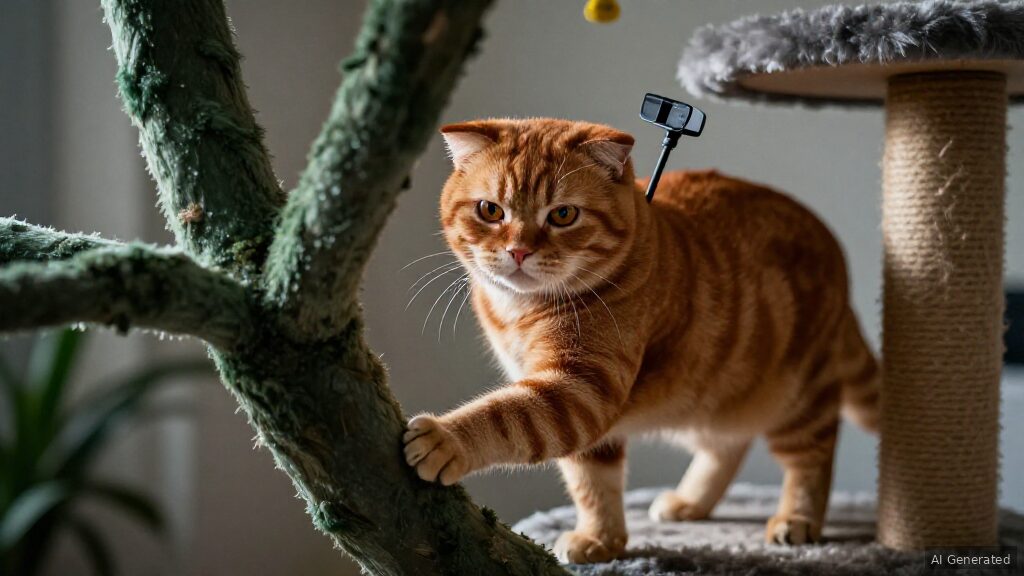
2. How to awaken the hunting instinct: Connecting food and play
A significant portion of a cat’s day is spent on eating. However, ‘passive feeding’—simply putting food in a bowl—leaves the cat’s brain in an inactive state. It is necessary to recreate the natural flow of Hunt-Kill-Eat indoors.
Utilizing puzzle feeders and slow feeders
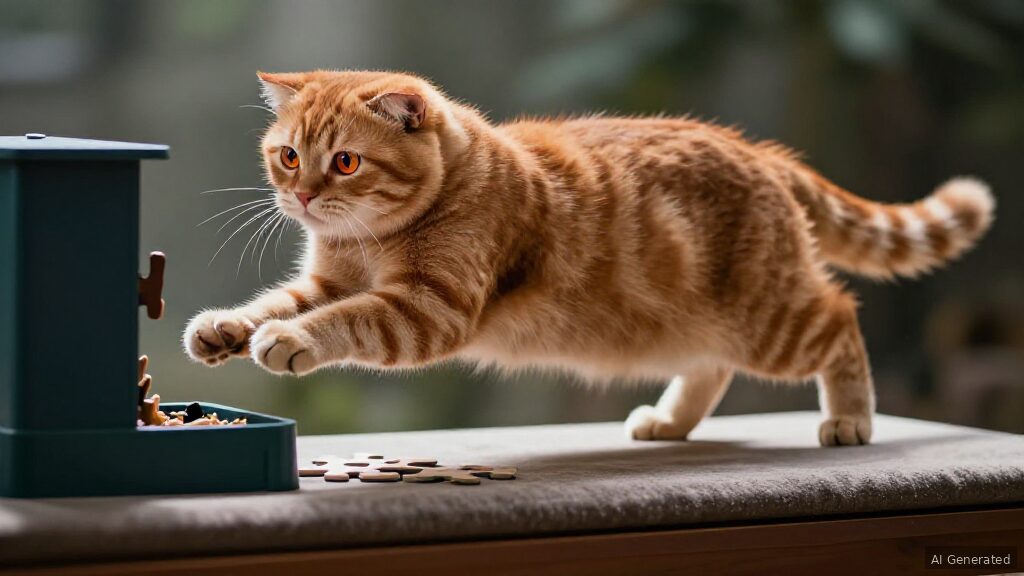
Instead of a regular bowl, use a Puzzle Feeder or Slow Feeder. These are devices that require the cat to think and move its paws or snout to get food. The energy expended searching for food helps with weight control and improves focus, correcting rapid eating habits. Start with low difficulty levels and gradually increase the challenge as your cat gets used to it to provide continuous cognitive stimulation.
Discharging energy through hunting play
It is recommended to engage in active hunting play for a total of 15-20 minutes, 2-3 times a day. Use wand toys (toys attached to a string) or laser pointers (ensure there is a reward at the end). The important point is to let the cat experience the final stage of ‘catching and eating.’ Providing a treat or meal immediately after play helps the cat learn the natural routine of ‘Successful Hunt → Meal,’ leading to significant psychological satisfaction.
| Age Group | Recommended Play Style | Main Purpose | Precautions |
|---|---|---|---|
| Kitten (Under 1 year) | Fast movements, high-difficulty puzzles | Energy expenditure, motor skill development | Watch out for overreaction due to excessive stimulation |
| Adult Cat (1-7 years) | Varied hunting play, treat hunting | Obesity prevention, stress relief | Rotate toys periodically to prevent boredom |
| Senior (7+ years) | Gentle exploration, low-difficulty puzzles | Maintain cognitive function, reduce joint strain | Avoid excessive jumping or fast movements |
3. Vertical space and hiding spots: Strategies for securing a cat’s territory
Cats prefer vertical spaces over flat ones. The view from high places gives cats a sense of security, making them feel they control their territory, and serves as a safe zone for immediate escape in threatening situations. Additionally, hiding in narrow, dark spaces is the most natural way for cats to find psychological comfort.
Placement of cat tunnels and towers
Preferred locations for cats are “above walkways” or “high places with a good view.” Installing a Cat Tower or shelves near a window allows cats to observe the outside scenery (birds, swaying leaves, etc.), providing rich visual stimulation. This is called ‘Cat TV’ and is very effective as a substitute for walks. PlayCat’s wooden furniture supports these vertical spaces stably and uses scratch-resistant materials to enhance durability.
Diversifying hiding spots
Instead of providing just one hiding spot, place hiding spots of various sizes and shapes. The more options a cat has to choose from, such as boxes, fabric tunnels, or spaces under low bookshelves, the better. This is especially essential in multi-cat households or after visitors arrive. Forcing a cat out of a hiding spot or playing with them while they are hiding can cause significant trauma. Always maintain an environment where there is an “exit to escape.”
4. Abundance of smell and touch: The power of hidden sensory stimulation
Improving the olfactory and tactile environment is a core part of behavioral enrichment, just as important as visual stimulation. A cat’s sense of smell is more than 14 times more sensitive than a human’s, allowing them to gather information and find emotional stability through scents.
Utilizing cat grass and herbs
Use herbs that are attractive to cats, such as Catnip, Valerian, and Sweet Agrephyllum. These promote dopamine secretion in cats, providing pleasure or relaxation effects. Especially for senior cats or those under high stress, Valerian may provide a softer relaxation effect than catnip. However, not all cats react the same way, so it is good to test various types of herbs.
Flooring and scratching posts with various textures
Cats have highly developed sensations in their paw pads. Mixing flooring materials like smooth tiles, soft carpets, and rough mats can stimulate their paw sensations. Additionally, Scratching Posts are important tools not just for protecting furniture, but for cats to stretch muscles, relieve stress, and mark their territory. Prepare a variety of vertical and horizontal types, and materials (cedar, sisal, cardboard), to find the form your cat prefers.
5. Social enrichment: Interaction with owners and managing multi-cat households
Although cats are solitary animals, they form bonds through appropriate social interaction. This is the area where the owner’s active intervention has the greatest impact.
Accumulating small attentions in daily life
Instead of excessive cuddling or forced play, engage in short and frequent interactions when the cat wants them. Slowly blinking while making eye contact is a ‘Cat Kiss,’ a way to express trust. Additionally, grooming (brushing) strengthens the bond between the owner and the cat, removes unnecessary fur, and is good for health. Find the intensity and duration the cat does not reject and practice consistently.
Principles of resource distribution in multi-cat households
Cats are inherently territorial animals. In multi-cat households, separation of resources is essential. Place water bowls, food dishes, litter boxes, and hiding spots in separate spaces. Ideally, prepare “number of cats + 1” litter boxes, and adjust their positions so that their scents do not mix. If even one cat is stressed, behavioral issues can arise in the entire group, so the environment must be designed so that each cat can secure its own space.
6. Common mistakes and solutions: Causes of behavioral enrichment failure
You may encounter unexpected problems while trying behavioral enrichment. Here is a summary of common mistakes and their solutions.
Mistake 1: Providing too much stimulation
Many people misunderstand ‘enrichment = giving a lot.’ However, too many toys or a complex environment can actually make a cat anxious. Excessive sensory overload can act as stress for cats.
Solution: Expose only 3-4 toys and store the rest in a drawer, rotating them periodically (Switching). It is best to leave only the toys the cat prefers and remove the others.
Mistake 2: Forcing participation in play
Forcing a cat to play when it does not want to destroys trust.
Solution: Interact only when the cat shows interest first. ‘Passive enrichment,’ where you throw a toy on the floor and wait for the cat to approach it on its own, is also important.
Mistake 3: Providing young cats’ stimulation to senior cats
Senior cats have weak joints and declining hearing/vision. Fast toys can cause frustration.
Solution: Recommend low-stimulation activities for senior cats, such as scent-finding games, gentle brushing, and listening to quiet music. Avoid installing equipment with high jumps, or install gentle ramps to improve accessibility.
7. Practical Checklist: 7 actions you can start doing today
This is a list of specific actions you can practice immediately, rather than complex theories. Start with 3-5 items from the checklist below and make them a habit.
- Dietary change: Use a puzzle feeder or slow feeder for one meal a day to increase feeding time to over 10 minutes.
- Hunting play time: After work or before bed, use a wand toy for 15 minutes to let the cat experience ‘catching and eating.’
- Secure vertical space: Install a cat tower or shelf near a window to create a space for observing the outside scenery.
- Add hiding spots: Add a box or tunnel in the bathroom or living room corner to secure a space for the cat to hide.
- Scent stimulation: Introduce a new toy containing cat grass or valerian, or wash existing toys to refresh the scent.
- Grooming time: Brush the areas the cat likes for 5 minutes to build a bond.
- Check resource separation: In multi-cat households, check if litter boxes and water bowls are not too close to each other and if there are enough of them.
8. Frequently Asked Questions (FAQ)
Q1. My cat doesn’t like toys at all. What should I do?
A: Not all cats like toys. Some cats may be more sensitive to olfactory or tactile stimulation than visual stimulation. Try toys with rosemary or valerian scents, or try activities connected to food first, like a ‘snake game’ where food is hidden. Also, if the cat prefers boxes over toys, hiding treats in those boxes is a good starting point.
Q2. Is behavioral enrichment too strenuous for senior cats?
A: No. However, you must adjust the ‘intensity’ and ‘method.’ For senior cats, ‘cognitive stimulation’ and ‘gentle physical activity’ are more important than vigorous exercise. Scent-finding games, low-difficulty puzzle feeders, and gentle brushing are good ways to maintain brain health without straining the joints. Observe the cat’s current physical strength and energy levels and proceed gradually.
Q3. I started behavioral enrichment, but my cat became more aggressive.
A: This is likely stress due to ‘overstimulation’ or ‘failure experience.’ Immediately stop all activities and provide a quiet environment where the cat can rest. Slow down the speed of the toys or switch to reward-based training using treats to build success experiences. Do not get angry or force the cat if it fails.
Q4. In a multi-cat household, if I improve one cat’s behavior, will the others improve too?
A: Not necessarily. Cats are social animals, but each has its own territory and stressors. Even if one cat’s behavioral issue is resolved, the overall environment will not improve if other cats are still stressed. You need to identify each cat’s preferences and needs for individualized approaches, and re-check if resources (water, litter boxes, etc.) are sufficiently separated.
Q5. Do I have to use PlayCat wooden furniture? Are other products okay?
A: PlayCat’s wooden furniture is durable and stable, providing a safe environment for cats, so I recommend it. Since cats jump and scratch a lot, heavy and stable wooden materials are advantageous for preventing accidents. However, not all products are essential. If your existing cat tower or scratching post is safe and kept clean, you can continue using it. What is important is not the brand, but the stability and hygiene that allow the cat to use it comfortably.
9. Conclusion: Big happiness created by small changes
Cat behavioral enrichment is not completed overnight. Nor does it need to be perfect. Just by hiding one of your cat’s favorite treats today or spending 5 minutes together watching the scenery from the window, your cat can become happier. Behavioral issues are environmental issues. Your small attentions and efforts will enrich your cat’s daily life and create a healthier, longer companion life.
PlayCat helps you design an environment where your cat can freely express its natural instincts. Refer to the guide introduced today and create a special, enriched daily life for you and your cat.
This content was created using AI technology. Always consult a veterinarian for medical information.