


What Is Environmental Enrichment and Why Is It Essential for Indoor Cats?
Environmental Enrichment is a comprehensive management strategy that provides physical, social, and cognitive stimulation to captive animals, increasing opportunities for instinctive behaviors and reducing stress and abnormal behaviors (stereotypical behaviors). It goes beyond simply providing toys; it is a key element in enhancing animal welfare by improving the quality of the entire living space. Research indicates that appropriate environmental enrichment significantly reduces stereotypical behaviors in animals, providing clear welfare benefits, especially for those in commercial transport or confined spaces. Indoor cats, who do not have opportunities to encounter various external stimuli, may develop behavioral issues such as urinary incontinence, over-grooming, and aggression due to boredom and stress if the owner does not intentionally design their environment. Therefore, environmental enrichment is not optional but a mandatory condition for modern indoor cat care.
The goal of environmental enrichment is to safely satisfy a cat’s innate hunting instincts, territorial exploration instincts, and need for hiding. In the wild, cats spend a significant portion of their day hunting, moving, and resting in hiding spots to expend energy. In contrast, indoor cats often have these energy outlets blocked. Environmental enrichment addresses this by providing diverse experiences similar to nature (various sensory stimuli, foraging, vertical movement, etc.) even in limited indoor spaces, thereby promoting the cat’s psychological stability. For example, some studies have shown that fish experiencing long-distance transport in impoverished environments exhibit increased abnormal swimming behaviors, whereas those in enriched environments show reduced stress responses. This suggests that cats are also highly sensitive to restricted movement and lack of stimulation, highlighting the importance of providing a rich environment in indoor spaces.
5 Areas of Enrichment: Balancing Sensory, Cognitive, Social, Feeding, and Physical Environments
For effective environmental enrichment, it is crucial to design five key areas in balance rather than focusing on just one. Each area satisfies different instincts and needs of the cat, working complementarily to improve overall quality of life. The table below summarizes the definitions and specific practical methods for the five enrichment areas.
– Prevention of depression and lethargy
– Maintenance of memory and reaction speed
| Enrichment Area | Main Purpose | Examples of Specific Practices | Expected Effects |
|---|---|---|---|
| 1. Sensory Enrichment (Sensory) |
Enhance cognitive ability of the surrounding environment by stimulating the five senses: sight, hearing, smell, touch, etc. | – Ensure window views (observing birds, butterflies) – Playing cat-safe sounds (natural sounds) – Providing herbal scents (catnip, valerian) – Various floor textures (carpet, wood, mats) |
– Reduced boredom – Stress relief through olfactory stimulation – Increased environmental adaptability |
| 2. Cognitive Enrichment (Cognitive) |
Maintain brain health and reduce mental fatigue by providing problem-solving abilities and learning opportunities | – Using puzzle feeders (intelligent feeders) – Hidden treat search games – Learning new play patterns – Training using clicker sounds |
|
| 3. Social Enrichment (Social) |
Form a sense of belonging and stability through positive interactions with owners or other animals | – 15-20 minutes of focused playtime daily – Petting or brushing – Gradual introductions in multi-cat households – Visiting cat-friendly cafes (socialization) |
– Reduced separation anxiety – Improved trust in owners – Mitigated aggression and territorial disputes |
| 4. Feeding Enrichment (Feeding) |
Increase mealtime satisfaction by recreating the ‘hunt-catch-eat’ process rather than simple consumption | – Using maze feeders – Sprinkling treats in multiple locations – Changing meal times and locations – Varied diets, such as strong-smelling fish |
– Prevention of overeating and obesity – Increased interest in meals – Increased physical activity aiding digestion |
| 5. Physical Environment (Physical) |
Increase physical activity through vertical space utilization, hiding spots, and safe exploration routes | – Installing cat towers and wall shelves – Providing hiding spots like boxes and paper bags – Using tunnel toys – Changing furniture arrangement seasonally |
– Weight control and muscle maintenance – Sense of security (hiding) – Maximizing space utilization |
These five areas are interconnected. For example, using a puzzle feeder for ‘feeding enrichment’ is also an element of ‘cognitive enrichment.’ Additionally, a ‘physical environment’ like a cat tower can serve as a stage for play (social enrichment) that stimulates hunting instincts. Therefore, it is important to design spaces so that these various areas work in combination rather than relying on a single tool. Especially for kittens, who are full of energy, physical activity and cognitive challenges are necessary, whereas senior cats may benefit more from soft-textured hiding spots and accessible feeders that consider joint health. Customized enrichment should be provided considering these age-related differences.
Space Rearrangement Strategy: Providing New Stimuli with Seasonal Furniture Reconfiguration
Cats become familiar with their environment over time and feel bored even in the same space. At this point, Spatial Rearrangement is one of the most powerful methods to effectively provide new stimuli with minimal cost. Cats rely heavily on visual cues to recognize their territory, so changing furniture positions or adding new structures sends a signal to the cat’s brain for “new exploration.”
Seasonal rearrangement strategies are as follows. In spring and summer, utilize carpets or thin blankets near sunny windows to create a “solar heating deck” for resting. Moving cat towers or shelters that were previously placed low to higher wall shelves allows cats to satisfy their instinctive pleasure of conquering new high ground. Conversely, in autumn and winter, it is better to block drafts from windows or place soft beds near warm radiators (maintaining a safe distance) or on the floor next to the bed to establish “warm hiding spots.” Utilizing the characteristics of temperature and lighting according to seasonal changes is an effective way to make cats re-perceive their indoor environment.
When changing furniture arrangement, a key point to note is not to break the cat’s “Safety Route.” Cats like to patrol their territory by moving along ceilings or high places. Therefore, when moving cat towers or wall shelves, maintain the continuity of existing paths or create new connections (e.g., a distance that allows jumping from a desk to a wall shelf). If adding new furniture, it is best to place it far away initially so it is not perceived as a threat, then gradually move it closer to help the cat become familiar with it. PlayCat’s solid wood structures are easy to anchor as the center of the space due to their sturdy materials and natural design, and they can be securely fixed even when adjusted seasonally, making them suitable for space rearrangement strategies. These subtle environmental changes break the boredom of daily routines, stimulate curiosity, and play a significant role in maintaining mental health.
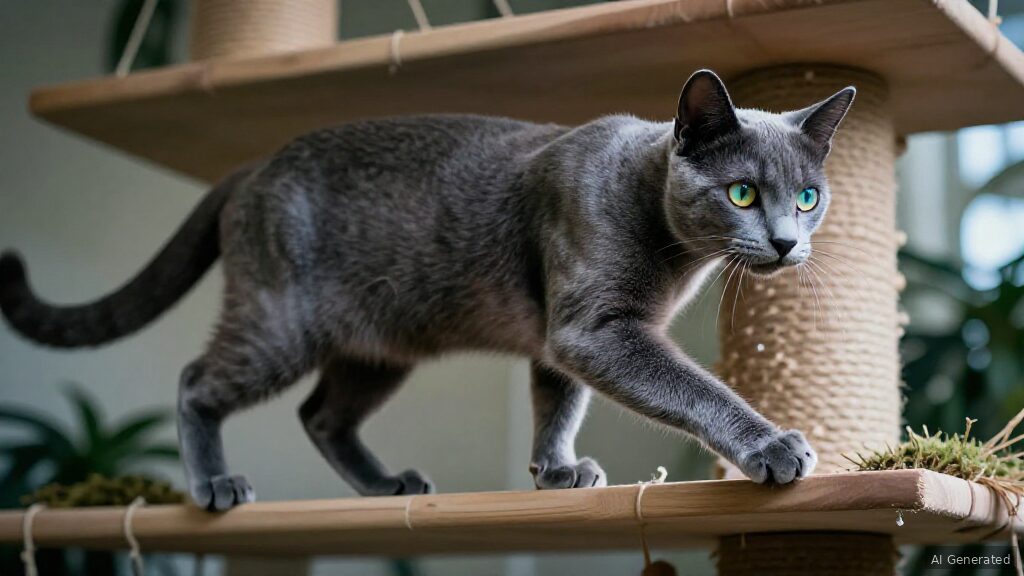
Introducing Natural Elements: Cat Grass, Safe Plants, and Catio (Outdoor Space)
Indoor spaces do not need to be disconnected from nature. Introducing Nature Elements stimulates a cat’s innate needs, purifies indoor air, and contributes to psychological stability. In particular, ‘Cat Grass’ is not only a source of essential dietary fiber and folic acid for cats but also helps remove tartar and promote intestinal movement through chewing. Cat grass made from wheat, barley, or oats is easy to grow and serves as a good tool for cats to feel a sense of ownership by checking their own food source.
Selecting safe plants is very important. Since many indoor potted plants are toxic to cats, only plants safe for cats, such as Pilea, lavender, and aloe vera, should be selected and placed. Additionally, the visual stimulation of swaying leaves or the smell of soil enriches a cat’s olfactory and visual senses. If there is garden space at home, it is ideal to prepare an outdoor connected space like a ‘Catio.’ A Catio is a safe outdoor space enclosed by a fence, allowing cats to feel the outside air and sunlight while being protected from external dangers (vehicles, other animals). This can be considered the pinnacle of environmental enrichment, significantly reducing stress for cats confined indoors. Even if a Catio is not possible, simply leaving windows open during ventilation to let the sounds and smells of the outdoors into the room provides sufficient sensory enrichment.
When introducing natural elements, ‘safety’ is always the top priority. Care must be taken to prevent cats from swallowing plants, and regular management is needed to prevent parasites or bacteria from breeding in the soil. Additionally, plants should be firmly secured to prevent overheating in direct sunlight or pots from tipping over. This connection with nature helps cats feel the rhythm of nature and maintain their biological rhythms even within the limited space of a home.
Utilizing Vertical Space: Cat Towers, Wall Shelves, and PlayCat Solid Wood Structure Placement
Cats prefer Vertical Space much more than horizontal space. Wild ancestors hunted, ate, and hid from predators in trees. Therefore, in indoor environments, designing vertical space using walls is more important than simply expanding floor area. Vertical space serves as a ‘watchtower’ where cats can overlook their territory at a glance, and resting in high places provides psychological stability.
Cat towers are the core of vertical space design. However, products with various combined functions (scratching posts, shelters, connecting tunnels, etc.) are more effective than cat towers that are simply tall. By utilizing wall shelves, you can create a ‘cat highway’ along the wall without a cat tower. This highway consists of shelves installed at different heights, allowing cats to move around every corner of the room without touching the floor. This is an effective solution, especially in small apartments or studio rooms.
Important factors to consider when designing vertical space are ‘accessibility’ and ‘stability.’ Cats move to high places by jumping, but senior cats may need ladder-like structures starting from lower steps to consider joint health. Also, if cat towers or wall shelves wobble, cats will not trust or use the space and may even experience anxiety. Therefore, sturdy materials and secure fixing devices are essential. PlayCat’s solid wood furniture provides stability when cats scratch or jump, thanks to the warmth of natural materials and a sturdy structure, and blends well with interior design, enhancing the aesthetic value of the space. Vertical space is not just a play area; it is a key element of environmental enrichment that allows cats to conquer their territory and feel a sense of control.
Rest and Hiding Spaces: The Importance of Safe Refuges and Placement Principles
While abundant stimulation is important, the lack of Hiding Spots or rest spaces, on the contrary, causes significant stress to cats. As hunters and intermediate predators in the food chain, cats always need a refuge to protect themselves. Especially when visitors arrive, when noise occurs, or when conflicts arise with other pets, a safe space to retreat acts as a shield for the cat’s mental health.
The principle of placing hiding spots is to give ‘freedom of choice.’ A completely dark box is not the only hiding spot. Under desks, inside cabinets, enclosed rooms in cat towers, or small houses placed in secluded corners can all serve as hiding spots. The important thing is that the cat must be able to feel confident that “no one will disturb them” in that space. Therefore, avoid placing hiding spots in the middle of frequently used passages like bathrooms or kitchens. Instead, place them in a corner of the living room or a quiet space in the bedroom.
The size of the hiding spot is also important. It should be small enough for the cat to feel completely hidden, but not so narrow that it feels trapped. Additionally, the material inside the hiding spot is important. Laying soft and warm cloth or blankets allows cats to rest more comfortably. Especially in multi-cat households, each cat should have at least one independent hiding spot. If one cat monopolizes the hiding spot, the other cats may experience anxiety and stress, leading to territorial disputes or aggression. Therefore, providing distributed hiding spots throughout the house is essential for environmental enrichment in multi-cat households.
Multi-Cat Household Environment Design: Resource Dispersion, Territorial Separation, and Conflict Prevention
In a Multi-cat Household where multiple cats are raised in one home, the concept of environmental enrichment becomes one step more complex. Cats are inherently solitary animals, and competition for limited resources (food, water, litter boxes, hiding spots) can cause severe stress and behavioral problems. The key strategies to prevent this are Resource Dispersion and Territorial Separation.
First, ‘resources’ should be placed in multiple locations throughout the house. For example, do not cluster food bowls in one place; instead, divide them between one side of the living room and one side of the veranda. Place water bowls in multiple locations away from the food bowls. The most important is the litter box. According to the ‘N+1 rule,’ you should place one more litter box than the number of cats, distributed in different rooms. This prevents other cats from approaching while one is using the litter box, protecting their vulnerability during elimination.
Additionally, it is good to use vertical space to create paths where each cat can enjoy its territory without meeting the others. By encouraging activity on different floors through high wall shelves or cat towers, cats can avoid physical collisions while maintaining a social presence in the same space. If conflicts between cats are severe, it may be necessary to set completely different rooms as ‘safe bases’ for each and go through the introduction process again to gradually adapt to each other’s scent and presence. Environmental enrichment in multi-cat households requires a sense of balance that goes beyond simple stimulation provision, appropriately maintaining ‘physical and social distance’ so that each cat can coexist without stress.
Measuring Environmental Enrichment Effects: Behavioral Change Observation Checklist
To confirm whether environmental enrichment is actually effective, you must systematically observe the cat’s behavior. Since the ultimate goal of environmental enrichment is to improve cat welfare, you can measure the effects and modify strategies if necessary through the following Behavioral Change Checklist.
- Reduction in stress behaviors: Have excessive grooming (pulling out fur), frequent yawning, tail twitching, and hiding behaviors decreased? (Research indicates that enriched environments significantly reduce these abnormal behaviors.)
- Increased hunting play: Has active playtime increased, such as chasing toys or finding hidden treats?
- Normalization of appetite and bowel movements: Is food intake stable, and is the litter box usage pattern regular? (Has constipation or diarrhea caused by stress disappeared?)
- Hiding spot usage patterns: Has the frequency of entering and exiting hiding spots become appropriate? (Continuous hiding can be a sign of anxiety.)
- Social interaction: Have positive social behaviors increased, such as rubbing against owners or other cats, or trying to rest together?
This observation goes beyond simply ‘good/bad’ and becomes data to determine which enrichment tools were most effective or which elements might be causing stress. For example, if a cat rarely uses a newly installed cat tower, the location or height may not be suitable. In this case, fine-tuning is needed, such as changing the location or placing treats nearby to attract interest. Environmental enrichment is not a one-time installation but a process that evolves through continuous interaction and observation with the cat. Regularly filling out the checklist and carefully observing the cat’s reactions is the secret to the most successful environmental enrichment.
Frequently Asked Questions (FAQ)
Q. Does starting environmental enrichment require a lot of cost?
A. Not necessarily. The most effective environmental enrichment often involves methods that cost little, such as ‘space rearrangement’ or ‘treat scattering.’ Hiding spots using boxes, paper bag play, and ensuring window views can all be done for free or at low cost. Of course, purchasing products like cat towers or puzzle feeders is good, but the most important thing in satisfying a cat’s instincts is the owner’s time, attention, and careful consideration of the space. Introducing these gradually according to your budget is the key to sustainable environmental enrichment.
Q. Do senior cats also need environmental enrichment?
A. Yes, environmental enrichment is very important for senior cats as well. However, instead of vigorous play like young cats, the focus should be on ‘cognitive enrichment’ and ‘physical convenience.’ Since movement may be difficult due to arthritis, accessibility should be improved by lowering the steps of cat towers or installing ramps. Additionally, due to decreased sense of smell from aging, providing cognitive stimulation with strong-smelling food or toys is effective. Boredom can promote depression and cognitive decline in senior cats, so social enrichment through gentle touch and daily interaction is essential.
Q. How can I provide a rich environment for all cats in a multi-cat household?
A. The key is ‘resource dispersion’ and ‘utilization of vertical space.’ Distribute food bowls, water bowls, litter boxes, and hiding spots in multiple locations around the house to prevent competition in one place. Especially, vertical space is effective in mitigating conflict by providing spaces where each cat can get out of each other’s sight or safely observe from high places. Also, since each cat may prefer different toys or rest spaces, it is good to prepare various types of enrichment tools and consider their preferences.
Q. When will the effects of environmental enrichment appear?
A. There are individual differences, but most cats take a few days to a few weeks to adapt to new environmental stimuli. Initially, they may be wary of or ignore new objects or arrangement changes. Therefore, rather than expecting results too quickly, patience is needed to wait for the cat to naturally explore and utilize them. Some studies have observed a reduction in abnormal behaviors in the short term after providing environmental enrichment, but for stable habit formation, maintaining a consistent environment for at least 2-4 weeks is recommended.
Q. Is environmental enrichment possible even in a small house?
A. Yes, the utilization of ‘vertical space’ is even more important in small houses. If the floor area is not wide, you can increase space utilization by actively using walls to install cat shelves or thin cat towers. Additionally, using space in segments is also a method. For example, dividing areas so that the living room is for play and feeding, and the bedroom is for rest and hiding, allows cats to have various experiences even in narrow spaces. Stylish and space-efficient solid wood furniture like PlayCat can be installed without feeling oppressive in narrow indoor spaces, helping with environmental enrichment in small spaces.
This content was created using AI technology. Please consult a veterinarian for medical information.