


Everything You Need to Know About the Relationship, Responsibility, and Environmental Enrichment for Living with a Cat
What Are We Missing at the Intersection of Pets and Human Society?
Recently, the statistics on pet ownership in our society have shown remarkable growth. The total number of pets is estimated to be around 7.76 million, with approximately 4.99 million being dogs and 2.77 million being cats. As so many cats join the household community, a complex social structure of ‘coexistence’ is forming, going beyond simply raising animals. According to research by Cheon Myeong-seon, animals with high cognitive abilities and sociality, such as elephants, can maintain deep emotional bonds with humans, yet they remain caught in a dual structure where they must clearly recognize their status as domesticated animals. This fact applies to cats as well; we must respect the high intellectual abilities and sensitivity of cats while, at the same time, assigning them appropriate roles within human-centric social norms.
When many guardians start raising cats, the first thing they worry about is not the brand of food or the price of toys. However, the perspective offered by Cheon Myeong-seon’s research points to a more fundamental issue: ‘relationship’ and ‘responsibility’. A cat is not merely an entity that stays within the house; it is an independent individual that shares emotional communion with humans. Therefore, to live with a cat, we must first understand their biological characteristics and psychological needs. If we overlook this part, simply feeding food or throwing toys does not guarantee the cat’s happiness. In fact, improper upbringing can cause stress to the cat, leading to behavioral or health problems.
In this article, based on the insights of Cheon Myeong-seon’s research, we aim to unpack the meaning of ‘responsible coexistence’ that cat guardians must know. We will go beyond simply managing cats and discuss the importance of ‘Environmental Enrichment’, creating an environment where they can express their natural instincts. Especially considering the characteristics of animals with high cognitive abilities and sociality mentioned in Cheon Myeong-seon’s research, we can see that creating an environment for cats goes beyond simply providing toys. As guardians, we will systematically examine what behaviors we should expect from cats and what environmental elements are needed for those behaviors. Through this article, you will acquire concrete methods to redefine your relationship with your cat and form a deeper, healthier bond.
Why Is Raising Cats Considering Their High Cognitive Abilities and Sociality Necessary?
A common misconception many guardians have is that cats live in a world of their own, like a hermit. However, according to Cheon Myeong-seon’s research, cats have very high cognitive abilities, similar to elephants, which play a decisive role in forming emotional bonds with humans. This cognitive ability allows cats to quickly learn and remember their surroundings and manage relationships with other individuals, including humans. Furthermore, it should not be overlooked that cats are social animals. Although they do not live in groups, they perform roles as family members, recognizing their position within the group and interacting with others. These high cognitive abilities and sociality can lead to serious negative consequences if cats are not provided with appropriate stimulation.
Looking specifically at what problems can occur, the cat’s brain has evolved to constantly process new information and attempt problem-solving. If a guardian does not provide the cat with necessary intellectual stimulation or physical activity opportunities, the cat will feel boredom. This boredom is very likely to be expressed as problem behaviors such as aggression, vocalization (e.g., meowing all night), object destruction, or loss of confidence. Cheon Myeong-seon’s research supports this phenomenon, stating that animals with high cognitive abilities show a sharp rise in stress hormone levels when the environment is monotonous. Therefore, we must go beyond simply feeding and cleaning up for our cats and create an environment where their brains can work actively.
Furthermore, the emotional bond between cats and humans is formed bidirectionally. When a guardian tries to understand the cat’s behavior and provides appropriate stimulation, the cat perceives the guardian as a trusted object and feels a deeper attachment. This goes beyond the cat just wandering around the guardian, manifesting as active interactions such as responding to the guardian’s voice or bringing objects. According to Cheon Myeong-seon’s research, the higher the sociality of an animal and the stronger the bond with humans, the higher the quality of life. In other words, providing a good environment for a cat directly affects not only the cat’s individual happiness but also the satisfaction felt by the guardian. We must respect the cat’s high abilities and correctly understand their sociality to live together.
Analysis of Behavioral Patterns of Cats with High Cognitive Abilities
A cat’s cognitive ability is expressed in various areas such as play, learning, and memory. For example, a cat manipulating a door handle using a door skin (Door Skin) when the guardian closes the door, or bringing a heating pad, are not simple habits but cases demonstrating problem-solving abilities. In Cheon Myeong-seon’s research, these behaviors are emphasized as natural results of satisfying the cat’s intellectual curiosity. Guardians should not just find these behaviors cute or treat them as disturbances, but approach them with the perspective of intellectual challenges needed by the cat. Locking the door and blocking the room to prevent the cat from manipulating the door handle can actually stimulate their curiosity and induce greater problem behaviors. The correct approach is to replace these abilities with appropriate play tools or guide desirable behaviors through training.
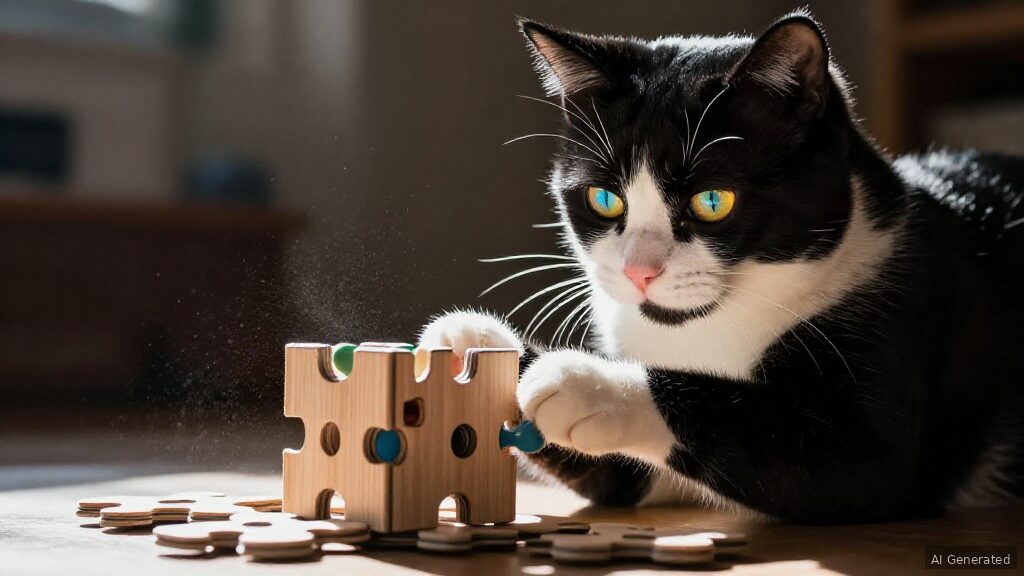
As a specific example, there are cases where cats show the behavior of picking up food directly from the food bowl. This is not just due to hunger, but a result of hunting instincts combined with problem-solving abilities. If a guardian forcibly prevents this behavior, the cat may feel frustration and show aggression towards the guardian or surrounding objects. Therefore, guardians should respect the cat’s cognitive ability and adjust the feeding time or method more flexibly, or introduce a locking device on the food bowl so the cat can open it themselves (e.g., puzzle feeder). This allows the cat to exercise their abilities and feel a sense of achievement.
Furthermore, cats can understand complex social signals. They perceive and react to human emotions through the guardian’s facial expressions, tone of voice, and gestures. According to Cheon Myeong-seon’s research, cats show avoidance behaviors such as lowering their bodies or hiding when they detect an angry human expression, or conversely, actively approach to attract the guardian’s attention. This is evidence that cats manage their relationship with humans very finely. Therefore, guardians should be aware of their own emotional state when communicating with cats and provide feedback in an appropriate way that the cat can understand. For example, suddenly speaking loudly or threatening with a hand while the cat is playing can cause confusion and fear in the cat. Considering these points, interaction with cats should always start by understanding the cat’s mood and state first.
Process of Bond Formation for Socially Active Cats
Although cats are often referred to as ‘independent animals’, they actually have the ability to form very strong social bonds. Cheon Myeong-seon’s research points out that the emotional connection between cats and humans can develop into an interdependent relationship, going beyond just intimacy. This is because the cat perceives humans as members of the group or guardians and seeks comfort and stability from them. In particular, cats feel stress relief and happiness through the affection and attention given by humans. Studies also show that cats with deep bonds with guardians have better health conditions and strengthened immune systems, increasing their resistance to diseases. Therefore, it is important for us to build a relationship that can provide emotional support, going beyond simply providing physical space for cats.
There are various specific methods to strengthen the bond between cats and humans. First, have playtime with the cat at a set time every day. This play should not just be throwing a toy, but an activity that stimulates the cat’s hunting instinct. For example, hiding a fluffy toy or playing a game of chasing the cat by moving slowly gives the cat great pleasure. Through such play, the guardian and cat can understand each other’s moods and form a common ground. According to Cheon Myeong-seon’s research, such regular interactions are effective in strengthening trust between the cat and guardian and reducing problem behaviors.
Second, there is a need to accurately understand the cat’s language and signals. Although cats do not express emotions with a ‘woof’ sound, they clearly convey their state through body language, eye contact, and tail wagging. For example, when a cat slowly wags its tail while lowering it to the ground, it is in a tense state, whereas wagging its tail upright and slightly indicates friendliness. If a guardian misses these subtle signals and simply pets or tries to play with the cat, the cat may feel stressed and react aggressively. Cheon Myeong-seon’s research emphasizes that when cats and humans accurately read each other’s signals, conflict decreases and bonds are strengthened. Therefore, guardians should strive to interpret their cats’ actions not just as something cute, but in their own language.
Concept and Importance of Environmental Enrichment
Environmental Enrichment refers to a strategy to improve the environment to stimulate and maintain an animal’s natural behavioral patterns. As emphasized in Cheon Myeong-seon’s research, considering a cat’s cognitive abilities and sociality, environmental enrichment is an essential element that goes beyond simply buying toys. Many guardians think that to enrich a cat’s behavior, they must buy expensive toys or install complex structures, but this is a great misunderstanding. The core of environmental enrichment is naturally incorporating activities that cats can instinctively perform (hunting, hiding, moving, smelling, etc.) into daily life. In other words, the effectiveness of environmental enrichment varies depending on how well the guardian’s intention and effort, and the cat’s environmental conditions are harmonized.
The reason environmental enrichment is important is because it is directly related to the cat’s mental health. According to Cheon Myeong-seon’s research, cats that do not receive appropriate environmental enrichment may suffer from severe stress and cause various problems. For example, if the hunting instinct is not satisfied, they may show aggression towards the guardian or other animals, and if there is a lack of hiding places, they feel anxiety. Furthermore, if the freedom to smell and move is restricted, the cat may feel bored and depressed. These problems go beyond just upsetting the cat’s mood and become a cause of disturbing the guardian’s daily life. Therefore, the environment provided to cats must be designed to satisfy their natural instincts.
Specifically, environmental enrichment is divided into feeding methods, play activities, environmental structures, and olfactory stimulation. Cheon Myeong-seon’s research emphasizes that these elements must be considered comprehensively to provide various experiences for cats. For example, instead of feeding at the same time and place every day, changing the method to hiding the food bowl or putting it in a puzzle toy makes the cat use its brain to find the food. This has the effect of developing problem-solving ability and cognitive ability beyond the simple act of eating. Furthermore, play activities are most effective when the guardian and cat participate together, and toys with appropriate difficulty levels should be selected according to the cat’s temperament. Environmental enrichment is an essential element that provides new stimulation to cats and continuously develops their cognitive abilities.
Designing an Environment to Stimulate a Cat’s Hunting Instinct
The most basic and important instinct of a cat is hunting. This is not just an action to obtain food, but a core activity that satisfies the cat’s physiological and psychological needs. According to Cheon Myeong-seon’s research, cats relieve stress and feel good by going through the hunting process (detection, tracking, attack, capture). If a guardian does not provide hunting opportunities for the cat, the cat may project this instinct onto other targets (e.g., the guardian’s hand, other animals, furniture) and cause problems. Therefore, guardians should actively create an environment that stimulates the cat’s hunting instinct. This goes beyond simply throwing a toy; it involves designing an environment where the cat can enjoy the entire process of hunting.
Specific environmental design methods are as follows. First, prepare a space where the cat can hide. Before starting to hunt, cats look for a hiding place. Narrow boxes near windows, inside vertical structures, or hiding spaces that can be installed on the ceiling give the cat great stability. Cheon Myeong-seon’s research revealed that cats with sufficient hiding places participate more actively in hunting behaviors. Second, prepare various toys that serve as hunting targets. Moving toys (e.g., laser pointers, fluffy toys) stimulate the cat’s tracking instinct, and static toys (e.g., hidden food bowls) require detection abilities. These toys should be used alternately so the cat can have various hunting experiences.
Third, create an environment that guarantees the success of hunting. If a cat hunts but does not get food, it may feel frustrated and stressed. Therefore, it is important for the guardian to feed the cat actual food or treats after throwing the toy. This forms a reward mechanism for the cat’s hunting behavior and strengthens the trust between the guardian and the cat. Cheon Myeong-seon’s research emphasizes that this reward process has a positive effect on the development of the cat’s cognitive abilities. Furthermore, the guardian must secure a certain amount of time for the cat to hunt every day. For example, playing with toys with the guardian for 10-15 minutes in the morning and evening is very effective in satisfying the cat’s hunting instinct. This environmental design is the most basic and important element to protect the cat’s mental health.
How to Satisfy a Cat’s Social Needs
We must remember again that cats are social animals. According to Cheon Myeong-seon’s research, cats gain emotional stability through interaction with humans or other cats. In particular, cats with deep bonds with guardians suffer a lot of stress when left alone for long periods. Therefore, guardians must choose appropriate time and methods to satisfy the cat’s social needs. This goes beyond simply petting the cat; it means spending time with the cat and interacting with them. If it is difficult for the guardian to secure time with the cat in their busy daily life, they should look for other ways to provide social stimulation for the cat.
First, allow the presence of other cats. Cheon Myeong-seon’s research reveals that households with multiple cats can reduce stress through social interaction between individual cats. However, not all cats get along well with other cats, so guardians must carefully observe each cat’s temperament. If they get along well with each other, they can play together or allow space sharing, but if there is severe conflict, they should live in separate spaces. Second, increase physical contact with the guardian. The cat approaching and being petted by the guardian, or the guardian stroking the cat’s body with their hand, is an important method to strengthen social bonds. Cheon Myeong-seon’s research emphasizes that when a cat responds to the guardian’s touch, hormone levels stabilize. The guardian should choose an appropriate touch method according to the cat’s mood and should not force it on parts the cat dislikes.
Third, involve the cat in the guardian’s daily life. Cheon Myeong-seon’s research states that activities done together by the cat and guardian (e.g., walking, cleaning, cooking, etc.) satisfy the cat’s social needs. For example, keeping the cat next to you when cleaning, or wearing a cat harness and taking a walk together provides social stimulation for the cat. These activities strengthen the trust between the guardian and the cat and help develop the cat’s cognitive abilities. Furthermore, it is important not to ignore the cat and let them exist together when the guardian is organizing the house or tidying up items. Cheon Myeong-seon’s research reveals that cats learn and adapt by observing the guardian’s daily life. Therefore, guardians need to make active efforts to satisfy the cat’s social needs, and through this, they can form a deeper bond.
Cat Behavioral Enrichment Checklist and Comparison Table
To effectively practice cat behavioral enrichment, a systematic approach is necessary. The table below summarizes the recommended behavioral enrichment methods by comparing the cat’s age, temperament, and required enrichment methods. Based on this information, guardians can choose appropriate methods suitable for their own cats.
| Cat Characteristics | Recommended Behavioral Enrichment Methods | Precautions |
|---|---|---|
| Kitten (Infancy) | Safe toys, various sound stimuli, play with guardian | Watch out for small objects that can be swallowed, prevent overheating |
| Adult Cat (Adulthood) | Food puzzles, hunting play, providing hiding places, olfactory stimulation | Adjust time to avoid excessive fatigue, monitor aggression |
| Senior (Old Age) | Low exercise, gentle touch, stable space | Watch out for bone or joint pain, avoid excessive stimulation |
| Active Personality | High-difficulty puzzles, play requiring quick reactions | Continuity is more important than ending too quickly, safety devices essential |
| Timid Personality | Latent toys, play progressing slowly | No forcing, provide hiding places essential, guardian’s patience needed |
| Aggressive Personality | Minimize physical contact, induce aggression with toys | Prevent conflict with people or other animals, professional consultation needed |
Refer to the table above to choose methods that can enrich the behavior of your cat according to its characteristics. The important thing is that not all cats respond to the same method. Guardians should continuously observe the cat’s reactions and understand what methods make the cat happy. Cheon Myeong-seon’s research emphasizes that the process of the guardian finding the right method for the cat itself is an expression of love for the cat. Therefore, guardians should not easily give up and should strive to gradually find the optimal method through the cat’s reactions.
In-depth Information on Cat Behavioral Enrichment and Solutions for Mistakes
Environmental enrichment should not be understood only theoretically, but must be continuously practiced in actual daily life. However, there are common mistakes that many guardians make when trying to practice environmental enrichment. One of them is ‘over-stimulation’. If a guardian provides new toys or environments too frequently and in large quantities for the cat, the cat may actually feel tired and stressed. Cheon Myeong-seon’s research reveals that while cats like to get used to new stimuli, excessive changes can cause anxiety. Therefore, guardians should carefully observe the cat’s condition and provide an appropriate level of stimulation.
Another mistake is ‘guardian-centered play’. Guardians often throw toys to make the cat play or instruct the cat on what to do. This can suppress the cat’s natural instincts and strengthen the power dynamic between the guardian and the cat, leading to conflict. Cheon Myeong-seon’s research emphasizes that the environment should be created so that the cat can participate as the main subject of play on its own. For example, instead of throwing the toy, it is better to hide the toy or make it so the cat can find it on its own. Furthermore, it is important for the guardian to suppress the desire to make the cat play and guide the cat to start playing on its own.
Advanced tips for effectively practicing cat behavioral enrichment include maintaining a balance between ‘consistency’ and ‘variety’. Cheon Myeong-seon’s research reveals that cats feel stability in predictable schedules but simultaneously develop cognitive abilities through new stimuli. Therefore, instead of using the same toy at the same time every day, guardians should apply play methods that change a little bit every day. For example, using a puzzle toy on Monday and hiding the food bowl on Tuesday ensures diversity. Furthermore, it is important to adjust behavioral enrichment methods according to the cat’s age and temperament. Young cats prefer active play, but senior cats need a stable environment. Guardians should consider these differences and design behavioral enrichment according to the cat’s life.
Common Mistakes and Solutions for Cat Behavioral Enrichment
Many guardians try to enrich their cat’s behavior, but in the process, they often cause stress to the cat. The most common mistake is ‘excessive provision of toys’. Guardians often fill the house with various toys so the cat can play. However, Cheon Myeong-seon’s research reveals that cats get bored and stressed when they have too many choices. Cats tend to focus on using a specific toy and gradually lose interest in it before moving on to another toy. Therefore, it is better for guardians to limit the number of toys and manage them centered around the toy the cat is currently using. For example, seal or place 80% of the toys in the house high up so that only 20% are available for the cat to choose.
The second mistake is ‘guardian interference’. Guardians often interfere when the cat is playing with a toy, or throw the toy again when the cat drops it. This can interfere with the cat’s hunting instinct and create dependency in the cat. Cheon Myeong-seon’s research emphasizes that it is important for the guardian not to interfere so that the cat can start and end play on its own. The guardian should only observe when the cat is playing with a toy, and naturally end the play when the cat leaves the play or looks tired. Furthermore, instead of throwing the toy again when the cat drops it, it is better to provide another toy or leave the guardian’s seat for a while. This allows the cat to learn to control play on its own and reduce dependency on the guardian.
The third mistake is ‘unsafe environment’. When guardians install new toys or structures for their cats, they often do not consider safety enough. For example, toys with small parts that can fall off or unstable structures where the cat can fall are dangerous. Cheon Myeong-seon’s research emphasizes that since cats have high cognitive abilities, the environment provided by the guardian must be safe. Therefore, guardians should predict how the cat will use the toy before installing it and remove potential hazards. Furthermore, precautions should be made in case the cat destroys the toy. For example, it is good to protect sofas and curtains from being easily torn. Proceeding with environmental enrichment without such safety measures can actually cause stress to the cat.
Behavioral Enrichment Checklist You Can Start Practicing Today
Based on the content explained so far, we have summarized specific methods for enriching behavior that you can start practicing immediately today. This checklist helps guardians choose methods suitable for their own cats and apply them immediately. Each item includes estimated time required, necessary items, and expected effects to increase the convenience of practice.
- Using Food Puzzles
Estimated Time: 10 minutes
Necessary Items: Food puzzle toy (PlayCat, etc.), food
Expected Effect: Increases food intake time and stimulates cognitive abilities.Description: The guardian feeds the cat by putting food in a puzzle toy or hiding it every day. This stimulates the cat’s hunting instinct and makes the cat use its brain to find the food. According to Cheon Myeong-seon’s research, such activities have the effect of reducing the cat’s stress and improving its mood.
- Cat-Specific Walks (Harness Walking)
Estimated Time: 15 minutes
Necessary Items: Cat harness, leash, mosquito net
Expected Effect: Cognitive stimulation through exploring new environments and securing exerciseDescription: The guardian takes the cat for a walk so it can safely explore external environments it usually cannot go to (e.g., park, backyard). This stimulates the cat’s hunting instinct and allows it to experience new smells and sounds. Cheon Myeong-seon’s research emphasizes that exploring new environments is important for developing the cat’s cognitive abilities.
- Providing and Organizing Hiding Places
Estimated Time: 5 minutes
Necessary Items: Box, cloth, wooden structure
Expected Effect: Provides stability and reduces stressDescription: The guardian prepares a space where the cat can hide in an appropriate location in the house. This satisfies the cat’s instinct to find a hiding place before and after hunting. Cheon Myeong-seon’s research reveals that cats with sufficient hiding places have lower aggression.
- Installing Cat-Specific Tree Structures (Cat Tree)
Estimated Time: Installation time + maintenance
Necessary Items: PlayCat wooden structure
Expected Effect: Satisfies hunting instinct and secures exerciseDescription: The guardian prepares a vertical space in the house where the cat can climb up or down. This stimulates the cat’s hunting instinct and allows it to observe from a high place. Cheon Myeong-seon’s research emphasizes that stress decreases when cats are active from a high place.
- Providing Sound Stimulation
Estimated Time: 5 minutes
Necessary Items: Radio, smartphone music app
Expected Effect: New sound stimulation and cognitive developmentDescription: The guardian makes various sounds audible in the house. This helps the cat react to new sounds and understand the surrounding environment. Cheon Myeong-seon’s research reveals that sound stimulation is effective in developing the cat’s cognitive abilities.
- Playtime with Guardian
Estimated Time: 10-15 minutes
Necessary Items: Fluffy toy, laser pointer, etc.
Expected Effect: Strengthening guardian-cat bond and stress reliefDescription: The guardian has playtime with the cat every day. This satisfies the cat’s hunting instinct and strengthens the bond with the guardian. Cheon Myeong-seon’s research emphasizes that interaction with the guardian is important for the cat’s happiness.
FAQ About Cat Behavioral Enrichment and Coexistence
Q1. My cat doesn’t like puzzle toys and chews or throws them away. What should I do?
If the guardian finds that the cat doesn’t like puzzle toys, they should adjust the cat’s temperament or the difficulty of the puzzle. According to Cheon Myeong-seon’s research, cats may feel frustrated with puzzles that are too difficult or lose interest in puzzles that are too easy. It is better for the guardian to start with puzzles of a difficulty level that the cat can easily solve and gradually increase the difficulty. Furthermore, if the cat doesn’t like puzzle toys, it is better to try other forms of behavioral enrichment (e.g., hiding food, playing with toys). The important thing is to continuously observe the cat’s reactions and find the way that makes the cat happy.
Q2. How should I practice behavioral enrichment if there is another cat in the house?
When there is another cat in the house, behavioral enrichment should be conducted considering each cat’s individual temperament. Cheon Myeong-seon’s research emphasizes that in households with multiple cats, it is important to provide appropriate stimulation for each cat. The guardian should understand each cat’s temperament (active, timid, etc.) and choose behavioral enrichment methods suitable for it. Furthermore, it is important to secure separate space and time for each cat to prevent conflict. It is recommended for the guardian to carefully observe each cat’s behavior and seek professional help if necessary.
Q3. How should I practice behavioral enrichment for senior cats?
Since senior cats may have reduced activity levels and cognitive functions, behavioral enrichment should be conducted in a safe and comfortable manner. Cheon Myeong-seon’s research reveals that senior cats need stable environments and gentle interactions rather than high-difficulty puzzles or play requiring quick reactions. The guardian should provide appropriate activities such as walking or light exercise considering the senior cat’s physical condition. Furthermore, the guardian should frequently check the senior cat’s mood and provide sufficient hiding places to reduce stress.
Q4. Aren’t toys for behavioral enrichment expensive and complicated?
Toys for behavioral enrichment do not have to be expensive or complicated. Cheon Myeong-seon’s research emphasizes that simple toys that cats can use on their own are also effective. Guardians can create simple puzzles or play spaces using everyday items in the house (e.g., boxes, cloth, paper, etc.). Furthermore, wooden structures like PlayCat satisfy the cat’s hunting instinct and provide a safe environment. The important thing is not the price or complexity of the toy, but understanding how the cat reacts. Guardians can proceed with behavioral enrichment by selecting toys that suit the cat.
Q5. Can cats reduce stress through behavioral enrichment?
Yes, according to Cheon Myeong-seon’s research, behavioral enrichment is very effective in reducing cat stress. Cats have high cognitive abilities and are social animals that require appropriate stimulation. If the guardian creates an environment that can satisfy the cat’s instincts, the cat can relieve stress and feel good. Furthermore, through interaction with the guardian, the cat gains stability and feels happiness. Therefore, it is important for the guardian to actively try to enrich the cat’s behavior.
Q6. Does behavioral enrichment interfere with the guardian’s daily schedule?
Behavioral enrichment does not greatly interfere with the guardian’s daily schedule. In fact, it can enrich the cat’s behavior by efficiently utilizing the guardian’s daily schedule. For example, you can practice behavioral enrichment by setting up a food puzzle or throwing a toy by investing just 10 minutes before or after work. Cheon Myeong-seon’s research emphasizes that if the guardian makes small efforts in daily life, the cat’s happiness improves greatly. Therefore, it is recommended for the guardian to adjust their schedule and consistently practice behavioral enrichment for the cat.
Conclusion: Responsible Choices for Coexistence with Cats
In summary, based on Cheon Myeong-seon’s research and the content of this article, what is needed to live with a cat is not just food or toys. It is ‘responsibility’ to respect the cat’s high cognitive abilities and sociality and create an environment where they can express their natural instincts. We must recognize that a cat is not merely an entity that stays in the house, but an independent individual that forms emotional bonds with humans. Environmental enrichment is the most effective way to strengthen this relationship and protect the cat’s mental health.
Guardians can form a deeper bond by observing the cat’s behavior and providing appropriate stimulation accordingly. Furthermore, interaction with the guardian plays a decisive role in reducing the cat’s stress and increasing happiness. Cheon Myeong-seon’s research emphasizes that such efforts have a positive effect on both the cat and the guardian. Therefore, we must take responsibility to practice behavioral enrichment and provide a better environment for cats for coexistence with them.
Finally, behavioral enrichment is a process of growing together for the guardian and the cat. The guardian learns continuously through the cat’s reactions, and the cat grows healthier through the guardian’s love and attention. Through this process, we can redefine our relationship with the cat and form a deeper, healthier bond. Check more cat behavioral enrichment information at PlayCat (playcat.xyz).
This content was written using AI technology. Always consult a veterinarian regarding medical-related information.