


Complete guide to environmental enrichment for cats and how to choose solid wood furniture in 2026
One of the biggest concerns for cat owners is not just feeding or litter box cleaning, but rather mental satisfaction and ways to relieve stress in the feline. This article presents strategies for environmental enrichment (Environmental Enrichment) validated by over 10 years of experience with the ‘butterfly’ cat and countless trials and errors. In particular, we explain in detail the scientific laws of positioning solid wood furniture, the focus of PlayCat. By reading this article, you will be able to increase the preventive health effects by creating an environment suitable for the cat’s instincts, instead of relying on expensive food or supplements, and identify the causes of your cat’s behavioral changes, applying the correct solution.
What is the need for environmental enrichment for cats and what are the scientific bases that the owner should know?
Problems that arise when the cat’s daily needs and reproductive instincts are not met
Many owners keep their cats indoors, which often prevents them from properly exercising their natural instincts, such as hunting prey (simulated) or defending their territory, as they would in nature. In the wild, cats hunt hundreds of mice or birds per day, expending energy while being pursued. On the other hand, domestic cats spend the day stepping on their owners’ feet or sleeping, which disrupts the cat’s natural physiological rhythm and emotional stability. According to ethology studies, cats with repressed hunting instincts manifest ‘hyperactivity’, destroying owners’ clothes, furniture, and toys throughout the night or making excessive noise. This is not just play, but indicates that cortisol levels (stress hormone) are abnormally high due to lack of energy release. Therefore, it is essential that the owner designs a physical environment that allows the cat to expend enough energy before sleeping.
Importance of environmental control to prevent stress and obesity
Stress in cats can lead to various difficult-to-treat diseases, going beyond a sad expression. Stressed cats have a weakened immune system, making them more susceptible to infections, as well as being prone to digestive and dermatological diseases. In addition, lack of physical activity naturally increases appetite, leading to obesity. Obesity is the leading cause of fatal diseases in cats, such as diabetes, arthritis, and nephritis. From the perspective of behavioral economics, the cost invested in prevention (time to create the environment and solid wood furniture) is much more rational when compared to surgical costs or long-term treatments that may arise. In other words, the owner should always remember that making the environment richer is the most efficient investment to reduce the probability of disease. This goes beyond simply buying toys; it is the first step of preventive medicine to protect the cat’s physical and mental health.
First practical action the owner can take: observation and recording
Before starting environmental enrichment, it is crucial that the owner understands the current state of the cat. Ask the question ‘What does this cat like?’ and observe it all day. Record which toys it spends the most time on, what height it prefers, and when it is most active. These records will serve as a basis to decide if the solid wood furniture or toys you intend to buy meet your cats’ needs. For example, if the cat likes to hide in corners near the window, solid wood furniture in high positions with rich visual stimuli will be effective. When the owner understands the cat’s language and behavioral patterns, they can create a truly enriched environment. Simply having the intention to ‘give something’ is not enough; a concrete behavioral analysis is necessary.
| Cat behavioral symptoms | Potential cause | Recommended direction for environmental enrichment |
|---|---|---|
| Sleeping all day and crying at night | Excessive energy accumulation, instinctual dissatisfaction | Encourage daytime activities (rotate toys), ensure high positions |
| Tearing furniture, penetrating objects | Suppression of hunting instinct, stress | Hunting simulation toys, provide vertical movement spaces |
| Increased aggression (scratches, kicks) | Stress, fear | Provide safe hiding spots, change the environment gradually |
What are the differences in environmental enrichment strategies according to the cat’s age and personality?
Challenges and learning for kittens and adolescents
Cats in the kitten phase (0-6 months) and adolescent phase (6 months until maturity) are physically the most active and the most appropriate time to learn new things. During this period, the cat goes through an important process of refining hunting skills, adapting to the environment, and forming bonds with the owner. The environmental enrichment the owner must provide should focus on ‘challenge’ and ‘learning’. Toys that are solved too easily are less effective than those that require the cat to find something hidden or react to a slight movement. In the case of solid wood furniture, in this phase it is essential to have shelves at different heights and non-slip ramps so the cat can practice balance running on the wood. If the owner does not do the correct exercise in this phase, the adult cat will have difficulty learning new techniques and established habits may become problems. Therefore, the kitten phase is the most important time to establish the ‘foundations of learning’.
Importance of safety and hiding spots for adult and senior cats
Adult cats (1-7 years) and seniors (over 7 years) tend to reduce physical activity and become more sensitive to stress. In this phase, the core of environmental enrichment is providing ‘safety’ and ‘hiding spots’. Adult cats desire to establish their territory and maintain a stable lifestyle, while senior cats have less energy and may react excessively to small stimuli or, conversely, become apathetic. In the case of solid wood furniture, in this phase it is important that there are high positions (towers or high ramps) where the cat can control its territory, and hiding spots with small holes where it can easily hide from unpleasant sounds. Especially for senior cats, as joints weaken, solid wood furniture with flat surfaces at intermediate heights, which the owner can climb easily, are more suitable than very high places with steep inclines. Adult cats feel safer in a ‘predictable environment’ than in ‘challenges’, which is better for their mental health.
Personalized approaches for cats of different personalities (active, shy, aggressive)
Each cat’s personality is unique and is an important variable that determines the direction of environmental enrichment. Cats with an active tendency prefer high-intensity exercises for short periods and need toys that move quickly or spacious areas to move around. On the other hand, shy or defensive cats tend to suffer stress with new environments or objects. In this case, changing the environment abruptly or providing noisy toys can have the opposite effect. For shy cats, it is better to introduce new toys slowly and provide ‘safety signals’, such as leaving the owner’s clothes leaning against the holes in the solid wood furniture so the cat’s scent can infiltrate. Cats with an aggressive tendency may have a very strong hunting instinct, so it is necessary to provide furniture with a structure that allows releasing aggressive energy safely through appropriate toys. The owner must correctly understand the cat’s personality and choose the most suitable type of solid wood furniture and toys for it.
Key factors to consider when choosing and positioning solid wood furniture
Checking wood texture and safety
When choosing solid wood furniture from PlayCat, the first point to check is the type of wood and the finish. Since cats feel the wood surface directly with their paws, rough surfaces or finishes with sawdust can be dangerous for both the owner and the cat. Safe wood furniture should protect the cat’s paws and hands using eco-friendly wood oils or natural varnishes, or through a smooth sanding finish. In addition, it is important to choose woods that do not release toxic chemical substances. If the owner associates the word ‘health’ with ‘wood safety’, choosing safe wood furniture, even if it costs more, will bring great benefits to the cat in the long term. This reflects the true intention of the owner to provide the best possible environment for the cat.
Structural safety and stability: preventing falls and securing
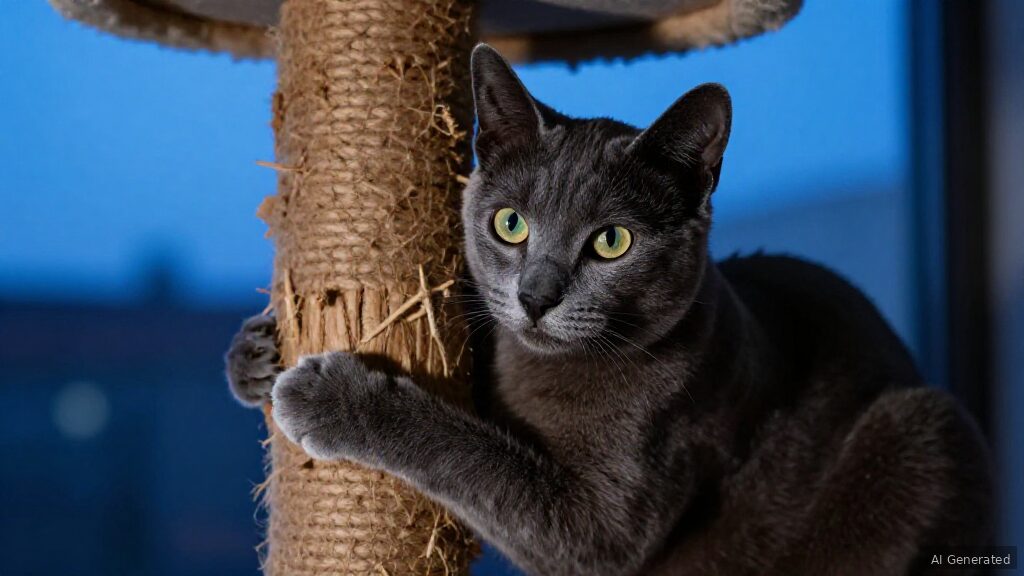
The structural stability of solid wood furniture is the most important factor to ensure the cat’s safety. Cats have the ability to jump more than double their weight and maintain surprising balance when jumping from high places. Therefore, wood furniture must be firmly fixed to the floor, and structures with thin legs or unbalanced ones should be prohibited. The owner should test if the furniture shakes or falls when the cat climbs on it. In addition, it is recommended to check if the structure is not damaged when the cat scratches with its claws. If the owner opts to provide wall mounting devices for the solid wood furniture, this is the best way to satisfy the cat’s desire for high movement while ensuring the safety of the furniture. Furniture without structural stability not only threatens the cat’s safety but can also cause psychological anxiety in the owner.
Space usage and positioning strategy: the importance of vertical space
In modern apartments or houses, space is limited, making it difficult to provide sufficient vertical space for cats. However, cats basically prefer high places and observe the surroundings and defend their territory from above. When positioning PlayCat solid wood furniture, it is better to install them on the wall or place them in corners to ensure the cat’s view, rather than leaving them just in the center of the room. This helps the cat recognize the entire house as its territory and move safely. In addition, the height between the levels of the wood furniture should be an appropriate interval for the cat to climb naturally. Spaces between shelves that are too narrow prevent the cat from climbing, while spaces that are too wide can be dangerous for the owner. It is efficient to position the wood furniture in locations where the owner can easily observe, considering the cat’s body structure and movement patterns.
Cost-benefit relationship: preventive investment and long-term vision
Many owners hesitate to buy solid wood furniture due to the high price. However, this is a view limited to short-term cost comparison. Investing in appropriate solid wood furniture for the cat, reducing stress, preventing obesity, and avoiding destructive behaviors, is a way to save the owner’s time and financial costs in the long term. For example, if the cat exercises enough through the wood furniture, the owner can buy toys less frequently and reduce necessary visits to the veterinarian for treatment. From the perspective of ‘behavioral economics’, this means that the preventive cost is a much more efficient choice than the treatment cost. In addition, wood furniture are not consumable items that break or wear out easily like toys; they are investments that can be used for a long time along with the cat’s growth. Therefore, the owner should perceive wood furniture not as simple toys, but as essential equipment to protect the cat’s health.
In-depth information on environmental enrichment and common mistakes owners make
Easy concepts to confuse: adding toys vs. designing the environment
Many owners confuse environmental enrichment with ‘buying many toys’. However, simply accumulating many toys can have the opposite effect. Since cats have difficulty deciding which toy to choose when there are many options (‘choice paradox’), they often do not play with anything. In addition, for cats that react sensitively to small changes, adding a single new toy can cause stress. Therefore, environmental enrichment should focus more on ‘environment design’. In other words, it is important to provide a structure (levels, holes, wood furniture ramps, etc.) where the cat can alter and explore the environment on its own. It is more effective to create an environment where the cat can choose ‘how to play’ than just providing toys.
Cat fatigue management and hyperactivity risks
If environmental enrichment is excessive, the cat can get tired. Unlike humans, cats have different activity patterns between day and night, and rest time is very important. If the owner plays with toys or shakes the wood furniture all day, the cat can get stressed and react defensively. Especially in the case of senior or adult cats, lack of energy can make them not react to toys, which can lead the owner to mistakenly think that ‘the cat doesn’t like it’. Therefore, it is important that the owner constantly observes the cat’s state and provides appropriate stimuli without exceeding its limits. In addition, it is necessary to check if the cat is suffering stress from being overly attached to toys or wood furniture. Healthy environmental enrichment is that which makes the cat feel ‘happy and comfortable’.
Owner participation: strengthening the bond with the cat
The most important factor in environmental enrichment is owner participation. Installing wood furniture or toys is the owner’s function, and it is crucial to help the cat use them naturally. Interactions like playing with the cat climbing up and down the wood furniture or playing with toys provide great satisfaction to the feline. This goes beyond just entertaining the cat; it is a process of strengthening the bond between owner and cat and increasing mutual trust. In addition, observing the cat’s behavior and understanding what it likes or dislikes is the core of environmental enrichment. If the owner does not participate actively, the wood furniture and toys will just be abandoned in the corners of the house, without generating the effects of environmental enrichment.
Environmental enrichment checklist you can implement today
1. Analysis and recording of the cat’s current environment
Estimated time: 15 minutes
Items needed: Notepad, camera
Expected effect: Understanding of the cat’s behavioral patterns and identification of the cause of problematic behaviors
Observe and record for an hour where the cat stays all day, what it does, and which toys it uses. Identify the cat’s favorite position and toy and discover what the owner is ignoring. This record will be the most important basis for positioning wood furniture or choosing toys in the future. In addition, record changes in the cat’s behavior (e.g., crying at night, increased aggression) to understand which environmental factors are causing stress.
2. Optimization of wood furniture arrangement and safety check
Estimated time: 30 minutes
Items needed: Wood furniture, mounting devices (optional)
Expected effect: Guarantee of safe vertical space and increase in cat movement ease
Explore every corner of the house and check the wood furniture or other vertical spaces (shelves, windows) the cat currently uses. Check if the furniture is stable and if the cat can climb easily, fixing it to the wall or adjusting the shelf height if necessary. In addition, check if there are enough holes or hiding spots for the cat to hide safely. Install protection devices on the wood furniture shelves that can be scratched by the cat’s claws, increasing the furniture’s lifespan and the cat’s satisfaction.
3. Toy rotation and ensuring diversity
Estimated time: 20 minutes
Items needed: Existing toys, new toys
Expected effect: Maintaining the cat’s interest and providing new stimuli
Gather all the house’s toys in one place. Cats tend to lose interest in familiar toys. Therefore, the owner should swap toys once a week, making the cat feel like it’s discovering a new toy. In addition, prepare toys of various shapes that can be used with wood furniture (hunting simulation, string toys, etc.) to stimulate the cat’s various instincts. In particular, choose toys the cat does not use well and spend time playing with them together with the owner.
4. Improvement of the feeding environment and food distribution strategy
Estimated time: 10 minutes
Items needed: Wood furniture ramps, food bowls
Expected effect: Increasing the cat’s interest in feeding and preventing obesity
When the cat is eating, distribute the food on the ramps or high positions of the wood furniture. This makes the cat feel that the ‘meal’ is a special event and stimulates its hunting instinct. In addition, divide the food bowl into several smaller bowls and distribute them at different levels of the wood furniture so the cat can enjoy the process of searching for food. This helps control the cat’s appetite and prevent obesity. It is important that the owner establishes meal times for the cat and creates a feeding environment using the wood furniture.
5. Encouraging daytime activities and energy expenditure
Estimated time: 15 minutes
Items needed: Toys, wood furniture
Expected effect: Reduction of nighttime crying and destructive behaviors
Before leaving for work or during the day, make the cat play enough using the wood furniture. Prepare toys that require the cat to climb up and down the high levels of the wood furniture to expend its energy. In particular, spend time playing with the cat; this can significantly reduce the feline’s stress. Even when the owner is not at home during the day, place and hide toys so the cat can play alone using the wood furniture. This helps the cat move in a safe environment even when the owner is not present.
6. Observation of the cat’s behavior and feedback
Estimated time: 5 minutes per day
Items needed: Notepad, camera
Expected effect: Monitoring of behavioral changes and strategy adjustment
Observe the cat’s behavior daily and record how effective the wood furniture and toys are. Check if the cat uses the wood furniture frequently, reacts to the toys, and if nighttime crying or destructive behaviors have reduced. If a specific toy or furniture is not working, the owner must adjust the strategy immediately. It is important to continuously improve environmental enrichment methods considering the cat’s state and preferences.
Frequently Asked Questions (FAQ)
My cat doesn’t like wood furniture. What should I do?
If the cat doesn’t like the wood furniture, the owner should check again the cat’s personality and current environment. It may be that the cat is afraid of high places or doesn’t like certain odors. Try lowering the height of the wood furniture or leaving the owner’s clothes leaning against the holes so the cat’s scent can infiltrate. In addition, spend time playing with the cat together with the wood furniture and provide positive experiences. It is important to wait until the cat naturally accepts the wood furniture.
What are the most important points to consider when buying solid wood furniture?
The most important point when buying solid wood furniture is ‘safety’ and ‘stability’. It is essential to check the wood safety (presence of toxins), the finish, and the structural stability of the furniture (prevention of falls). In addition, it is important to choose considering the height and spacing between shelves appropriate to the cat’s personality and body structure. The owner should perceive wood furniture not just as a purchase, but as essential equipment to protect the cat’s health and safety.
Are there additional costs for environmental enrichment?
Additional costs for environmental enrichment are not very high. Simply buying wood furniture can already bring sufficient effects, and toys can be easily made at home or using recycled materials. In addition, environmental enrichment reduces the cat’s stress and prevents diseases, saving costs for the owner in the long term. Therefore, the owner should perceive environmental enrichment not as a cost, but as an investment to protect the cat’s health.
Should environmental enrichment methods be different for senior cats (over 7 years)?
In the case of senior cats, as physical activity decreases and joints weaken, it is more important to provide wood furniture that offers safety and comfort than active toys. Since senior cats may have difficulty climbing up and down high places, it is recommended to choose wood furniture with many flat surfaces at intermediate heights or structures that the owner can climb easily. In addition, since senior cats are sensitive to stress, it is better to provide wood furniture with many hiding spots and introduce new toys slowly.
Can environmental enrichment cause stress to the cat?
If environmental enrichment is not performed correctly, the cat can suffer stress. For example, if many unknown toys are given suddenly or if the wood furniture is positioned too high. Therefore, it is important that the owner constantly observes the cat’s state and creates a comfortable and pleasant environment. The focus is on the owner participating actively, understanding the cat’s behavior, and providing appropriate stimuli.
Conclusion: The first step for a happy day by the cat’s side
The environmental enrichment strategies and solid wood furniture selection methods presented in this article are essential elements to protect the cat’s healthy life and strengthen the bond between owner and feline. Satisfying the cat’s instincts and creating a suitable environment through wood furniture is not just a luxury or preference, but a very rational choice from the perspective of preventive medicine. From today, the owner should observe the cat’s behavior, position wood furniture, and use toys to create a happy life for the feline. Time spent with the cat will become a more special and meaningful day.
PlayCat (Playcat) solid wood furniture is optimized to respect the cat’s instincts and provide a safe environment. Check more information on environmental enrichment for cats at PlayCat (playcat.xyz).
This content was written using AI technology. Consult a veterinarian for health-related information.