


Why Cats Obsess Over Wooden Furniture and the Correct Environmental Enrichment Guide
The behavior of cats repeatedly climbing, hiding, and scratching on wooden structures goes beyond mere play; it signifies the fulfillment of essential instinctual needs. This article, based on feline behavioral characteristics and the importance of wooden furniture, provides specific methods for pet owners to communicate better with their cats and practice healthy environmental enrichment (Environmental Enrichment). Through this text, we will deeply analyze age-specific traits, gender differences, and the practical problems solved by wooden furniture (such as reduced aggression, litter box issues, etc.) with scientific evidence, and learn how to implement optimal space configurations using PlayCat(플레이캣) products. Please read this article to the end to prepare practical solutions that help your cat spend comfortable and happy moments on wooden furniture right now.
Psychological and Biological Reasons Why Cats Prefer Wooden Structures
Inheritance of Ancient Wild Cat Instincts and Predator Behavior
A cat’s behavior of climbing or hiding in trees is based on instincts formed over millions of years of evolution. Past wild cats had the habit of climbing to high places to escape predators or climbing trees to observe prey while hunting. These behaviors are naturally reproduced in modern domestic cats when they are stressed or feel threatened. By gaining a visual advantage from a high vantage point, cats gain psychological stability; this is the result of applying wild survival strategies directly to modern living environments.
Specifically, it is known that cats maintain significantly lower levels of the stress hormone cortisol in environments with vertical structures. According to research, when resting spaces at appropriate heights are provided, cats feel a sense of control over their surroundings, which is a key factor in preventing aggression or hyperactivity. Therefore, wooden furniture is not just a toy, but serves as an essential safe haven for a cat’s psychological stability.
Regulation of Arousal Levels and Natural Energy Expenditure
Cats spend a significant portion of the day sleeping and are animals that must constantly regulate their arousal levels (Arousal Level). During the day, they maintain high arousal to prepare for hunting instincts, and at night, they rest and recover energy. Structures like wooden furniture serve as important mediators that help cats regulate their activity levels according to this arousal cycle. Especially for adult or senior cats, they can choose positions suitable for their state to rest or play using wooden structures when their energy is depleted or, conversely, when they are overly active.
Such behavior goes beyond simple play and is directly linked to a cat’s physical health. Activity on vertical structures is beneficial for musculoskeletal health; especially for senior cats, it supplements exercise while reducing joint strain. Additionally, wooden furniture provides wide flat surfaces and various heights that support a cat’s weight, allowing them to shift their center of gravity and use various muscle groups. This helps prevent muscle weakness caused by indoor living and contributes to maintaining overall body composition.
Individual Preference Differences and Analysis of Gender/Age Characteristics
Not all cats utilize wooden furniture in the same way. The shape and height of preferred structures vary significantly depending on the individual cat’s personality, gender, and age. For example, active cats with strong hunting instincts tend to prefer scratcher-type or tower-type structures that allow them to climb quickly to high places. On the other hand, shy or cautious cats tend to avoid climbing high and show an approach of gradually increasing height from flat structures close to the ground.
Differences based on gender are also distinct. Male cats have a strong instinct to mark and defend a wide territory, so they frequently attempt to expand their territory through wide platforms and complex structures with multiple levels. In contrast, female cats value hiding spots more and often prefer structures with narrow, dark spaces or cubby holes. Additionally, kittens (infants) prefer structures with low heights and gentle slopes, while senior cats, finding it difficult to climb high, prefer structures combining mid-height resting spaces with soft materials.
Choosing furniture without considering these differences may fail to meet the cat’s usage needs, ultimately causing them to ignore the furniture and instead scratch the owner’s shoes or other furniture. Therefore, it is important to accurately identify the individual characteristics of the cat and select wooden furniture with appropriate heights, shapes, and materials. For example, aggressive cats need structures where they can climb up and look down, which is also effective in reducing conflicts with other animals in the home.
Practical Feline Behavioral Problems Solved by Wooden Furniture
Providing the Correct Alternative for Scratching Behavior
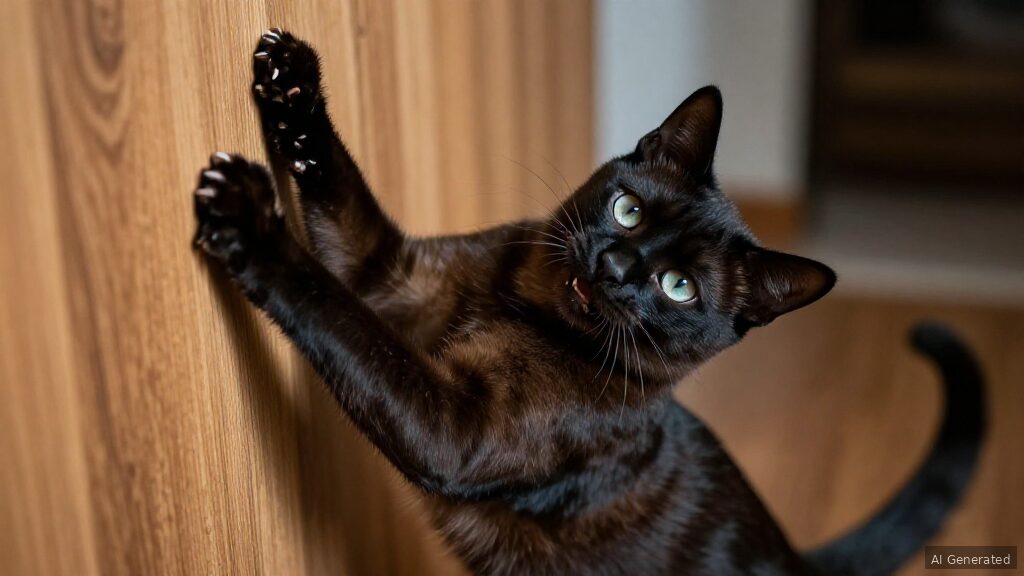
A cat’s behavior of scratching furniture or walls is not simply an intention to destroy furniture, but an essential physiological requirement to sharpen and maintain claws. Additionally, it has psychological functions such as marking territory by leaving scents and relieving stress through scratching. If appropriate alternatives (such as wooden scratchers) are not provided at home, the likelihood of the cat destroying the owner’s belongings or furniture becomes very high.
PlayCat’s wooden scratchers help manage claws more effectively than artificial materials (such as faux leather) by providing friction when natural wood fibers are used to sharpen claws. Natural wood provides strong friction while not irritating the cat’s paw pads, regulating the claw’s life cycle. This prevents claws from becoming too long while simultaneously preventing them from becoming too short, maintaining claw health. Additionally, it is important to install wooden furniture in various locations in the home so the cat can access it immediately when they want to scratch.
Practically, to effectively utilize wooden furniture, it is necessary to place a new wooden scratcher at the location where the cat previously scratched (e.g., next to the sofa). Since cats have a tendency to scratch at specific locations habitually, presenting a new alternative at that location is required. Additionally, when first installing new furniture, it is good to lightly scratch the cat’s claws to leave a scent and spray favorite cat pheromone sprays there to help the cat recognize the furniture as ‘their territory’.
Impact on Reducing Aggression and Mating Behavior
Conflicts within the home between other cats and humans are primarily derived from resource competition and the desire to mark territory. If a space where cats can look down from a high place (tower or upper part of wooden furniture) is secured, they can effectively monitor and defend their territory. This plays an important role, especially in multi-cat households or homes where cats and dogs live together.
The visual advantage (Visual Advantage) provided by wooden furniture gives cats psychological stability, contributing to reducing aggressive behavior. When looking down from a high place, cats feel that they can protect their bodies better, which relieves stress. According to research, providing appropriate vertical structures has the effect of significantly lowering aggression indicators in cats. In particular, territory defense behavior appearing in adult or male cats is likely to be replaced by the behavior of climbing high and looking down at the opponent.
In relation to mating behavior (Mating Behavior), the upper levels of wooden furniture provide the space needed for cats to find mates or perform mating behaviors. Especially male cats are active in various spaces to defend their territory and attract mates during the mating period. Wooden furniture creates an environment where cats can naturally express mating behaviors by providing wide platforms and various heights where such behaviors can occur. This reduces stress for cats and satisfies healthy breeding instincts.
Improvement of Urine Problems and Elimination Habits
A cat’s urine problem can be derived from one of stress, disease, or environmental factors. Especially if the litter box is too narrow or the structure does not allow climbing to a high place, the cat may avoid the litter box. Wooden furniture provides cats with resting spaces of various heights, allowing them to gain stability from a high place before approaching the litter box.
Additionally, the wide platform of wooden furniture provides a space where cats can lie down comfortably. Cats need time to balance their bodies and observe the surrounding environment before urinating. Wooden furniture with sufficient height and wide flat surfaces supports these pre-urination behaviors, helping to prevent urine problems. Especially for senior cats or cats with deformities, it is important to consider structures connecting mid-height platforms with the litter box, as climbing to high places may be difficult.
Actually, numerous feline behavioral studies have reported that providing appropriate vertical structures lowers the incidence of urine problems in cats. This is because providing sufficient space and height helps cats effectively manage their territory and prevents them from fearing the litter box. Therefore, when installing wooden furniture, it is good to consider and arrange it with connectivity or accessibility to the litter box.
Space Design from the Perspective of Feline Ethology and Animal Welfare
Recreation of Ancient Cat Habitats and Environmental Enrichment
‘Environmental Enrichment (Environmental Enrichment)’ emphasized in ethology (Ethology) is essential for encouraging a cat’s natural behavior and reducing stress. This goes beyond simply providing toys; it means creating a space where the cat can explore, hunt, and rest on its own. Wooden furniture is a core element of this environmental enrichment, helping cats perform natural behaviors within the limited space of the home.
In the habitat (Wild Habitat) of ancient cats, trees played a very important role. Cats climbed trees to hunt for food, escape predators, and rest. Wooden furniture recreates this natural habitat, allowing cats to satisfy their instincts even in the artificial environment of the home. This plays a decisive role in maintaining a cat’s psychological health and preventing behavioral problems.
Specifically, wooden furniture provides various ‘challenges (Challenges)’ for cats. In the process of climbing trees, cats use their stamina, explore various heights, and find hiding spaces. This process stimulates a cat’s cognitive ability (Cognitive Ability) and has the effect of reducing stress. Additionally, wooden furniture serves as a ‘safe zone (Safe Zone)’ that helps cats effectively manage their territory.
Animal Welfare Approach: Comfort, Safety, and Control
From the perspective of animal welfare (Animal Welfare), a cat’s happiness depends on comfort (Comfort), security (Security), and control (Control). Wooden furniture is an ideal structure that can satisfy all three of these elements.
First, comfort is achieved by providing appropriate high and wide resting spaces for cats. The soft wood surface of wooden furniture provides stability that can support the body without irritating the cat’s paw pads. Second, security is secured by providing spaces where cats can climb high to hide or avoid conflicts with other cats. Third, control is secured by providing cats with the opportunity to choose their activity range and height on their own.
These elements contribute to enhancing a cat’s psychological well-being and preventing behavioral problems. Especially in multi-cat households or homes where cats live together, wooden furniture plays an important role in reducing conflicts between cats and satisfying each cat’s individual needs. Therefore, when selecting wooden furniture, it is good to consider these animal welfare principles and select a structure that matches the individual characteristics and needs of the cat.
Application of Behavioral Principles: Habit Formation and Behavior Modification
When modifying a cat’s behavior or inducing new behaviors, it is important to apply behavioral principles (Behavioral Principles). This is achieved through ‘reinforcement (Reinforcement)’ and ‘association (Association)’. To effectively utilize wooden furniture, positive experiences must be provided when the cat uses the wooden furniture.
For example, it is good to provide positive reinforcement (Positive Reinforcement) through treats or praise when the cat climbs the wooden furniture. This forms an association for the cat that ‘this structure is good’. Additionally, it is important to remove elements that can cause stress when the cat uses the wooden furniture (e.g., other cats, noise, etc.) and maintain only a positive environment.
On the other hand, for cats that do not use wooden furniture, forcing them up or punishing them can have the opposite effect. Instead, it is good to provide the cat with sufficient time and space to use the wooden furniture and gradually induce the cat to explore the structure on its own. This respects the cat’s voluntary behavior (Voluntary Behavior) and is essential for forming the habit of using wooden furniture in the long term.
Specific Environmental Enrichment Practices for Cat Owners
Home Space Analysis and Wooden Furniture Placement Strategy
To effectively utilize wooden furniture, a space analysis of the home is required first. After identifying the locations the cat prefers, such as where the cat mainly moves, the litter box location, and near windows, the wooden furniture should be placed in those locations. Especially, the space where the cat can use the wooden furniture can become a ‘safe zone’ for the cat, so it is good to place it in a quiet and undisturbed place.
Additionally, the height of the wooden furniture should be at a level easy for the cat to access. If the cat finds it difficult to climb high, they are likely to stop using that structure. Therefore, it is good to design the first floor of the wooden furniture to be close to the floor and gradually climb to higher levels. Additionally, the structure of the wooden furniture should provide various heights for the cat, helping them choose a height suitable for their state.
Specific placement tips include placing the wooden furniture near a window so the cat can observe the outside. This provides visual enrichment (Visual Enrichment) for the cat, helping to reduce stress. Additionally, the location of the wooden furniture should be placed along a pathway (Pathway) easy for the cat to access, paying attention not to be obstructed by other furniture or barriers.
Usage Methods by Type of Wooden Furniture and Selection Matching Cat Characteristics
Wooden furniture provides various functions depending on the type. Tower-type (Tower) induces climbing to high places, scratcher-type (Scratcher) helps with claw management and territory marking, platform-type (Platform) provides wide resting spaces, and cubby hole (Cubby Hole) provides space to hide. These wooden furniture types should be combined and used according to the cat’s personality and age.
Cats with an active tendency prefer structures combining tower-type and scratcher-type, while shy cats prefer structures with cubby holes. Additionally, for senior cats, it is good to select structures combining mid-height platforms with soft materials, as climbing to high places may be difficult. Especially, in multi-cat households, it is good to provide wooden furniture with different heights and shapes for each cat.
Specific selection tips include selecting wooden furniture that can replace structures the cat previously preferred (e.g., desks, sofas, etc.). This allows the cat to maintain a familiar environment while providing a better structure. Additionally, the material of the wooden furniture should be made of natural wood fibers, and artificial materials should be avoided.
Inducing and Habituating Wooden Furniture Use with Simple Home Training
To induce a cat to voluntarily use wooden furniture, ‘home training (Home Training)’ is required. This is a process of helping the cat recognize the wooden furniture as their territory and use it on their own. First, place the wooden furniture in a location easy for the cat to access and lure the cat to that structure with treats or play.
The specific step-by-step method is as follows.
- Step 1: Luring and Exploration Induction – Call the cat’s name or place treats inside or on the structure to lure the cat to explore the wooden furniture, inducing climbing or hiding behaviors.
- Step 2: Positive Reinforcement – Provide praise and treats every time the cat uses the structure to connect the structure with a positive experience. At this time, do not force them up, but reward only when the cat moves voluntarily.
- Step 3: Increasing Usage Frequency – Gradually increase the height or complexity of the structure over time, providing more challenges for the cat. This increases the cat’s adaptability and induces them to use the structure more frequently.
- Step 4: Routine – Make the wooden furniture part of the home so the cat can use it naturally whenever needed. At this time, avoid competition with other furniture and maintain the wooden furniture as the most attractive option.
Through this process, the cat comes to recognize the wooden furniture as their safe haven, which greatly helps in preventing behavioral problems and psychological stability.
Advanced Information and Precautions for Cat Owners
Common Mistakes at Home and Correct Solutions
Many cat owners purchase wooden furniture, but many cats do not use it. This is mostly because the cat’s characteristics were not considered. For example, common mistakes include placing structures that are too high, narrow spaces, or in locations difficult for the cat to access. Additionally, there are cases where cats cannot use the wooden furniture due to competition with other cats.
To solve these problems, first, you must provide the cat with sufficient time and space to use the wooden furniture. Additionally, to avoid competition with other cats, it is good to provide individual wooden furniture or spaces for each cat. Especially, in multi-cat households, it is important to place the wooden furniture in locations easy for each cat to access.
Additionally, you must check if the material and structure of the wooden furniture are safe and comfortable for the cat. If the wood surface is too rough or the structure is unstable, the cat may not use it. Therefore, when selecting wooden furniture, it is good to choose products with soft materials that do not irritate the cat’s paw pads and stable structures.
Management Points and Customized Solutions by Cat Age (Kitten/Adult/Senior)
The utilization and management points of wooden furniture differ depending on the cat’s age. Kittens (infants) prefer structures with low heights and gentle slopes, adults prefer high places and complex structures, and senior cats prefer structures combining mid-height platforms with soft materials, as climbing to high places may be difficult.
In the case of kittens, the structure of the wooden furniture should be safe and sturdy, and it is good to design it so the cat can climb up on its own. Additionally, kittens have strong hunting instincts, so it is good to have spaces to play on the structure (e.g., holes to hide). In the case of adults, the height of the structure should be high and provide various heights, and especially for aggressive cats, structures where they can climb up and look down are necessary.
In the case of senior cats, it is good for the structure not to be too high and to have many mid-height platforms. Additionally, it is important for the surface of the structure to be soft and not irritate the paw pads. Especially, considering the joint health of senior cats, it is good to design the structure to support the cat’s weight.
Utilization of Wooden Furniture and Competition Prevention Strategies in Multi-Cat Households
In multi-cat households, wooden furniture plays an important role in reducing conflicts between cats. To avoid competition between cats, separate wooden furniture or spaces should be provided for each cat. Especially, in the case of male cats, the desire to mark territory is strong, so they prefer complex structures with wide platforms and multiple levels.
In multi-cat households, it is important to place the wooden furniture in locations easy for each cat to access. Additionally, the structure of the wooden furniture should provide appropriate heights and shapes for each cat and be designed to avoid competition with other cats. Especially, shy cats may avoid climbing to high places, so structures with mid-height platforms and hiding spaces are necessary.
Additionally, to reduce conflicts between cats using wooden furniture, it is good to provide individual wooden furniture or spaces for each cat. This avoids competition between cats and helps increase each cat’s psychological stability. Especially, in multi-cat households, it is important to place the wooden furniture in locations easy for each cat to access.
Behavioral Enrichment Checklist You Can Practice Right Now
Specific Behavioral Checklist: Connecting Cats with Wooden Furniture
We have summarized specific environmental enrichment methods that can be practiced immediately starting today. Follow this checklist to increase your cat’s happiness all day long.
- 1. Re-adjusting Wooden Furniture Location (Time Required: 10 minutes) – Check if the current location of the wooden furniture is difficult for the cat to access. Place it near where the cat mainly moves or near windows to provide visual enrichment. Effect: Reduced cat stress and satisfaction of observation desire
- 2. Structure Utilization Analysis (Time Required: 5 minutes) – Observe which level of the wooden furniture the cat prefers most. Place treats or play on the level the cat frequently climbs to increase the usage frequency of that level. Effect: Increased usage frequency of wooden furniture and strengthened bond with the cat
- 3. Claw Management and Scratcher Utilization (Time Required: 5 minutes) – Lightly scratch the cat’s claws on the wooden scratcher to leave a scent and spray the cat’s pheromone spray there. Effect: Inducing use by making the cat recognize the wooden furniture as ‘their territory’
- 4. Expanding Play Time (Time Required: 15 minutes) – Put treats for the cat on the high level of the wooden furniture and have play time. Praise and reward the cat for climbing the structure. Effect: Recognizing the wooden furniture as a fun playground to form usage habits
- 5. Adding Environmental Enrichment Elements (Time Required: 10 minutes) – Add holes or flat platforms where the cat can hide to the wooden furniture. Induce the cat to explore and hide in the structure. Effect: Increased psychological stability of the cat and satisfaction of exploration desire
- 6. Preventing Competition in Multi-Cat Households (Time Required: 5 minutes) – In multi-cat households, provide separate wooden furniture or spaces for each cat. Especially, for shy cats, provide structures with mid-height platforms and hiding spaces. Effect: Reduced competition between cats and secured psychological stability for each cat
- 7. Joint Protection for Senior Cats (Time Required: 10 minutes) – In the case of senior cats, select structures where the height of the wooden furniture is not too high and there are many mid-height platforms. Additionally, it is important for the surface of the structure to be soft and not irritate the paw pads. Effect: Protection of joint health and improved mobility for senior cats
Feline Environmental Enrichment and Wooden Furniture Utilization FAQ
Q1. What if the cat never uses the wooden furniture?
If the cat never uses the wooden furniture, this may be a signal that the cat’s characteristics were not considered or the structure’s location is inappropriate. First, relocate the wooden furniture to a location easy for the cat to access (e.g., near windows, where the cat mainly moves). Additionally, check if the height or shape of the structure matches the cat’s tendency and replace it with a structure with the height and shape the cat prefers. For example, shy cats may avoid climbing to high places, so it is good to provide structures with mid-height platforms and hiding spaces.
Additionally, the cat may not use the wooden furniture because they do not recognize it as their territory. In this case, you must induce the cat to leave their scent on the wooden furniture. For example, there are methods such as placing the cat’s favorite treats inside or on the structure or lightly scratching the cat’s claws to leave a scent. This forms an association for the cat that the wooden furniture is ‘their territory’, potentially increasing usage frequency.
Finally, you must check if the structure of the wooden furniture is safe and comfortable. If the wood surface is too rough or the structure is unstable, the cat may not use it. Therefore, when selecting wooden furniture, it is good to choose products with soft materials that do not irritate the cat’s paw pads and stable structures. Induce the cat to voluntarily use the wooden furniture through these measures.
Q2. How should wooden furniture be placed in a multi-cat household?
In multi-cat households, wooden furniture plays an important role in reducing conflicts between cats. To avoid competition between cats, separate wooden furniture or spaces should be provided for each cat. Especially, in the case of male cats, the desire to mark territory is strong, so they prefer complex structures with wide platforms and multiple levels. On the other hand, female cats often prefer structures with narrow, dark spaces or cubby holes, as they value hiding spots more.
In multi-cat households, it is important to place the wooden furniture in locations easy for each cat to access. Especially, shy cats may avoid climbing to high places, so structures with mid-height platforms and hiding spaces are necessary. Additionally, to reduce conflicts between cats using wooden furniture, it is good to provide individual wooden furniture or spaces for each cat. This avoids competition between cats and helps increase each cat’s psychological stability.
Specifically, it is important to place the wooden furniture in locations easy for each cat to access. Additionally, the structure of the wooden furniture should provide appropriate heights and shapes for each cat and be designed to avoid competition with other cats. Especially, in multi-cat households, it is important to place the wooden furniture in locations easy for each cat to access.
Q3. Can wooden furniture reduce a cat’s aggression?
Wooden furniture provides cats with space to climb up and look down, securing visual advantage (Visual Advantage). This gives cats psychological stability, contributing to reducing aggressive behavior. When looking down from a high place, cats feel that they can protect their bodies better, which relieves stress.
According to research, providing appropriate vertical structures has the effect of significantly lowering aggression indicators in cats. In particular, territory defense behavior appearing in adult or male cats is likely to be replaced by the behavior of climbing high and looking down at the opponent. Additionally, the wide platform of wooden furniture provides a space where cats can lie down comfortably, which gives cats psychological stability.
Therefore, when installing wooden furniture, it is good to consider a structure where the cat can climb up and look down. Especially, in multi-cat households or homes where cats live together, wooden furniture plays an important role in reducing conflicts between cats and satisfying each cat’s individual needs. Through these measures, you can reduce a cat’s aggression and maintain harmony in the home.
Q4. How should the material and structure of wooden furniture be selected?
The material of wooden furniture should be made of natural wood fibers, and artificial materials (such as faux leather) should be avoided. Natural wood regulates the claw’s life cycle by providing strong friction without irritating the cat’s paw pads. Additionally, the structure of wooden furniture should provide various heights for the cat, helping them choose a height suitable for their state.
Especially, in the case of senior cats or cats with deformities, it is good for the structure not to be too high and to prefer structures combining mid-height platforms with soft materials. Additionally, it is important for the surface of the structure to be soft and not irritate the paw pads. Especially, considering the joint health of senior cats, it is good to design the structure to support the cat’s weight.
Specifically, when selecting wooden furniture, it is good to choose products with soft materials that do not irritate the cat’s paw pads and stable structures. Additionally, you must check if the structure of the wooden furniture is safe and comfortable, and it is good to praise and reward the cat for climbing the structure. Induce the cat to voluntarily use the wooden furniture through these measures.
Q5. What should be noted when using wooden furniture?
When using wooden furniture, the points to note are the safety of the structure and the cat’s psychological stability. You must check if the structure of the wooden furniture is safe and stable, and pay attention not to collapse when the cat climbs the structure. Additionally, check if the material of the wooden furniture irritates the cat’s paw pads and select soft materials.
Additionally, to reduce conflicts between cats using wooden furniture, it is good to provide individual wooden furniture or spaces for each cat. This avoids competition between cats and helps increase each cat’s psychological stability. Especially, in multi-cat households, it is important to place the wooden furniture in locations easy for each cat to access.
Finally, relocate the wooden furniture to a location easy for the cat to access (e.g., near windows, where the cat mainly moves) and check if the height or shape of the structure matches the cat’s tendency. Additionally, induce the cat to leave their scent on the wooden furniture to form an association that the wooden furniture is ‘their territory’.
Q6. How can a cat’s health be managed through wooden furniture?
Wooden furniture helps maintain musculoskeletal health by providing various heights for the cat. Especially, by climbing the structure, the cat uses stamina and various muscle groups. This helps prevent muscle weakness caused by indoor living and contributes to maintaining overall body composition.
Additionally, the wide platform of wooden furniture provides a space where cats can lie down comfortably, which gives cats psychological stability. Especially, in the case of senior cats or cats with deformities, it is good for the structure not to be too high and to prefer structures combining mid-height platforms with soft materials. Additionally, it is important for the surface of the structure to be soft and not irritate the paw pads.
Finally, wooden furniture can help prevent urine problems in cats. Wooden furniture with sufficient height and wide flat surfaces provides time for the cat to balance their body and observe the surrounding environment before urinating, helping to prevent urine problems. Therefore, when installing wooden furniture, it is good to consider and arrange it with connectivity or accessibility to the litter box.
Conclusion: A Happy Daily Life with Your Cat
The reason cats obsess over wooden furniture is to satisfy essential instinctual needs and secure a safe haven for psychological stability. Based on feline behavioral characteristics and animal welfare principles, wooden furniture creates a natural environment for cats, prevents behavioral problems, and plays a decisive role in enhancing psychological well-being. We hope you have learned how to utilize wooden furniture and specific practical methods considering age and gender characteristics of cats through this text.
Start your efforts to increase your cat’s happiness through wooden furniture from now on. Daily life with a cat goes beyond simple coexistence; it is a process of understanding and respecting each other’s instincts and characteristics. Check for more feline behavioral enrichment information at PlayCat(playcat.xyz).
This content was written using AI technology. Always consult a veterinarian regarding medical-related information.