


The First Step to Awaken Your Cat’s Instincts: What is Feeding Enrichment?
For cats living comfortably at home, the biggest concerns are ‘boredom’ and ‘lack of energy release.’ While their wild ancestors spent all day hunting or searching for food, modern house cats get their meals from bowls placed on the table. In this process, cats completely lose the opportunity to perform instinctive hunting behaviors, leading to various problems such as overeating, obesity, and stress-related diseases. The concept that emerges here is ‘Feeding Enrichment.’
Feeding enrichment is an environmental improvement strategy that goes beyond simply filling the belly; it encourages cats to perform a series of instinctive behaviors—hunting, exploring, foraging, and eating—during the process of obtaining food. This aligns with the case of Everland Safari World, which introduced devices to hide food or induce behaviors to increase the activity of big cats. From an animal welfare perspective, changing the method of food supply is a key element in simultaneously enhancing an animal’s mental and physical health.
For a cat, mealtime is not just about consuming nutrients; it is the most important ‘play’ and ‘work’ of the day. The process of thinking about how to get food, touching it with paws, and looking around stimulates the cat’s brain and provides satisfaction. If you transform your home into a hunting ground through PlayCat’s environmental improvement solutions, your cat will no longer feel bored, and you will see a healthier and more energetic companion. From now on, let’s explore in detail the specific methods to awaken your cat’s instincts through feeding enrichment.
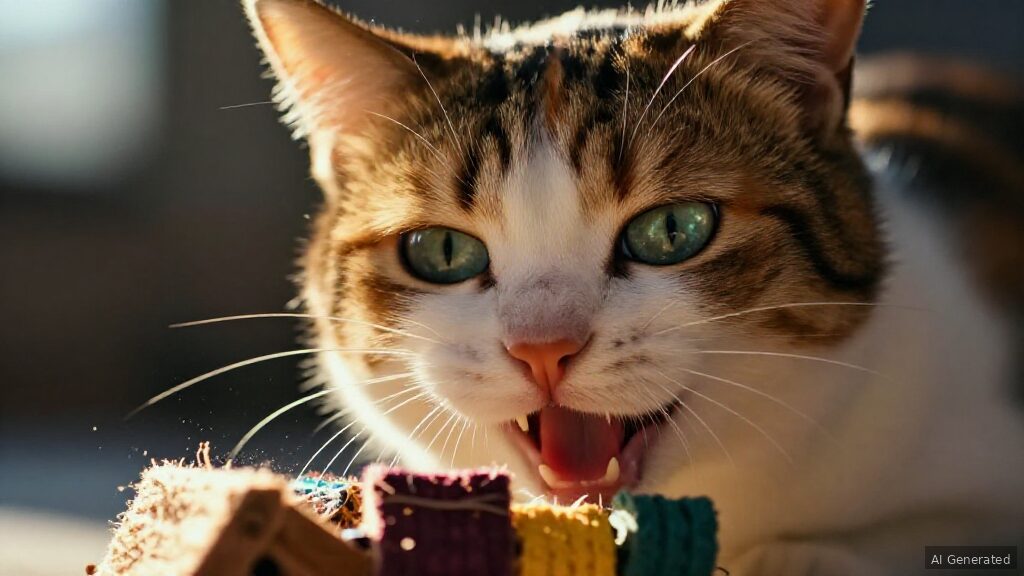
Difficulty-Based Puzzle Feeder Selection Guide: Which Tool Fits Our Home?
A puzzle feeder is a tool that encourages cats to solve problems to obtain food, making it the most representative means of feeding enrichment. However, not all puzzle feeders are suitable for every cat. You must choose a product with an appropriate difficulty level based on the cat’s intelligence, learning ability, and current condition. A product that is too easy can cause them to lose interest quickly, while one that is too difficult can cause frustration, leading them to refuse to eat altogether.
The table below summarizes the characteristics of puzzle feeders by difficulty level, recommended targets, and placement strategies using PlayCat solid wood furniture. Analyze the actions your cat needs to perform to get food at each stage to choose the optimal product.
| Difficulty | Key Features | Recommended For | Expected Effects | PlayCat Environment Setup Tips |
|---|---|---|---|---|
| Beginner (Level 1) | Simple structure involving slightly opening a lid or taking kibble out through holes. Low physical barriers. | Puzzle feeder beginners, elderly cats, senior cats with weak stamina | Stimulating interest in food, acquiring basic problem-solving skills | Place on top of low PlayCat solid wood shelters to ensure accessibility |
| Intermediate (Level 2) | Structure where food comes out only after pressing a lever or manipulating a rotating part. Requires some strategy. | General adult cats, cats already familiar with puzzle feeders | Improved cognitive ability, extended mealtime, relief from boredom | Place on intermediate steps of PlayCat solid wood ladders or stairs to include in movement paths |
| Advanced (Level 3) | Complex structure requiring composite operations or where food comes out only after passing through multiple stages. | Highly intelligent cats, obese cats with overeating habits, highly active cats | Long-term mental stimulation, increased energy expenditure, satisfaction of hunting instincts | Place on top of PlayCat solid wood furniture or in hidden spaces to gamify exploration |
| Custom (DIY) | Customizable difficulty using materials available at home. | All cats, cats needing various environmental changes | Flexible stimulation, fostering a sense of new challenges | Transform into a hide-and-seek space utilizing gaps in PlayCat solid wood furniture |
When selecting a puzzle feeder, the key point is the balance between ‘fun’ and ‘success.’ If a cat repeatedly fails at the beginning, they may lose interest, so we recommend a ‘progressive learning’ approach: start with an easy difficulty level and gradually increase it. Additionally, PlayCat’s solid wood furniture provides an environment familiar to a cat’s paw sensation and sense of smell due to its natural wood material. Placing a puzzle feeder on top of solid wood instead of plastic, or utilizing the structure of solid wood furniture as part of the puzzle, can provide a more natural and attractive hunting ground for your cat.
Especially for obese cats, it is important to extend mealtime to over 10–15 minutes using Level 2 or higher products. This prevents the stomach from stretching and promotes the secretion of satiety hormones, thereby preventing overeating. Designing a process where the cat has to work hard to get food, rather than simply placing kibble in a bowl, is the core of feeding enrichment.
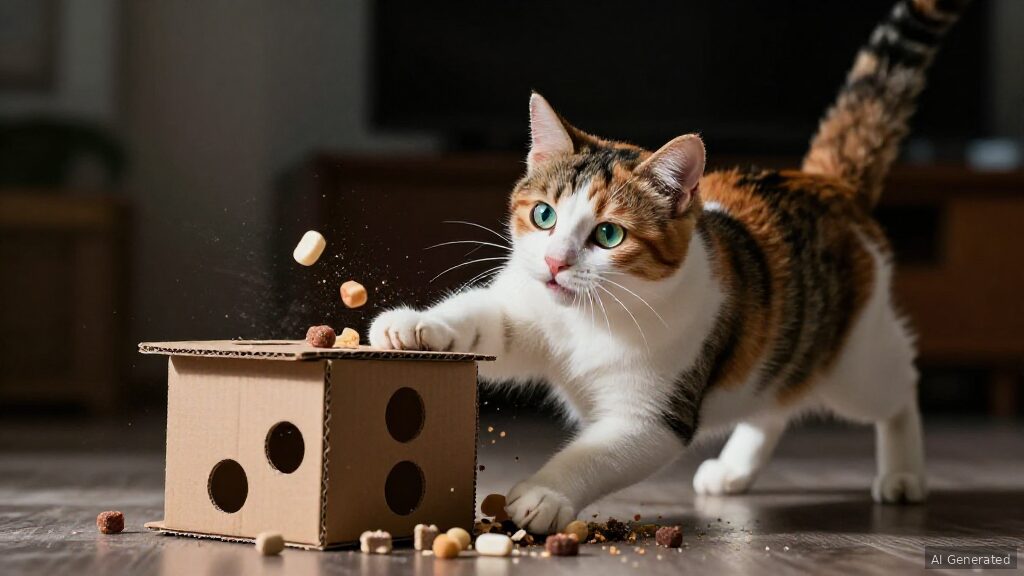
Strategy for Hiding Treats All Over the House: Transforming into a Hunting Ground
A cat’s hunting instinct is most strongly expressed during the ‘exploration’ phase of finding food. A fixed food bowl is merely a ‘food supply station’ for a cat, not a ‘hunting ground.’ Therefore, you should introduce a ‘hide-and-seek feeding’ strategy that hides treats or kibble in various spaces around the house. This mimics the behavior of exploring various terrains to find food in the wild.
Places to hide treats should be locations that stimulate the cat’s curiosity. For example, behind sofa legs, between bookshelves, inside toy boxes, or narrow gaps near windows can be good spots. The important thing here is ‘unpredictability.’ If you hide treats in the same place every day, the cat will quickly figure out the pattern and lose interest. You must change the location daily or vary the depth and method of hiding to provide new challenges.
PlayCat solid wood furniture serves as a perfect stage for this hide-and-seek game. You can slightly open the drawers of the solid wood furniture to put treats inside, or drill small holes in the gaps of the furniture to hide kibble. In particular, PlayCat’s multi-level solid wood furniture provides a multi-layered space that requires cats to jump and explore; hiding treats of different difficulty levels on each floor makes for excellent exercise and hunting training. For example, place easily accessible treats on the 1st floor, and treats requiring some jumping or climbing on the 2nd or 3rd floors.
When hiding treats, safety is paramount. Ensure the cat does not knock over furniture while looking for treats or swallow dangerous objects. Also, choose well-ventilated areas or places where the indoor temperature is properly maintained so that the hidden treats do not spoil. Especially in summer, be careful not to leave kibble or treats that are sensitive to humidity unattended for long periods.
This strategy also greatly helps improve the cat’s cognitive abilities. To find hidden food, the cat utilizes past experiences and memories and exercises spatial awareness. This process gives the cat great satisfaction and also has the effect of strengthening the bond with the owner. Exploring the location where treats are hidden together with the owner, or praising the cat when they find them, acts as positive reinforcement, making feeding enrichment activities even more enjoyable.
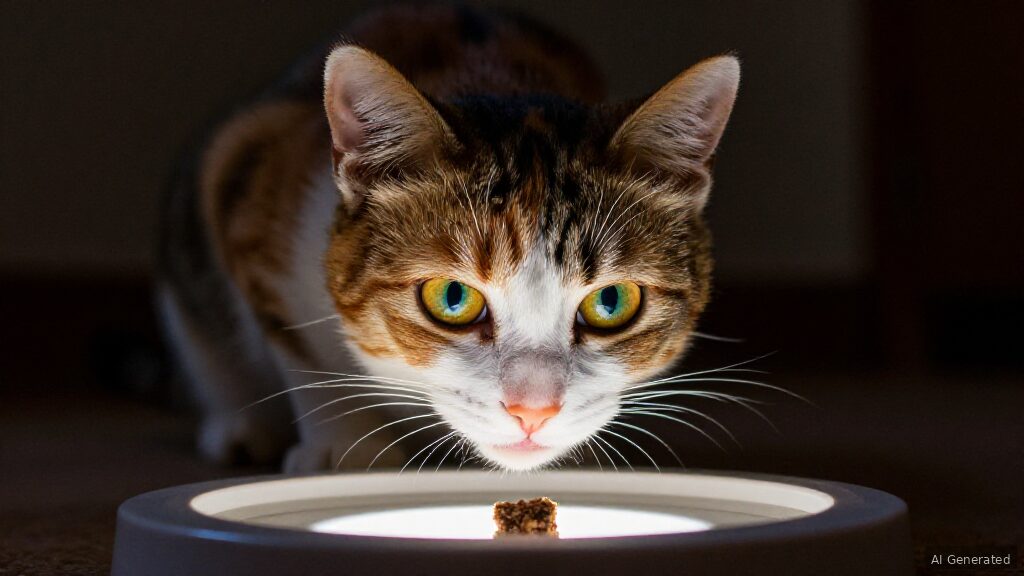
The Importance of Regulating Feeding Time: Slow Feeders and Improving Eating Habits
If a cat eats too quickly, it can lead to indigestion, vomiting, or obesity. Especially the habit of ‘binge eating’ large amounts of kibble at once not only burdens the gastrointestinal tract but also causes overeating before the feeling of fullness is reached. The most effective way to solve this is the use of a ‘Slow Feeder.’
A slow feeder is a bowl designed with a complex structure so that kibble does not come out easily, encouraging the cat to nibble or dig for food slowly rather than eating it in one bite. This extends the mealtime for the cat and secures the time for satiety signals to be transmitted to the brain. Using a slow feeder means the cat invests more effort and time to obtain food, which naturally becomes a process of satisfying their hunting instincts.
The effects of a slow feeder go beyond just extending mealtime. Studies show that cats that eat slowly have higher digestive efficiency and a significantly reduced frequency of vomiting. Additionally, as mealtime lengthens, the cat’s stress levels decrease, and the ratio of transitioning to active play after eating increases. This contributes to forming the ‘healthy lifestyle habits’ that are the ultimate goal of feeding enrichment.
When introducing a slow feeder, you must consider the cat’s adaptation period. At first, the cat may get angry or push the bowl away because the kibble doesn’t come out easily. At this time, be patient, set the difficulty of the slow feeder low, or put a little of their favorite treats inside to induce interest. Placing the slow feeder on a PlayCat solid wood table to create an environment where the cat can sit comfortably and eat is also a good method. The warm touch of the wood makes the cat’s mealtime even more stable.
Also, it is effective to combine the slow feeder with a ‘frequent but small amount’ feeding method. Instead of giving a large amount once or twice a day, provide small amounts of kibble through a slow feeder several times a day. This provides the cat with constant opportunities for hunting and consumption, stabilizes blood sugar levels, and exerts an excellent effect in preventing obesity.
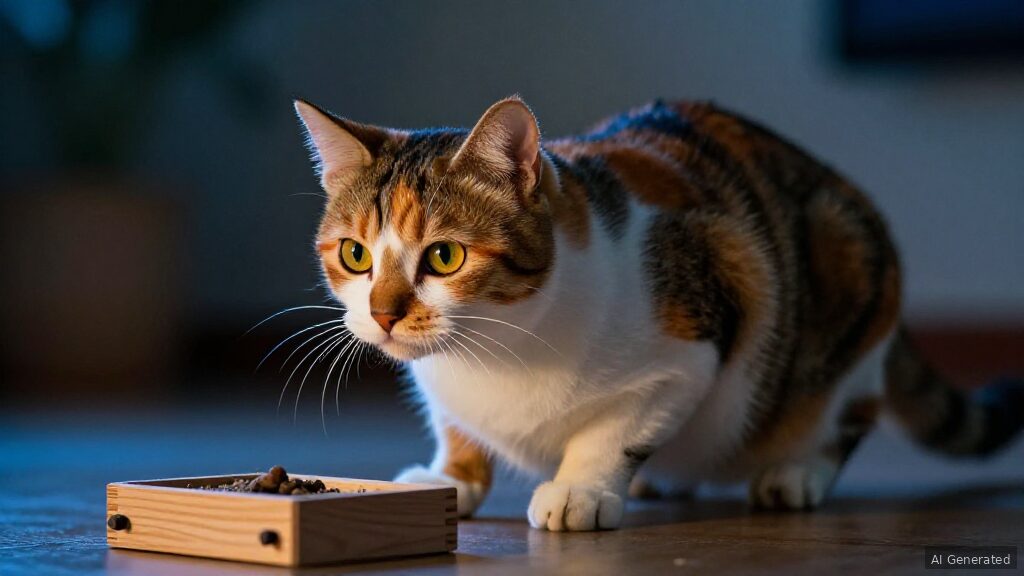
Connecting Play and Food: Creating a Natural Feeding Routine
In the wild, cats consume food after successfully hunting. That is, ‘play (hunting)’ and ‘food’ are not separate but are closely connected as a single flow of behavior. However, at home, it is common to prepare food bowls in advance or completely separate playtime and mealtime. This breaks the causal relationship between hunting and eating for the cat, preventing them from properly satisfying their hunting instincts.
To complete feeding enrichment, you must establish a ‘feed after play’ routine. Play with your cat sufficiently at a set time of the day (e.g., before dinner), and provide food immediately after the hunting play ends. At this time, it is better to use a puzzle feeder or hidden treats instead of a regular food bowl. The process of obtaining food while exhausted and excited from play perfectly recreates the cat’s instinctive hunting-consumption cycle.
Repeating this routine makes the cat realize, “I worked hard hunting (playing), so I get delicious food as a reward.” This gives positive meaning to the cat’s behavior and increases anticipation for meals. Also, feeding after play prevents the cat from releasing excess energy after mealtime, inducing a stable state until bedtime.
PlayCat solid wood furniture naturally helps connect this play and feeding. For example, you can use PlayCat’s high solid wood ladder to play jumping games with your cat, or conduct hunting games moving across the furniture, and then place a puzzle feeder on the top or intermediate steps to feed. This increases the efficiency of space utilization while providing physical and mental stimulation to the cat simultaneously.
To establish this routine, consistency is key. You must connect play and feeding in a similar way at the same time every day. At first, the cat may be confused, but with repetition, they will become familiar and show signs of requesting play and waiting for mealtime on their own. This strengthens the trust relationship between the cat and the owner and plays a major role in positively regulating the energy in the house.
Making DIY Food Puzzles: Inexpensive and Creative Methods
Commercial puzzle feeders are convenient, but they can be expensive or may not suit your cat’s preferences. At this time, ‘DIY food puzzles’ made using recycled materials available at home are an excellent alternative that not only saves costs but also provides a customized difficulty level for your cat. DIY puzzles can be infinitely modified depending on the type of material and structure, stimulating the cat’s curiosity for a long time.
The basic materials needed to make a DIY puzzle are as follows: Materials: Empty tubes (toilet paper rolls, paper towel cores), plastic containers (yogurt cups, tofu containers), cardboard boxes, tape, scissors. Difficulty: You can adjust the difficulty depending on how you combine the materials. Time Required: Can be simply made in about 10–20 minutes.
The simplest DIY puzzle is the ‘Toilet Paper Roll Puzzle.’ Drill several holes in a toilet paper roll, or put kibble between the rolls and block both ends. The cat must try to roll the toilet paper roll so that the kibble comes out through the holes. A slightly more advanced method is the ‘Box Maze.’ Put smaller boxes or cups inside a small box and hide kibble inside them. The cat can only get the kibble by opening the box or lifting the cups.
You can also upgrade DIY puzzles by utilizing the structure of PlayCat solid wood furniture. For example, you can apply a method of drilling small holes in PlayCat’s solid wood boards and putting kibble inside, or create a passage for kibble to fall by using the gaps in the solid wood furniture. The durability and natural texture of wood are more familiar to a cat’s paws than plastic products and are safe as they deform less even with long-term use.
When making DIY puzzles, pay attention to safety. Trim sharp edges and do not use small parts that the cat could swallow. Also, ensure the materials are kept clean and dry so they can be managed hygienically. Since DIY puzzles elicit different responses from each cat, the process of making various shapes and finding the one your cat likes most can be a fun experience in itself.
Such DIY activities provide new environmental changes for the cat and offer the owner an opportunity for creative problem-solving. If you make puzzles of different shapes every day, the cat can enjoy hunting and eating without boredom, providing the ‘sustainable stimulation’ that is the core of feeding enrichment.
Tailored Strategies by Age: From Kittens to Seniors
Since a cat’s physical abilities and cognitive development levels differ by age, feeding enrichment strategies must also be subdivided. Applying the same type of puzzle feeder or feeding method to all cats is not efficient and can even have negative effects.
Kittens (3 months ~ 12 months): The Age of Curiosity and Learning
Kittens have a very strong curiosity for new things, and their motor skills and cognitive abilities are developing rapidly. During this period, it is important to nurture hunting instincts and problem-solving skills through simple puzzle feeders and hide-and-seek games. Use Level 1–2 puzzle feeders that are not too difficult to help them accumulate success experiences, and strengthen the play element by mixing various types of toys and treats. It is good to use the lower steps of PlayCat solid wood furniture to induce jumping and exploration, and hide treats on top of them.
Adult Cats (1 year ~ 7 years): Energy Management and Instinct Satisfaction
Adult cats have the highest activity levels, and this is when hunting instincts are most strongly expressed. During this period, it is effective to provide high-difficulty puzzle feeders and long exploration times. Actively use slow feeders to prevent obesity, and regulate energy expenditure through a ‘feed after play’ routine. It is good to maximize the use of the multi-layered structure of PlayCat solid wood furniture to create an environment where the cat can play hunting games while moving around the house.
Seniors (8 years and older): Considering Comfort and Digestive Function
Senior cats may have weak joints, declining cognitive function, and reduced digestive function. During this period, avoid puzzle feeders that are too difficult or strenuous, and use Level 1 products that are easy to access. Also, place hidden food in low locations so the cat can eat without strain. Maintain the use of slow feeders to aid digestion, but avoid structures that are too deep. Place food on the flat and wide shelters of PlayCat solid wood furniture to allow them to eat comfortably.
Obese Cats: Controlling Intake and Inducing Activity
Obese cats need to reduce intake and increase activity to lose weight. In this case, a combination of puzzle feeders and slow feeders is essential to increase the satisfaction felt by the cat without reducing the amount of kibble. Slow down the speed at which kibble comes out as much as possible, and increase the distance of hiding treats to increase movement time. Utilizing vertical space with PlayCat solid wood furniture can also serve as a safe exercise tool for obese cats.
Safety Precautions and Foods to Avoid
Feeding enrichment is essential for a cat’s health, but incorrect execution can instead pose risks. When using puzzle feeders or DIY devices, safety must be the top priority. First, only use materials that are safe for cats to ingest. Adhesives, tape, and small parts carry a risk of being swallowed, so choose and fix them carefully.
Also, ensure that using a puzzle feeder does not cause too much stress to the cat. If the cat shows frustration because they cannot get food, or tries to break the device, lower the difficulty or temporarily stop using the device. Since the purpose of feeding enrichment is to bring joy to the cat, it should not become a source of stress.
Understanding foods that cats should not eat is also important. When hiding treats during feeding enrichment, do not recklessly use foods harmful to cats. Foods to Avoid: Onions, chives, chocolate, grapes, raisins, garlic, alcohol, caffeine, etc. These foods can destroy red blood cells or cause kidney damage in cats, so they are strictly prohibited. Also, avoid human snacks containing artificial seasonings.
Hygiene management is also important. After using a puzzle feeder or hidden treats, be sure to wash and dry them. If kibble is exposed to moisture, mold can grow or bacteria can multiply, so be especially careful during the summer. When using PlayCat solid wood furniture, moisture management of the wood is also important; maintain a hygienic environment through regular cleaning and ventilation.
Finally, respect the cat’s individuality. Not all cats like puzzle feeders. Some cats prefer to find kibble themselves, while others may prefer to be fed directly by the owner. Observing the cat’s reaction and finding and applying the most suitable method is the best feeding enrichment strategy.
Frequently Asked Questions (FAQ)
1. What should I do if my cat refuses to eat when I first introduce a puzzle feeder?
When a cat first encounters a puzzle feeder, they may feel unfamiliar or scared. At this time, do not force them; instead, place a small amount of their usual favorite kibble next to the puzzle feeder to help them get used to it. Also, it is good to set the puzzle feeder to the lowest difficulty level so they can easily get food, and then gradually increase the difficulty. Having the owner play near the puzzle feeder or show them the food is also a good method.
2. Does using a slow feeder cause stress to the cat?
If you use a slow feeder with an appropriate difficulty level, the cat will actually feel relieved of stress and experience satisfaction. However, structures that are too difficult can cause frustration. Observe the cat’s eating speed and behavior; if mealtime becomes too long or signs of stress appear (e.g., pushing the bowl away or staring blankly), adjust the difficulty or pause for a while.
3. What materials are safe to use when making DIY puzzles?
The safest materials are non-toxic ones with no risk of being swallowed. For example, sturdy cardboard boxes, plastic containers (of a size that cannot be swallowed), and toilet paper rolls. Minimize the use of adhesives or tape, and be sure to use only products that are not harmful to cats. Also, cover sharp edges with sandpaper or tape to ensure safety.
4. Does feeding enrichment reduce the amount of kibble consumed?
Feeding enrichment does not reduce the amount of kibble consumed but changes the ‘method’ and ‘time’ of consumption. Rather, using a puzzle feeder causes kibble to come out slowly, preventing the cat from eating a large amount at once and maintaining a feeling of fullness for a long time, thus preventing overeating. As a result, it helps prevent obesity and promote health.
5. How can I utilize PlayCat solid wood furniture for feeding enrichment?
PlayCat solid wood furniture provides an environment like a hunting ground, naturally inducing feeding enrichment. If you place puzzle feeders or hide treats in each step or gap of the furniture, the cat can enjoy the process of jumping, exploring, and obtaining food. In particular, the natural material of the wood is familiar to the cat’s paw sensation and sense of smell, creating a more comfortable and safe environment than plastic products.
This content was written using AI technology. Always consult a veterinarian regarding medical information.