


Basic Principles of Designing an Ideal Space for Humans and Cats to Coexist
A home with a cat should be more than just a living space for humans; it must become a complex ecosystem that satisfies the cat’s instinctual needs. Many cat owners struggle to balance the aesthetic completion of interior design with the convenience of the cat’s daily life, but in reality, these two values do not conflict. On the contrary, when you understand the cat’s behavioral patterns and integrate them into the space, a more dynamic and warm living environment is created. The core of space design lies not in ‘horizontal expansion’ but in ‘vertical utilization.’ This is because cats instinctively prefer high places, and looking down from above is their primary method of securing territory and feeling safe. Therefore, the first principle is to secure the maximum floor area while building a three-dimensional route extending from the walls to the ceiling.
The second principle is ‘securing hidden spaces.’ When stressed or in need of rest, cats seek dark, enclosed spaces where they can hide. Modern apartments often have open structures that can actually induce anxiety in cats, but this psychological stability can be provided through gaps in wooden furniture or dedicated resting spots. PlayCat’s solid wood furniture series is designed not merely as decoration, but as spaces where cats can naturally hide and rest, offering a solution that balances interior design and functionality. The third principle is ‘diversity of stimulation.’ Even within the same space, the stimulation a cat feels should vary by season and time of day. To prevent boredom, the space should offer variations that encourage diverse activities, such as sunbathing by the window, grooming on the floor, or surveillance from high places.
These design principles have a positive impact not only on cats but also on the humans living there. A neatly organized vertical route reduces scattered toys on the floor, lessening the cleaning burden, while the natural use of solid wood furniture adds warmth to the space. Especially for novice cat owners, it is easy to dismiss scratching or biting behaviors as mere bad habits, but these usually stem from a lack of proper environmental design. Simply arranging appropriate scratchers and selecting the right location for a cat tower can reduce problem behaviors. Therefore, when designing a space, it is crucial to stand at the cat’s eye level and simulate their routes and rest patterns first. Now, let’s examine specific space design strategies step by step.
From Floor to Ceiling: The Standard for Vertical Route Design
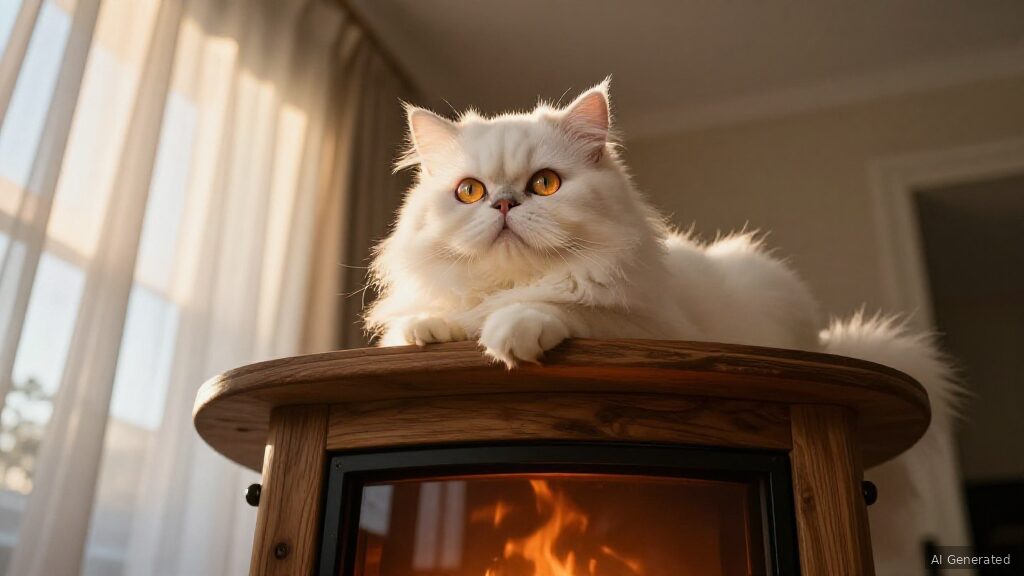
If you consider a cat’s living range only horizontally, space design is bound to fail. Cats are animals that move through space via jumping and climbing, making ‘vertical routes’ essential infrastructure, much like stairs and hallways for humans. When designing vertical routes, you must consider the cat’s jumping ability and stamina. While adult cats can jump about 1.5m to 2m at once, kittens or senior cats require lower settings. Therefore, routes must consist of continuous connections, avoiding sudden drops.
Step 1: Starting from the Floor and Claw Maintenance Zones
The vertical route begins at the floor. Since the floor is the space where cats are most active initially, scratchers and low cat tower bases should be placed there. It is advisable to place a scratcher near the entrance or in a corner of the living room to encourage the cat to sharpen its claws immediately upon entering the house. At this stage, the scratcher should not simply lean against the wall; it must have sufficient height and stability for the cat to stretch its body fully and stretch its claws. PlayCat’s solid wood scratchers are firmly fixed to the floor and do not wobble, providing safety so they won’t tip over even if the cat strikes hard with its claws. This area is also where territorial marking behavior is most active, so placing scented solid wood furniture here can effectively implant positive memories.
Step 2: Resting and Transit Points at Mid-Height
The space at a height of approximately 60cm to 120cm from the floor is the ‘mid-point’ where cats rest most comfortably and observe their surroundings. This height is almost parallel to or slightly below the eye level of a sitting person, making it an ideal height for cats to make eye contact or interact with humans. In this section, install wall-mounted shelves or intermediate platforms leading to the window area. Shelves should be spaced 30cm to 50cm apart to allow cats to move by jumping lightly. If they are too far apart, cats may give up and return to the floor, breaking the vertical route. Solid wood shelves provide non-slip friction, giving the cat’s paws a secure grip and building trust.
Step 3: The Watchtower and Hideout Near the Ceiling
The uppermost zone near the ceiling serves as the cat’s ‘watchtower’ and safest hideout. Cats feel safe surveying their entire territory from high places, typically at heights of 180cm or more. The crucial point here is to ensure the route to the ceiling remains unbroken. Place the top of a tall cat tower or the highest step on the wall close to the ceiling, and if possible, use ceiling clamp fixtures to minimize wobbling. It is advisable to provide a box-shaped resting space in this area where the cat can completely hide its body. Especially for cats prone to stress, which prefer enclosed spaces at high places, this should be an optimal location where external noise is blocked and visibility is secured.
Vertical Route Connection Strategies and Precautions
When connecting these three steps, ‘continuity’ is the most important factor. For example, if a cat cannot jump directly from a floor scratcher to a wall shelf, you should place small steps or a low table in between to create intermediate stages. Additionally, there must be no obstacles above the route. If wires or fragile decorations are located above the route, the cat could be injured while moving, so the upper wall area along the route should be kept tidy. PlayCat’s cat tower series is designed like a single system to provide a structure that naturally connects from the floor to the ceiling. The warm feel and sturdy structure of solid wood furniture give cats the trust to move freely. Especially in households with senior cats, it is essential to lower the jump height and add ramps with slopes to smoothly connect the routes.
Rediscovering Window Spaces: Designing Window Perches and Sunbathing Areas
For cats, the window is the most important portal connecting them to the world. Birds passing by, leaves, and branches swaying in the wind are excellent environmental enrichment elements for cats. Therefore, the cat’s happiness level depends greatly on how you utilize the brightest and best-ventilated window space in the house. Instead of simply closing the curtains and leaving it alone, you should transform the window area into a dedicated resting space for cats.
The Importance of Installing a Window Perch
A window perch attached directly next to or on the window provides a ‘bedroom in the sky’ for cats. It offers the optimal height for looking out the window, especially for cats who find it difficult to jump from the floor to the glass. Particularly in summer, it serves as a cool resting place where they can regulate their body temperature through the cold glass. When installing, you must ensure safety by using suction cup types or frame-fixing types. If there is a risk of the glass breaking or the suction power is weak causing it to fall, it could lead to a major accident; therefore, it is recommended to choose products with sturdy supports and safe fixing devices, such as PlayCat’s solid wood window perches. The perch should be designed wide enough for the cat to lie down comfortably, and an ideal structure would have ventilation holes so the bottom is not completely sealed.
Strategies for Hammocks and Sunbathing Spaces
You should add hammock-style resting spaces in the window area to secure various positions. Cats love sunny spots, but the usability of the window space changes depending on the time of day when sunlight enters. For east-facing windows where morning sunlight streams in, lay down warm blankets or cushions to make waking up enjoyable. For south-facing windows where afternoon sunlight is strong, place shade covers or dense solid wood structures to prevent overheating. Hammocks can be hung on the window frame or fixed to a separate stand, and soft materials that allow the cat to sleep while feeling the breeze are best. The crucial point here is the height of the hammock. If it is too high, the cat will struggle to climb up; if too low, the view will be blocked, so it must be adjusted to the cat’s eye level.
Window Safety Devices and External Stimulation Control
The most important aspect of utilizing window spaces is safety. To prevent accidents where cats pass through the glass or squeeze out through window frames, you must install insect screens or window locking devices. Especially for kittens, who can escape through even small gaps, the use of sealed insect screens without gaps is recommended. Additionally, excessive external stimulation can make cats anxious. Windows with too many birds or other animals passing by can over-excite cats and cause stress, so you should create a system to control stimulation by adjusting curtains or blinds appropriately. PlayCat’s structures combined with solid wood curtain rails provide a design solution that serves as a natural interior element while preventing cats from climbing the curtains.
Tips for Utilizing Window Spaces by Season
You should apply different methods for utilizing window spaces depending on the season. In summer, open the windows to allow airflow, but install safety nets to prevent cats from escaping, and prepare resting spaces on cool solid wood floors or tiles. In winter, use insulated curtains to prevent direct contact with the cold air from the windows, and lay heating carpets or electric blankets in sunny spots near the window so the cat can rest warmly. Especially for senior cats whose ability to regulate body temperature declines, special attention must be paid to insulation in window spaces during winter. These seasonal changes provide new stimulation to the cat’s daily life, improving their quality of life.
Interior Utilization of Solid Wood Furniture and Cat-Friendly Placement
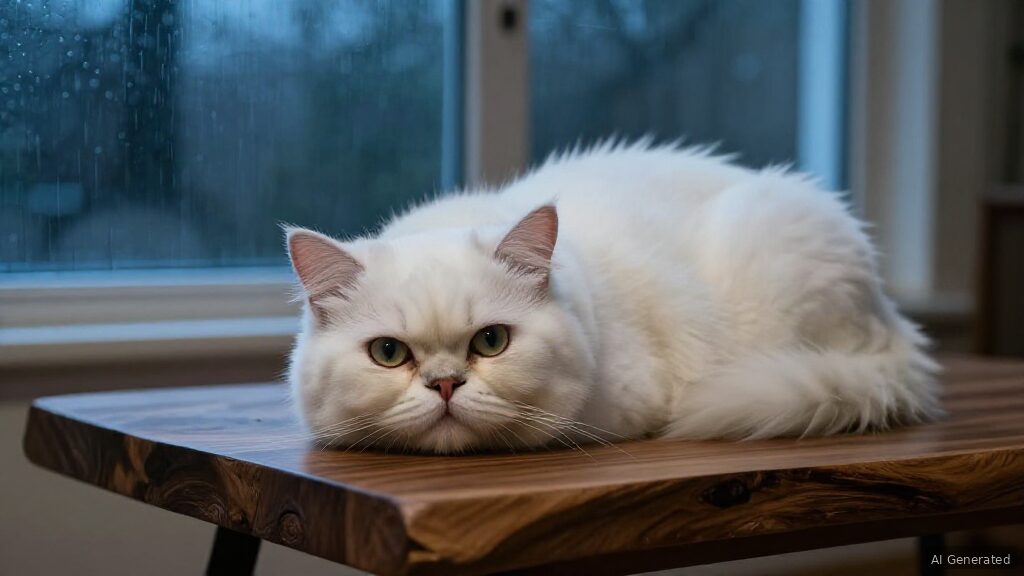
In modern interior design, solid wood furniture is a key element in creating a warm and natural atmosphere. PlayCat has developed products that leverage the characteristics of solid wood furniture to provide a safe and comfortable environment for cats. Compared to plastic or synthetic resin materials, solid wood is not slippery and transmits a soft temperature to the cat’s paws, encouraging them to approach naturally. Additionally, the grain and texture of solid wood provide visual and tactile stimulation to cats, helping to prevent boredom.
Functional Placement Methods for Solid Wood Furniture
Rather than simply placing solid wood furniture, it should be reinterpreted as a route and resting space for cats. For example, a solid wood desk can be utilized as a platform where cats can walk around on top from a high vantage point. The space between the desk legs and the tabletop can serve as an intermediate step like a cat tower, while the top of the desk becomes a space where the cat can sit, look outside, or spend time with people. At this time, it is advisable to remove fragile items from the desk and place safe ramps or steps so the cat can climb up. A solid wood dresser can be used as a hideout by leaving drawers slightly open, or the top of the dresser can serve as a starting point for a cat tower to connect vertical routes.
Integration of Scratchers and Solid Wood Furniture
While buying separate scratchers to prevent cats from scratching furniture is good, it is more natural to utilize or combine the solid wood furniture itself as a scratcher. PlayCat’s solid wood scratchers are designed to look like part of the furniture, preserving the unity of the space. Solid wood pillars have the perfect hardness and durability for cats to sharpen their claws, and scratch marks appear like the natural grain of the wood, not interfering with the interior. Furthermore, instead of protecting the corners of solid wood furniture, covering those parts with scratchers gives cats permission to scratch, satisfying their instincts while protecting the furniture. This is a positive approach of ‘guiding’ rather than ‘blocking.’
Safety and Maintenance of Solid Wood Furniture
When using solid wood furniture as a cat space, safety and maintenance are considerations. Solid wood is susceptible to moisture, so if a cat spills water or has an accident in the litter box, it must be wiped immediately. Additionally, wood finishes must be non-toxic and coated with an eco-friendly material safe even if the cat chews or licks it. PlayCat products strictly adhere to these safety standards, designed so that cats are not harmed even if they lick or chew the furniture. In terms of maintenance, it is recommended to regularly apply oil to the wood to prevent surface wear, and when scratches appear, sand them down to expose a new surface. This way, solid wood furniture reveals more beautiful patterns over time, transforming into a space filled with memories with your cat.

Optimizing Small Living Spaces: Strategies for Studio and Two-Room Apartments
Since most modern people live in studios or two-room apartments where space is limited, creative space utilization is essential for living with a cat. The smaller the floor area, the more you must maximize vertical space, making multi-functional furniture key. We have summarized strategies designed to ensure cats get enough exercise and rest even in narrow spaces in the table below.
| Category | Studio (1R) Utilization Strategy | Two-Room (2R) Utilization Strategy |
|---|---|---|
| Vertical Space | Install step-like shelves utilizing the entire wall. Place a cat tower extending to the ceiling. | Secure routes connecting the walls between the living room and bedroom. Utilize the space above the hallway. |
| Resting Space | Prepare hideouts next to the bed or under the desk. Install a window hammock to secure floor area. | Set up separate resting zones in each room. Utilize solid wood furniture in the living room as a complex resting space. |
| Toys and Activities | Use mobile scratchers and foldable cat towers. Storable when not in use. | Install fixed cat towers and wall toys. Secure hunting play areas in the spacious room. |
| Hygiene Space | Prepare a hygiene space next to the bathroom or on the veranda. Use odor-blocking solid wood litter boxes. | Place litter boxes in each room, or set up a dedicated hygiene zone in a corner of the living room. |
| Interior Integration | Arrange PlayCat solid wood furniture to blend seamlessly with other furniture. Raise the line of sight to make the space look larger. | Create cat spaces with different themes in each room. Arrange so that overall routes are connected. |
In the case of a studio, since all functions are gathered in one space, ‘zoning’ is important so that the cat’s territory does not overlap with the human’s. For example, you can distinguish the bed area as a human resting space and the desk area as a cat activity space, or utilize the veranda as a cat-only room. PlayCat’s small solid wood cat towers are designed to utilize vertical space efficiently even in narrow areas, making them suitable for studio residents. In the case of a two-room apartment, you should utilize each room as a space with different functions so the cat can experience various environments. It is good to distinguish the living room as an activity and play space, and the bedroom as a resting and hiding space to provide stability for the cat. Additionally, utilizing empty spaces in hallways or walls to install tunnels or shelves where cats can jump and play can maximize space utilization.
Safety Design: Preventing Escapes and Blocking Hazards
The most important thing in a space shared with cats is safety. Cats are curious and have a strong desire to explore, so they can easily access small gaps or dangerous objects. Therefore, safety devices must be considered from the space design stage.
Escape Prevention System
Cat escapes are one of the biggest causes of accidents. Blocking gaps in doors and windows is the top priority. Especially for veranda doors and entrance doors, it is recommended to install automatic locking devices and use safety rings to prevent cats from opening them. Windows must have insect screens installed, and the fixing screws of the screens must not come loose. PlayCat’s solid wood furniture can be designed to act as a barrier blocking escape routes when placed near door thresholds or windows. For example, placing a solid wood desk in front of a window prevents the cat from touching the window directly, or placing a scratcher in front of the door is an indirect method to make the cat forget the action of opening the door.
Blocking Hazards and Protecting Wires
There are many dangerous objects inside the house for cats. Wires are targets that cats easily bite, which can lead to electric shock accidents. Wires should be placed flush against the wall or covered with wire protectors. Additionally, toxic plants or small decorations should be placed high out of the cat’s reach or completely removed. When using solid wood furniture, ensure the finishing material is non-toxic, and the corners should be rounded so they are not sharp. PlayCat products consider all these safety elements, with corners treated smoothly and non-toxic coatings applied so cats can use them safely.
Preparation for Fire and Emergencies
In the event of a fire, cats may evacuate later than humans, so you must secure evacuation routes for them in advance. It is good to leave windows or doors open that cats can easily escape through, and install fire alarms to ensure early detection. Additionally, installing CCTV in every corner of the house or minimizing spaces where cats can hide are methods to find them easily during an emergency. PlayCat’s solid wood furniture is sturdy and can maintain its structure for a certain period even during a fire, possessing the potential to buy evacuation time for cats.
Seasonal Space Changes: Summer Coolness and Winter Warmth
Cats’ living patterns and space requirements change with the seasons. Seasonal space design reflecting this is essential for maintaining the cat’s health and happiness.
Summer: Cool Flooring and Ventilation Design
In summer, cats prefer cold floors or glass to lower their body temperature. Solid wood floors may not be cool enough in summer, so it is advisable to add cool mats or solid wood tiles on top of tiles or wooden floors to create a cool resting space. Additionally, open windows to allow airflow, but install safety nets to prevent cats from escaping. PlayCat’s solid wood cat towers are designed with good ventilation to help cats stay cool even in summer. Especially, resting spaces near the ceiling can be where hot air accumulates, so they should be located where air conditioning wind does not blow directly, and shade covers should be installed to prevent overheating.
Winter: Warm Hideouts and Insulation Design
In winter, cats wander looking for warm places to maintain their body temperature. Since cold wind comes in from the window side, it is good to use insulated curtains and lay warm carpets or electric blankets near the window. Additionally, gaps in solid wood furniture or box-shaped resting spaces make good hideouts that retain warmth. PlayCat’s solid wood furniture utilizes the insulating properties of wood to maintain a constant internal temperature, providing a warm nest where cats can escape the cold. Especially for senior cats whose body temperature regulation declines, it is important in winter to place heating devices out of the cat’s reach and prepare warm resting spaces around them.
Before & After Design Checklist
This is a checklist to verify the effects by comparing the space before and after design. You can identify current problems in the space and derive improvements through this list.
- Before: Toys are scattered on the floor, and there are scratch marks on furniture everywhere.
- After: Vertical routes are installed, making the floor tidy, and scratchers are placed in appropriate spots to protect the furniture.
- Before: The window space is empty, and the cat cannot look outside.
- After: Window perches and hammocks are installed, allowing the cat to rest comfortably by the window.
- Before: Solid wood furniture is used only as simple decoration.
- After: PlayCat solid wood furniture is combined with cat towers and utilized as an activity space for cats.
- Before: The cat is stressed, showing accidents like inappropriate urination or excessive grooming.
- After: With sufficient hideouts and resting spaces, the cat’s stress is reduced, and they find stability.
Through this checklist, you can verify whether the space design has brought positive changes to both cats and humans. Create an ideal coexistence space through consistent observation and modification.
Frequently Asked Questions (FAQ)
1. What should I do if there is not enough space to install a cat tower in a studio apartment?
In a studio, it is best to utilize wall-mounted cat towers that do not occupy floor space or vertical structures extending to the ceiling. PlayCat’s small solid wood cat towers can be attached to walls or combined with furniture, maximizing space efficiency. Additionally, you can expand vertical routes by utilizing desks or dressers as part of the cat tower.
2. Will solid wood furniture be damaged if the cat scratches it?
PlayCat’s solid wood furniture is made with sturdy wood materials and durable coatings so it is not damaged even if the cat scratches it. On the contrary, scratch marks look like the natural grain of the wood and do not interfere with the interior; regular oil treatment can even create more beautiful patterns. There are also products that integrate scratcher functions, satisfying the cat’s instincts while protecting the furniture.
3. What is the suitable space design for senior cats?
Since senior cats have reduced jumping ability, you should lower the steps of the vertical route and add ramps with slopes. Additionally, it is important to prepare comfortable resting spaces on the floor and place the litter box and food nearby to reduce travel distance. It is also essential to round the corners of solid wood furniture to prevent injuries if they fall.
4. Are window perches installed on windows safe?
Window perches must ensure safety when using suction cup types or frame-fixing types. PlayCat’s products are designed with sturdy supports and safe fixing devices so they do not fall even if the cat jumps or lies down. You must check the condition of the glass and the sturdiness of the fixing device before installation and inspect them regularly.
5. Is it necessary to change the space design by season?
Since a cat’s body temperature regulation and activity levels change with the seasons, it is good to flexibly adjust the space design. In summer, secure cool flooring and ventilation, and in winter, add warm hideouts and insulation devices. PlayCat’s solid wood furniture can be utilized in various ways depending on the season, making it a good solution for responding to seasonal changes.
This content was written using AI technology. Always consult a veterinarian regarding medical information.