


Scientific Approaches to Unlocking Your Cat’s Hidden Intelligence
One of the common images we have of cats is that they are ‘lazy’ or ‘animals that just sleep.’ However, from the perspectives of animal psychology and cognitive science, cats are predators equipped with highly sophisticated thinking abilities. Their wild ancestors had to exert high-level cognitive functions to hunt, including complex environmental analysis, stealth strategies, and timing control. If these instincts have not disappeared in modern indoor cats, failing to stimulate them appropriately can lead to behavioral problems or mental fatigue. Cognitive Enrichment refers to the process of creating training and environments that satisfy these intellectual needs and keep the cat’s brain active.
Cats often possess logical and practical problem-solving abilities like machines. Much like humans with an ISTP personality type, they display a cold yet subtly addictive level of focus to find solutions to given problems. However, indoor cats have extremely limited opportunities to use these abilities. Consequently, boredom can lead to excessive sleeping, loss of appetite, or aggression. PlayCat’s approach goes beyond simply providing toys; it aims to keep the brain healthy by stimulating the cat’s natural hunting instincts and desire to solve problems. This is an essential element throughout their entire life, from improving learning abilities in kittens to preventing cognitive decline in senior cats.
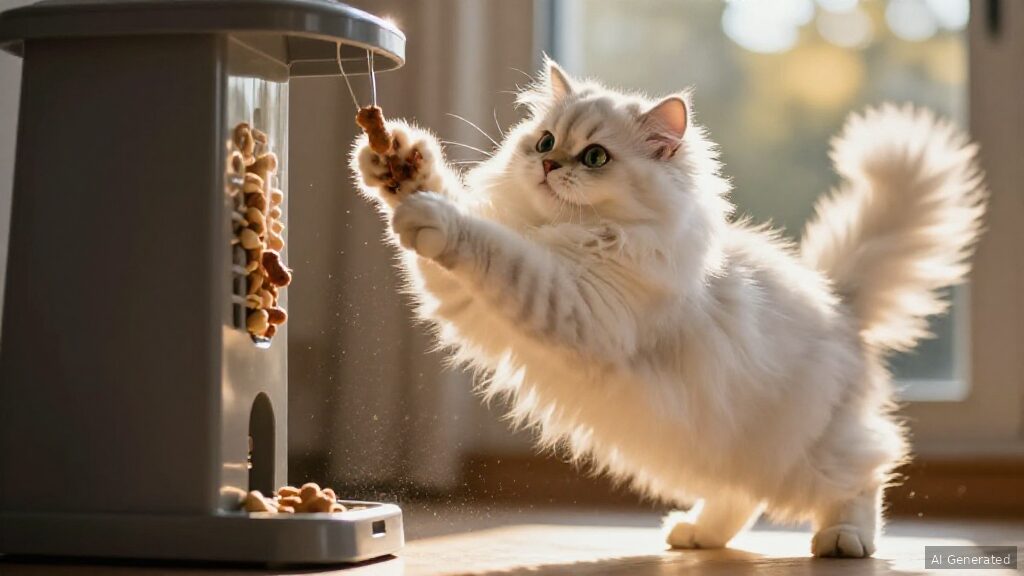
Guide to Selecting Puzzle Feeders and Smart Toys by Difficulty Level
A Puzzle Feeder is a toy that requires the cat to perform specific manipulations to obtain food. This replaces the simple act of filling the stomach with a cognitive process called ‘successful hunting,’ activating the brain’s reward circuit. However, not all cats prefer toys of the same difficulty level. Toys that do not match their level can frustrate the cat or cause them to lose interest. Therefore, it is important to select appropriate tools step-by-step based on the cat’s age, intelligence level, and current interests.
The table below summarizes recommended toy types based on the cat’s developmental stage and cognitive abilities. In particular, the wood-based puzzle toys provided by PlayCat are made from eco-friendly materials, making them safe for cats to bite and lick. The subtle warmth and texture unique to wood help stimulate the cat’s five senses.
| Stage | Recommended For | Main Activities | Expected Effects | Recommended Toy Types |
|---|---|---|---|---|
| Beginner | Novice cats, senior cats, shy personalities | Pushing a bowl or lifting a lid slightly | Providing a sense of achievement, stimulating appetite, learning basic cause-and-effect | Simple hole feeders, covered treat dispensers |
| Intermediate | Active adult cats, cats bored with previous toys | Pressing levers, rolling balls, opening multiple doors | Improving problem-solving skills, strengthening focus, increasing exercise | Lever feeders, rolling ball mazes, multi-stage tunnels |
| Advanced | Intelligent cats, analytical ISTP types | Operating in sequence, unlocking complex mechanisms | Enhancing logical thinking, relieving stress, strengthening long-term memory | Sequence-learning feeders, complex mazes, finding hidden doors |
When introducing toys, you must consider the ‘learning curve.’ Initially, it is best to put in plenty of treats so the cat can succeed easily, then gradually reduce the amount of treats and increase the difficulty. In particular, PlayCat’s wooden furniture and toys are highly durable and do not easily deform even when scratched by cat claws, providing an environment where gradual difficulty adjustment is possible over a long period.
Basics of Clicker Training: The Link Between Words and Actions
Clicker Training is a conditioning method where a ‘click’ sound is made when an animal performs a specific action to mark that exact moment, followed by a reward. This method helps the cat clearly recognize ‘when’ is the correct time for a complex action. For cats, sound can be a faster and clearer signal than sight. Especially since a cat’s hearing is very sensitive, the clicker sound becomes a powerful psychological cue of ‘correct answer’ for them.
The first step in training is ‘connecting sound and reward,’ or creating a ‘click-reward’ association. By repeatedly giving a treat immediately after the cat hears the clicker sound, the cat learns, “When I hear a click, something good happens.” Once this process is complete, when the cat performs the desired action (e.g., sitting, rolling over), immediately make the click sound and give a reward. The key here is ‘timing.’ The click must be made within 0.5 seconds of the action ending so the cat understands exactly which behavior was rewarded.
The step-by-step training method is as follows. First, wait for a behavior the cat does naturally (e.g., lifting a paw), and as soon as the paw lifts, click and give a treat. Repeating this encourages the cat to voluntarily lift its paw more often. Afterwards, add ‘hand signals’ or ‘verbal commands’ to induce the behavior. For example, point your finger down while saying “Sit,” and when the cat sits, click and reward. This training goes beyond simply teaching tricks; it strengthens the trust relationship between human and cat and enhances the cat’s problem-solving abilities.
Hide-and-Seek and Treasure Hunts to Stimulate Exploration Instincts
Cats instinctively enjoy exploring new spaces and finding hidden food. This exploratory behavior promotes dopamine secretion in the cat’s brain, creating a sense of happiness. Changing the home environment from simply a ‘living space’ to a ‘field of exploration’ is the core of cognitive enrichment. In particular, PlayCat’s wooden furniture provides a perfect exploration space for cats due to its natural texture and structures of various heights.
Hide-and-Seek Training is an effective method that stimulates both the cat’s vision and sense of smell. Hide treats in places where the cat cannot see them and let them find them by scent. Start by hiding them in easy-to-find places (under the sofa, behind the door), then gradually increase the difficulty by hiding them inside desk drawers, on high shelves, or inside complex structures. It is important to give big praise when the cat finds the treat. This makes the cat feel a sense of self-esteem, thinking, “I solved the problem myself.”
Treasure Hunt Games require a more systematic approach. Prepare several boxes, put treats in only one of them, mix the positions of the boxes, and let the cat choose. When the cat chooses the correct box, reward them immediately. This process forces the cat to use its Memory and Inference abilities. If the cat chooses the wrong box, simply ignore it and let them try again. Never punish them, as this only hinders learning.
To encourage exploration of new spaces, it is also good to periodically change the traffic flow in the house. Even moving furniture slightly allows the cat to discover a new ‘hunting ground.’ PlayCat’s modular wooden furniture is designed to respond flexibly to such spatial changes, making it easy for owners to reconfigure the environment as they wish. Spaces unfamiliar to the cat provide new stimuli that keep brain circuits active.
Specific Training Methods to Build Problem-Solving Skills
Cats are animals with logical and practical problem-solving abilities. Especially like humans of the ISTP type, they tend to analyze problems and find solutions with mechanical precision. To cultivate these abilities, they must be faced with small obstacles in daily life and guided to overcome them on their own.
Drawer Opening Training is a good exercise that utilizes the cat’s omniscient senses and dexterity. Put treats in a slightly open drawer and guide the cat to open it completely to eat. At first, open it slightly with your hand and help the cat open it further using its paws. With repetition, the cat will figure out how to grab and pull or push the drawer handle to open it. This is very effective for learning Cause and Effect.
Obstacle Course Training combines physical exercise with cognitive ability. Have the cat pass through narrow spaces like between desk legs, tunnels made of boxes, or under chairs to get treats. At this time, the cat must calculate the relationship between its body size and the space to decide how to pass. When creating complex obstacle courses, the difficulty must be increased gradually so the cat does not get frustrated. PlayCat’s wooden furniture provides an environment where such obstacle courses can be easily constructed through natural gaps and holes.
Sequence Learning Training requires more advanced cognitive abilities. For example, use a toy where treats come out only after pressing button A then button B, or set up a maze where you must pass stage A to reach stage B. The cat must first solve A and then realize that B has opened as a result. This fosters planned thinking (
Cognitive Decline Prevention Care for Senior Cats
Like humans, cats can experience cognitive decline as they age. This is called ‘Feline Cognitive Dysfunction Syndrome (CDS).’ Senior cats may show symptoms such as loss of direction, changes in sleep patterns, indiscriminate nighttime vocalization (howling), and litter box accidents. Consistent cognitive stimulation is essential to prevent or delay these symptoms.
Training for senior cats should focus on ‘effortless fun.’ Training that is too difficult or fast can actually cause stress. Instead, stimulate the brain by using familiar toys in new ways or playing simple games involving sniffing and finding. For example, put their usual food in a puzzle feeder so they can eat slowly, or hide fragrant herbs for them to find.
PlayCat’s wooden furniture provides a safe and comfortable environment for senior cats as well. The warmth of wood puts less strain on senior cats’ joints than cold floors, and stable structures reduce the risk of falling. Additionally, the modular design that allows furniture height adjustment helps senior cats climb up easily, contributing to maintaining their activity levels. Regular brain stimulation is the best way to improve the quality of life for senior cats and strengthen the bond with their owners.
DIY Cognitive Enrichment Tools You Can Make at Home
Even without expensive toys, you can provide new cognitive experiences for your cat using materials found around the house. DIY tools provide ‘novelty’ to the cat, and the process of making them itself strengthens the bond between owner and cat. Below is a DIY guide organized in a checklist format with materials, methods, and time required.
1. Creating a Tube Maze
- Materials: 4-5 toilet paper rolls, scissors, tape, treats
- Method: Cut the toilet paper rolls into small pieces and connect them to create a complex maze. Put treats at one end and let the cat push them out from the other. Alternatively, attach several toilet paper rolls to a wall so the cat can reach in with its paws to retrieve treats.
- Time Required: 15 minutes
- Effect: Spatial awareness, fine motor skills training
2. Hide-and-Seek Box
- Materials: Empty shoebox, knife, treats
- Method: Cut holes of various sizes in the lid and bottom of the shoebox. Turn the box upside down and put treats inside. The cat must reach in through the holes with its paws to get the treats.
- Time Required: 10 minutes
- Effect: Olfactory stimulation, problem-solving skills, patience building
3. Wooden Block Stacking Game
- Materials: PlayCat wooden blocks (or regular wooden blocks), treats
- Method: Stack the blocks to build a tower, then hide treats in between them. The cat must push or remove the blocks to get the treats. PlayCat’s wood is coated with non-toxic paint, so it is safe even if the cat bites it.
- Time Required: 5 minutes (Preparation)
- Effect: Balance, cause-and-effect learning, generating interest in toys
4. PET Bottle Feeder
- Materials: Empty PET bottle (label removed), scissors, treats
- Method: Poke several small holes in the PET bottle. Put treats inside, close the cap, and place it on the floor. When the cat rolls the bottle, treats fall out through the holes.
- Time Required: 10 minutes
- Effect: Increased exercise, learning goal-oriented behavior
Precautions and Common Mistakes
There are several points to be careful about when conducting cognitive enrichment training. The biggest mistake is overestimating the cat’s abilities or, conversely, underestimating them and failing to provide appropriate stimulation. Additionally, if the cat shows signs of stress during training, stop immediately.
1. No (Forced) Actions: Do not force the cat to perform actions it does not want to do. Cats are animals where volition is important. If the cat avoids the toy or shows no interest, take a break and try a different method or change the toy.
2. Appropriate Amount of Rewards: Giving too many treats during training can cause obesity in cats. Training treats should be adjusted to within 10% of the daily calorie intake. Instead, you can use their usual food as training treats, or provide rewards with praise and petting.
3. Safety Check: When using DIY toys or puzzle feeders, always check for small parts that the cat could swallow or sharp edges. Especially for wooden products, ensure they are smoothed down so splinters do not occur. PlayCat products have been verified for this safety, so you can use them with peace of mind.
4. Maintain Consistency: Cognitive training should not be a one-off event but become part of daily life. If you have a regular training session of 10-15 minutes every day, the cat’s brain will remain continuously active.
Frequently Asked Questions (FAQ)
Q1. Is cognitive training necessary for both kittens and senior cats?
Yes, cognitive training is essential for cats of all ages. Kittens are in the brain development stage and can improve their learning abilities and problem-solving skills through various stimuli. Senior cats need consistent brain stimulation to slow down cognitive decline and improve their quality of life. However, the intensity and difficulty should be adjusted according to the age group.
Q2. What should I do if my cat shows no interest when using a puzzle feeder for the first time?
First, lower the difficulty. Make the holes larger so treats can be obtained easily, or set it up so treats come out just by the cat touching the toy. Also, you can use treats the cat loves to induce interest. PlayCat’s wooden toys are easy for cats to become curious about due to their natural texture.
Q3. I have had failures with clicker training before; can I try again?
Of course. The results of clicker training can vary depending on the cat’s personality and the trainer’s timing. When trying again, start slowly from the ‘click-reward’ connection stage. If you repeat with patience until the cat reacts to the sound, the connection will eventually be formed.
Q4. Can cognitive enrichment training reduce destructive behavior in the house?
Yes, in many cases. Destructive behavior caused by boredom or stress can be significantly reduced by providing opportunities to use the brain. By satisfying hunting instincts and building problem-solving skills, cats will channel their energy into constructive activities.
Q5. How do PlayCat’s wooden furniture pieces help with cognitive training?
PlayCat’s wooden furniture stimulates the cat’s exploration instinct with various heights and structures, and the safe materials mean there is no worry about biting or licking. Additionally, the natural texture and warmth of the wood help stimulate the cat’s five senses, making cognitive activities even richer. This is a solution that improves the environment beyond just being a toy.
A cat’s brain is far more complex and interesting than we imagine. Through cognitive enrichment, you can unlock your cat’s potential and share a happier, healthier life together. Start today with a small puzzle feeder or a game of hide-and-seek. You will see your feline friend’s eyes sparkle as they solve new problems.
This content was created using AI technology. Always consult a veterinarian regarding medical information.