


Why do zoos periodically change toys and environments?
The most important goal of behavioral enrichment in zoos is the elimination of ‘boredom’ and the maintenance of ‘mental and physical health’. In zoo academia and breeding facilities, when constant stimuli are repeated, animals often exhibit ‘normal behavior’ characterized by feelings of helplessness or repetitive abnormal behaviors such as pacing and over-grooming. To prevent this, keepers change food, toys, and environmental structures on a regular cycle to encourage animals to solve new problems.
This same principle applies to household cats. Cats are instinctively hunters, and once new stimuli disappear, they quickly lose interest and return to a state of apathy. Zoo rotation strategies go beyond simply changing toys; they stimulate a cat’s cognitive abilities and help lower cortisol levels, the stress hormone.
Lessons learned from giraffe and tiger breeding cases
Successful enrichment cases in zoos are highly specific and data-driven. For example, Gwangju Woochi Zoo operates programs like ‘The Man Who Lives with Animals’ to provide ecological explanations for giraffes and public feeding activities for tigers (Hogwang-i). They treat the breeding process itself as an enrichment process, rather than just feeding. Research has also shown that giraffes exhibit biological activities such as chewing leaves or ruminating when they detect environmental changes like shifts in sound frequency or light levels during phenomena such as solar eclipses. This indicates that subtle changes in the environment determine an animal’s activity levels.
Conversely, cases like Dalseong Park, which lacks perches and features a monotonous environment, are cited as problems in small to medium-sized zoos. Environments where turkeys and other birds cannot rest sufficiently or display diverse behaviors cause significant stress to the animals. This is similar to the context where household cats become lethargic or exhibit aggressive behavior when exposed to the same toys or locations for extended periods. Therefore, zookeepers analyze animal behavior patterns to randomly change feeding times, walking (leash) times, and play times, ensuring animals cannot predict when the next activity will occur.
Strategies for balancing cognitive and physical activity
Enrichment in zoos focuses not just on providing objects, but on balancing ‘cognitive enrichment’ and ‘physical enrichment’. As seen in some senior care facilities or animal education programs, design tasks like ‘decorating the zoo’ or reflex games like ‘Red Light, Green Light’ are prime examples where brain training and physical exercise occur simultaneously.
Similarly, enrichment for cats is insufficient if it merely involves throwing toys (physical activity). The process of the cat solving problems and earning rewards on its own (cognitive activity) is essential. For instance, hiding food or placing treats inside toys so the cat must extract them provides cognitive satisfaction similar to a tiger exploring its hunting grounds. This multi-faceted approach plays a crucial role in extending a cat’s lifespan and maintaining its health.
What is the zoo-style toy rotation strategy for house cats?
When applying zoo principles to house cats, remember three key words: ‘accessibility’, ‘variability’, and ‘unpredictability’. To implement this, you need a systematic rotation schedule and tools that provide various stimuli.
Step 1: ‘Hiding’ and ‘Revealing’ toys and environments
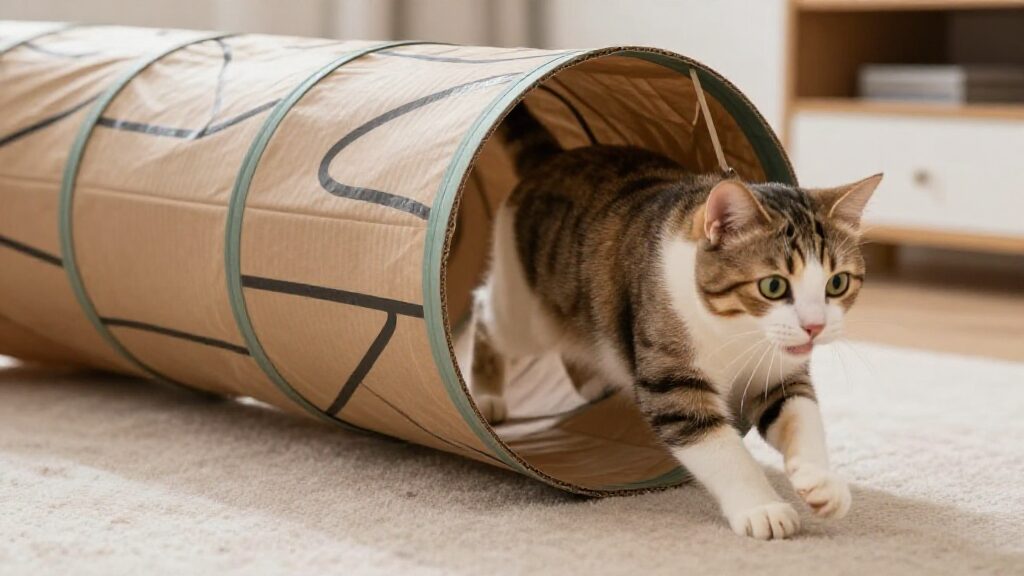
In zoos, keepers replace toys or create new environments where animals cannot see them. At home, this is applied as a ‘toy break’. Do not put all toys out at once; place only 3 or 4 in the current space and store the rest in a box. After two weeks, take out the stored toys and store the ones currently in use. When a cat rediscover a toy that was ‘gone’ for two weeks, it reacts as if it has discovered new prey.
Step 2: Introduce food puzzles and hunting simulations
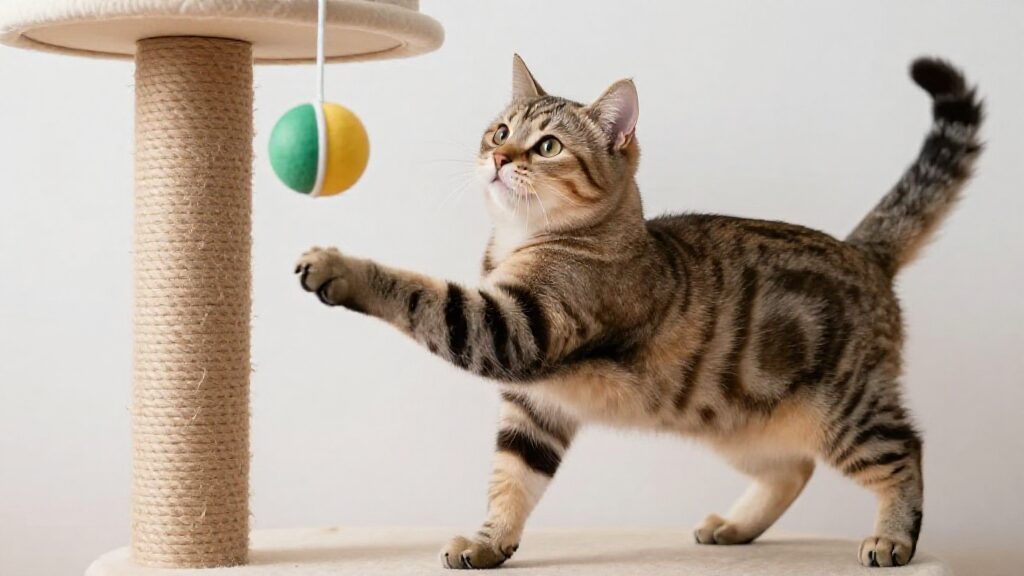
Just as tigers and giraffes perform various behaviors to find food, do not simply put food in a bowl for your cat; hide it. Use a ‘Puzzle Feeder’ or place treats inside a toy so the cat must bat at it to make them appear. This stimulates the cat’s hunting instinct and transforms mealtime from a simple act of consumption into a hunting game.
Step 3: Diversify sensory stimuli (smell, sound, touch)
Zoos use various materials to allow animals to receive sensory stimuli such as smelling and hearing. For house cats, provide cat-safe herbs (like Valerian or Silver Vine), blankets with new textures, and play areas constructed with various heights and materials. In particular, perching spots placed near windows or at high heights are important spaces where cats can observe their surroundings and rest. Avoid monotonous environments lacking perches, as seen in the Dalseong Park case.
| Step | Behavioral Enrichment Element | Home Application Method (Example) | Expected Effect |
| :— | :— | :— | :— |
| Step 1 | Environmental Change | Rearranging furniture, creating new hiding spots | Stimulating curiosity, reducing stress |
| Step 2 | Food Enrichment | Using puzzle feeders, hiding food | Satisfying hunting instinct, preventing obesity |
| Step 3 | Toy Rotation | Replacing every 2 weeks, hiding unused toys | Fresh play experience, resolving apathy |
| Step 4 | Cognitive Activity | Command training, hidden object search games | Brain training, extending lifespan |
What safety rules should be observed when applying behavioral enrichment?
When applying zoo-style enrichment at home, the cat’s safety must be the top priority. Not all toys are safe for cats, and improper use can actually create hazards.
1. Remove small parts: Ensure that eyes, noses, and small balls on toys do not come loose. If a cat swallows them, intestinal obstruction can occur.
2. Exclude harmful substances: Do not use toys contaminated with plants toxic to cats (such as lilies or aloe) or chemical agents.
3. Supervised play: Toys with strings (wand toys) must always be put away after play. This is because there is a risk of the cat accidentally swallowing them or getting them tangled around their neck.
4. Observe stress signals: If the cat hides or growls during enrichment activities, stop the activity immediately and provide a stable environment.
Frequently Asked Questions (FAQ)
Q1. How often should I change the toys?
A. Generally, changing them every 2 to 3 weeks is most effective. The key is to provide new stimuli before the cat becomes completely familiar with the toys. If your cat loves a specific toy, a ‘partial replacement’ method is also good, where you keep that toy and only rotate the others.
Q2. How do I manage a cat that doesn’t need toys?
A. While some cats enjoy playing without toys, most require physical stimulation. In such cases, environmental enrichment may be more effective, such as changing the furniture layout or creating resting spaces at high heights to transform a ‘stimulus-free environment’ into a ‘stimulus-rich environment’.
Q3. If I introduce a puzzle feeder, will my cat stop eating?
A. At first, the cat may be confused. In this case, set the puzzle difficulty very low so that food comes out with just one touch. Once the cat has a successful experience, you can gradually increase the difficulty to stimulate their hunting instinct.
Q4. How do I handle rotation when raising multiple cats?
A. In multi-cat households, individual cats may have different preferences, so you should manage toys separately for each cat or provide enough shareable toys. Especially in cases of intense competition, it is important to prepare multiple toys so that when one cat is playing, others cannot approach.
Q5. Does behavioral enrichment actually help cat health?
A. Yes, this has been proven by many studies and zoo cases. Appropriate enrichment lowers stress hormone levels in cats, prevents obesity, and helps maintain cognitive function, contributing to a longer lifespan. This effect is particularly pronounced in senior cats regarding brain training.
Key Summary
Behavioral enrichment rotation in zoos is a core strategy to protect the mental and physical health of animals through ‘unpredictable changes’ and ‘diverse stimuli’. By applying toy rotation every 2-3 weeks, utilizing food puzzles, and providing environmental changes to house cats, you can satisfy their hunting instincts and reduce unnecessary stress. Check PlayCat (playcat.xyz) for more information.
This content was created using AI technology. Always consult a veterinarian for medical-related information.