


Why Do Only Cats Experience More Stress?
While the number of households raising cats alone is increasing, many owners are unaware of the psychological burden faced by only cats. In particular, studies targeting cats isolated in shelters or foster facilities suggest that a single-rearing environment can be a potential stressor. Although cats are naturally territorial animals, they also require hiding spots to cope with crises. It has been confirmed that when a cat is alone in a narrow cage or limited space, levels of stress hormones like cortisol and ‘Fecal Glucocorticoid Metabolites (FGM)’ rise within their body.
This stress response manifests not just as anxiety, but as clear behavioral changes such as excessive grooming, reduced food intake, and an increase in the Cat-Stress-Score (CSS). While these levels tend to decrease gradually over time, the distress experienced during the initial adaptation period negatively impacts the cat’s immune system and overall health. Therefore, owners must understand that providing food and water is not enough; ‘Environmental Enrichment’ strategies are essential to help stabilize the cat’s psychology. This article provides detailed guidance on specific environmental improvements to reduce stress and increase happiness for only cats, based on scientific research.
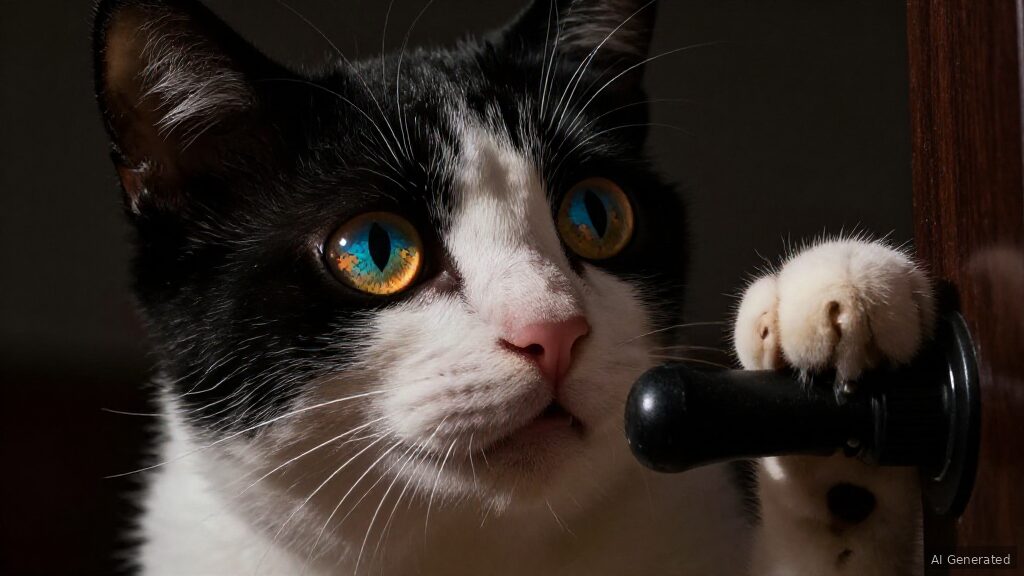
How Can We Identify and Utilize a Cat’s Personality?
Differences Between Bold and Shy Cats
The degree to which cats feel stress and their coping mechanisms vary significantly from individual to individual. Research suggests that cats can be broadly categorized into ‘Bold’ and ‘Shy’ personalities, and the effectiveness of environmental enrichment can differ depending on these traits. Bold cats tend to adapt quickly to new environments or objects and show a strong desire to explore, whereas shy cats exhibit behaviors like immediately hiding or avoiding when they feel threatened. These personality differences are a key variable in determining how effective the provided environment is at alleviating stress.
Especially for shy cats, stress hormone levels tend to be higher when raised alone, and the adaptation period is longer. They place greater value on safe spaces where they can hide rather than new toys or high perches. Therefore, owners must accurately identify their pet’s personality to establish a customized environmental improvement strategy. Creating a spatial structure where the cat feels comfortable is far more important than simply buying expensive toys.
Scientific Methods to Test Cat Personality
There is a concise and efficient testing method developed in shelter environments to determine a cat’s personality. This involves measuring the time it takes for a cat to exit a carrier and the time spent inside the carrier in an empty space for 5 minutes. Research results indicate that classifying cats that take more than 10 seconds to exit the carrier as ‘Shy’ and those with shorter times as ‘Bold’ is the most accurate method.
This test can be easily performed without complex equipment and clearly shows individual differences. Shy cats tend to spend longer periods inside the confined space of a carrier, which is an instinctive defense mechanism to avoid external stimuli. Conversely, bold cats try to get out quickly. If owners identify their pet’s personality through such tests at home, they can predict in advance which type of hiding spot or play area will be more suitable for future environmental improvements.
| Personality Type | Carrier Exit Time | Characteristics & Behavior | Recommended Environmental Strategy |
|---|---|---|---|
| Bold Cat | Less than 10 seconds | Curious about new stimuli, active exploration, relatively high stress resilience | Provide perches at various heights and exploration-type toys |
| Shy Cat | More than 10 seconds | Strong tendency to avoid threats, prefers hiding spots, high and prolonged stress hormone levels | Enclosed hiding spots, quiet spaces, accessible and reassuring structures |
What Environmental Enrichment Elements Do Cats Love Most?
The Importance and Effect of Hiding Spots
Among various types of environmental enrichment elements, the one cats prefer most and which is most effective for stress relief is undoubtedly the ‘Hiding Box’. In studies, when cats entered a cross-shaped choice space, they spent significantly more time in the area with a ‘hiding box’ compared to areas with toys or empty areas. This means that for cats, a space to hide is not just a resting place but an essential resource that guarantees psychological safety.
Hiding spots provide a sense of ‘control’ that allows cats to manage external threats or uncertain situations. Especially for only cats, a hiding spot becomes the only safe zone where they can secure their territory, rest, and relieve anxiety. According to research, cats in cages provided with hiding spots had significantly lower Fecal Glucocorticoid Metabolite (FGM) levels compared to control groups and consumed more food. This is strong evidence that hiding spots directly reduce physiological stress responses.
Relative Value of Shelves and Toys
On the other hand, shelves or toys did not show as absolute a stress-relief effect as hiding spots. In studies, the frequency of use in shelf areas showed no significant difference from other areas, and cats spent less time in areas with toys compared to hiding spots or empty spaces. This suggests that a cat’s instinctual needs prioritize ‘hiding in a safe place’ over ‘playing’ or ‘climbing high’.
Of course, this does not mean toys or shelves are completely useless. For bold cats, satisfying hunting instincts through toys can help relieve stress, and shelves can contribute to expanding territory by utilizing vertical space. However, to ensure basic psychological stability for only cats, securing a ‘place to hide’ must come first. Additional stimulating elements should be added afterward.
Should Environmental Improvements Vary Based on Cat Personality?
Analysis of Environmental Enrichment Effects by Personality
Many owners think, ‘Shouldn’t we give hiding spots to shy cats and toys to bold cats?’ However, the research results were different from expectations. When hiding spots were provided to both bold and shy cats, both groups showed positive effects, including decreased stress hormone levels and increased food intake. In other words, the ‘opportunity to hide’ is essential for all cats, regardless of personality.
However, shy cats used hiding spots significantly more frequently than bold cats, and their stress scores (CSS) remained higher during the initial adaptation period (up to 5 days). This means that shy cats rely more on hiding spots and require more time to adapt to environmental changes. While bold cats relieve stress by exploring various elements, shy cats manage stress by focusing on a single, reliable safe zone: the hiding spot.
Approaches Considering Age and Timing
The need for environmental enrichment also varies depending on the cat’s age and growth stage. For Young Kittens, who are curious and have excellent learning abilities, actively utilizing both hiding spots and toys is common. Rich environmental experiences during this period have a long-term impact on the social skills and stress coping abilities of adult cats. Adult Cats already have fixed personalities, so providing a stable hiding spot that suits their current personality is most effective. Especially for adult cats living alone, hiding spots play a core role in maintaining daily rhythms.
For Senior Cats, comfortable rest becomes more important than playing with toys due to physical joint issues or declines in hearing/vision. For them, hiding spots close to the ground with easy access are essential. Spaces made of soft fabric where they can hide may be more suitable than high shelves or complex toys. As cats age, their resilience to stress may decline, making consistent environments and stable hiding spots even more important.
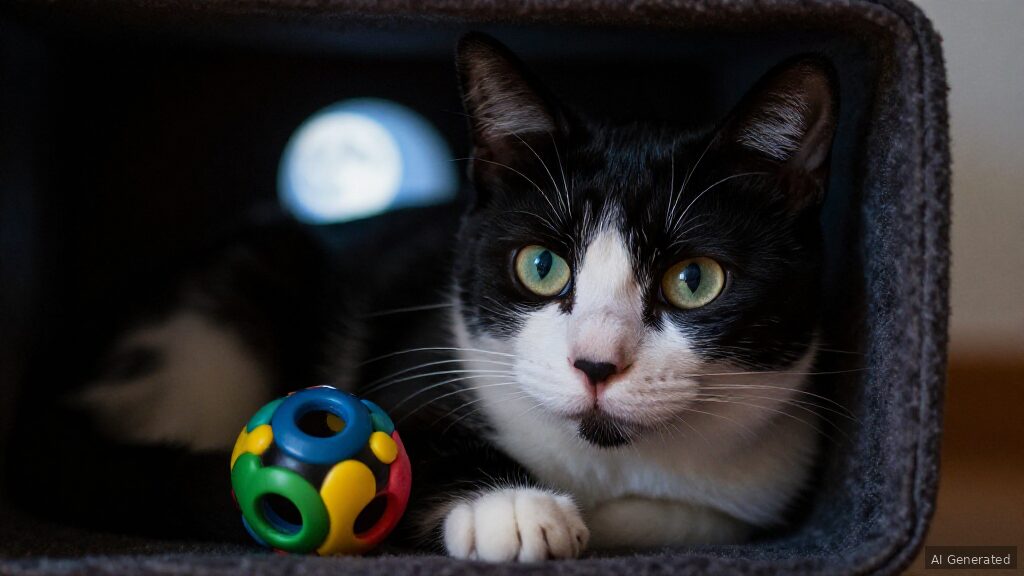
What Are Common Mistakes and Their Solutions?
There are common mistakes owners make when attempting cat environmental enrichment. One of the biggest misconceptions is thinking, ‘If I buy many good toys for my cat, the stress will disappear.’ As mentioned in the research above, cats prefer simple ‘hiding boxes’ over complex toys. Providing too many toys can actually overwhelm the cat, causing them to become more withdrawn.
Another mistake is placing hiding spots too high or making the entrance too narrow, making it uncomfortable for the cat to enter. Especially for senior cats, high shelves can become threatening spaces that are difficult to access. Hiding spots should be placed where the cat can choose to enter comfortably on their own and designed to fit the cat’s body size.
Finally, making sudden environmental changes is also problematic. Introducing new hiding spots or furniture abruptly can actually cause stress, especially for shy cats. It is best to introduce new elements slowly and give the cat enough time to explore them directly.
The Role of PlayCat Solid Wood Furniture
PlayCat’s solid wood furniture can be an excellent alternative solution for these environmental improvements. PlayCat products, based on the natural warmth of wood and sturdy structures, simultaneously serve as hiding spots that provide stability to cats. In particular, solid wood cabinets or box-shaped products with enclosed designs provide an optimal environment where cats can block outside views and hide safely. Solid wood furniture, which is not just a simple toy but harmonizes with home interior design, improves the quality of the space where cats spend their daily lives, directly contributing to the psychological stability of only cats.
Checklist You Can Start Practicing Today
- Secure Hiding Spots: Place a box slightly larger than your cat or a solid wood hiding spot like PlayCat in a quiet corner of your home. It is good to have multiple hiding spots throughout the house.
- Cat Personality Test: Determine if your pet is bold or shy through the carrier test. The shyer the cat, the more important the hiding spot becomes.
- Optimize Hiding Spot Location: Ensure the hiding spot is not in a high-traffic area or a noisy place. Place it in a quiet and safe location where the cat feels comfortable.
- Separate Eating and Resting Areas: Provide separate spaces for hiding spots and eating. This increases the sense of safety while eating and helps increase food intake.
- Selective Toy Usage: Do not give all toys at once. Provide only 1-2 favorite toys first, observe the reaction, and then add more.
- Maintain Consistency: Do not frequently change the location of environmental enrichment elements. Cats prefer predictable environments, and a consistent spatial structure is important for reducing stress.
- Observation and Recording: Observe the time the cat spends in the hiding spot, food intake, and grooming frequency to check stress indicators. If there are positive changes, the environmental improvement is working well.
Frequently Asked Questions (FAQ)
1. Is a hiding spot really essential for an only cat?
Yes, for an only cat, a hiding spot is not an option but an essential element. Studies show that isolated cats have high stress hormone levels, and these levels significantly decrease when hiding spots are provided, along with an increase in food intake. Especially for shy cats, it is difficult to achieve psychological stability without a hiding spot.
2. Do bold cats also like hiding spots?
Yes, bold cats also like hiding spots. According to research results, all cats, regardless of personality, benefited from reduced stress and increased food intake through hiding spots. However, shy cats tend to use hiding spots more frequently.
3. Does buying many toys help relieve stress?
Toys are helpful, but they do not have as immediate and powerful a stress-relief effect as hiding spots. Cats prefer spaces where they can hide over toys, and excessive toys can actually be a burden. Therefore, it is best to secure hiding spots first and then add toys.
4. Is environmental enrichment more important as cats get older?
Yes, senior cats may be more vulnerable to stress due to decreased physical and mental resilience. For them, easily accessible hiding spots and a stable environment are even more important, which directly impacts maintaining health in old age.
5. Where is the best place to put a hiding spot?
It is best to place the hiding spot in a quiet and safe location where the cat can choose to feel comfortable on their own. Ideally, it should be in an area with little foot traffic from people or other animals, where they can see out but still hide their body.
6. What materials should be used for environmental enrichment?
Cats prefer natural materials. In particular, solid wood furniture like PlayCat provides the warmth and stability of natural wood, which helps with the cat’s psychological stability. Additionally, materials that are well-ventilated and easy to clean are advantageous for hygiene management.
Conclusion: Small Changes Create Big Happiness
If you are an owner raising an only cat, do not forget to provide psychological stability beyond just meeting physical needs. Scientific research clearly shows that regardless of the cat’s personality, the ‘opportunity to hide’ is the most effective environmental enrichment element for reducing stress and promoting health.
Rather than expensive toys or complex facilities, providing just one hiding spot where the cat can feel safe and rest brings about much greater change. Nature-friendly environmental improvement solutions like PlayCat’s solid wood furniture change the atmosphere of the home while gifting psychological stability to your pet. Starting today, observe your pet’s behavior and personality, and create the safe space they need most. That small change will make your cat’s life much happier and healthier.
This content was created using AI technology. Always consult a veterinarian regarding medical information.